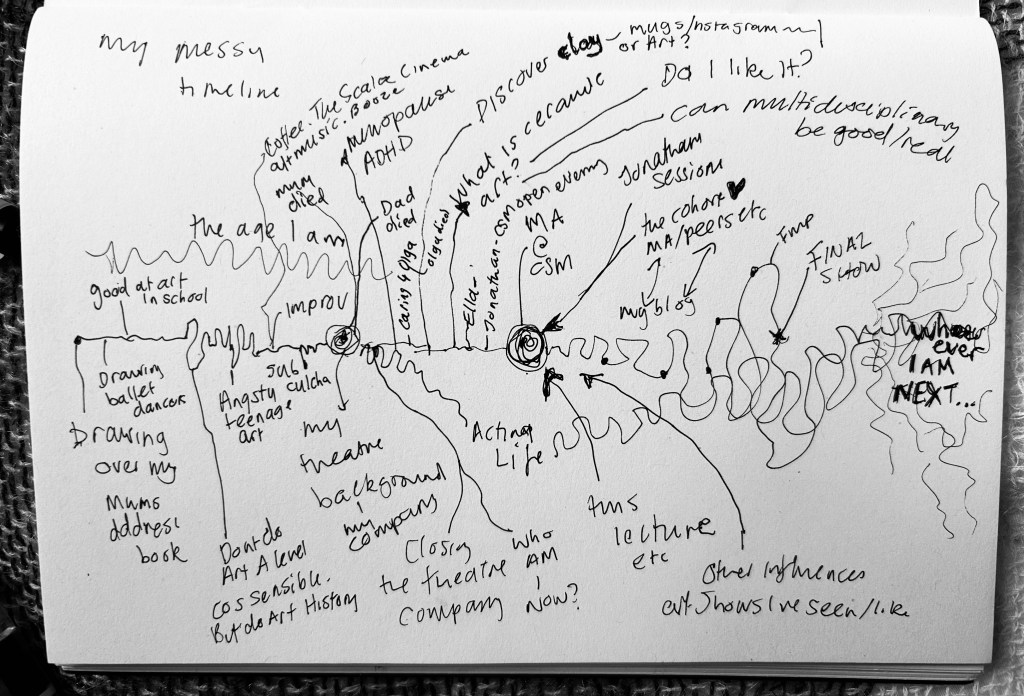
Really interesting lecture from the Art in Context series run by Dean Kenning. About diagrams as a methodology. Diagrams being ‘synoptic’ – you see everything at once. How we think in terms of a diagram creating order but there is not necessarily an order.
A timeline is the most basic diagram. It spatialises time.
Diagrams like timelines use metaphors to do with directions of travel – we say ‘go forward’ ‘go back’ – arrows towards some kind of end point.
This joined up with Jonathan’s lecture for me about the reflective process as a cyclical plan – reflect, plan, achieve, observe > new question now, reflect, plan, achieve, observe etc. Rinse and repeat. And how that is problematic with art because ‘continual progress’ and a ‘final end point’ is deceiving. It looks more like messy, tangential, zig-zagging. Rito’s ‘radical incompleteness’.
Dean Kenning showed us some examples of timelines that demonstrate that they are always …that word ‘partial’ again…always selecting, never neutral.
Joseph Priestley’s New Chart of History – (1769?) – a view of the history of the world from the point of view of the Empire. Alfred Barr’s graphic of the relationships that make up – in his view – the story of Modern Art. As the founder of MOMA NY he should know – but like all custodians of artwork he is partial, selective.
(Note to self here – to check out ‘System’s Theory’. And the Zeno Paradox – where you are only ever halfway to a point, always halfway to another point etc to infinity.)
So anyway. No arrow. Just the rewriting of a story in particular and personal terms.
What to take from this?
The above messy timeline of my own. I notice I didn’t place my now in art history terms, just in terms of my journey and what got me here now. All the influences that make up me. Looking at it again I see that I have blown some things up and minimised other events and I guess this would look completely different say 5 or 10 years ago. I feel excited about what things will become important and prominent in the next 5 or 10 years time. I have no idea.
 Alex Murdoch, Artist
Leave a comment