This is a short draft for my future research paper, exploring initial ideas and questions.
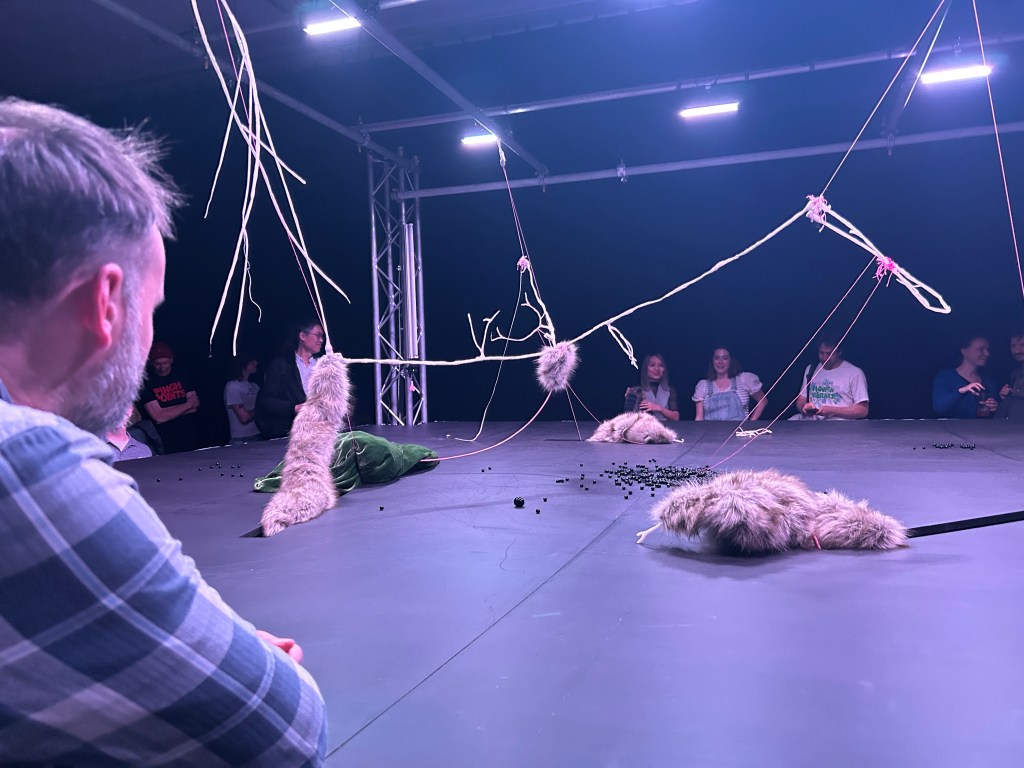
How can visual artists give agency to their audiences and take responsibility for a genuine two-way exchange?
In his 1957 essay ‘The Creative Act’ Duchamp made the statement that creative work is ‘not performed by the artist alone’ and in doing so raised the lowly spectator to at least equitable status with the lofty artist. This democratising moment has given rise to expansive experimentation with the nature of the artist and audience relationship.
Roland Barthes and Joseph Beuys both played key roles in shifting the attention from the myth of the artist as a genius to the agency of the audience. Barthes (1967) removes the artist from the artwork altogether on contact with audience, whereas Beuys extends the idea by amalgamating the artist and the public in acts of ‘social sculpture’. From the 1950’s and 60’s ‘happenings’ through to current practices around participation, immersive performance and interactive art this idea continues to be tested.
Now it is required of artists that they think about who the work is for. The role of the audience has shifted – are they passive or active, participant or spectator? In the UK at least arts subsidy policy foregrounds ‘audience engagement’ – artist are required to prove their commitment to nurturing the audience’s level of engagement if they want the money to begin to make the work itself. Has this created a chicken and egg situation regarding artist’s true intentions around audience care? My feeling is that a good deal of participatory and interactive art in practice can feel like a cynical and transactional relationship.
According to Riazi et al. (2025), interactive art completely redefines the social contract in art practice by sharing ownership and even authorship of the work. I would argue with their assertion that participating with the work by default creates a transformative relationship with meaning. Although it seems a cosy idea – is ‘co-creation’ really happening for both the artist and the audience? Is ‘joining in’ enough to step over the barriers of an increasingly intellectualised and obscure contemporary art world?
If the audience complete the work, do they truly share it? I feel the nature of engagement in much interactive or participative work is in actuality a self-concious, performative act along with being exclusive to an art-literate audience. While typical ‘arts-attendee’s (to adopt arts funding language) may be familiar with participation and may genuinely enjoy the quirks of ‘joining in’ much of this is lost on a newcomer to a gallery or art experience and often very alienating. Perhaps as alienating as an obscurely articulated catalogue or difficult artist statement.
In this paper I will question the level of care taken by artists in terms of organising their audience’s experience. And while I do this I want to raise the question – why should they care? Zangwill (1999, p. 315) goes as far as to claim that ‘art has nothing essential to do with an audience’, a position that only exacerbates the sense that contemporary art is bound up by a coolness and distance. Non-representational art involves a leap of faith for the uninitiated, leaving the question hanging in the air over whether one might have received or experienced something tangible at all. The question of the importance of picking up on the artist’s intention may create anxiety rather than enlightenment. The Gallery can become a place of confusion, of right and wrong answers and deep psychological barriers which no amount of encouragement to ‘do what you like with it’ can overcome. In societal terms the contemporary art world can be seen as a class war between those shut out on the outside looking in on practice that doesn’t seem to really care.
If we believe art is important at all then we have to work harder on our case for it’s existence. We cannot do that with what sometimes appears to be disdain for the audience’s experience. Much good and worthy work has been done on this on a practical, educative level by museums and galleries and that is not the focus of my paper. I think there is a missing piece about the nature of the relationship of the audience to the art work and that job of work needs to take place within artistic practice itself.
I want to explore how the audience can be given authentic agency. Informed by my background in improvisatory theatre practice I want to examine the extent to which visual artists are taking responsibility for the quality of the experience when their audience meets their work – whether they are present in the moment of the encounter or not.
How do we give space for the audience in terms of connecting with the work and making meaning? I would assert that we need to interrogate the idea of the audience as ‘active’ in relationship to practice. Is the audience really ever a co-creator, and is interactive art just another way of fixing and controlling the audience’s experience, placing the artist again on a pedestal which the audience member is in service of or subservient to. I believe we need to let go of what we believe an art experience must be and reexamine the roles of the artist and audience member. Can the artist let go of the idea that they are the puppet-master of the work? I also want to assert that the audience member also needs to let go of the underlying idea that they are coming to be ‘impressed’. This involves letting go of a finality in terms of a fixed outcome, of a sense of resolution and the notion of ‘success’ in terms of the artists intention.
In order to do this I want to suggest that the issue at stake here is fundamentally around the concept of control. Much has been explored, notably by Fisher, Fortnum and University of the Arts London (2013), about how the artist uses the sense of the unknown in the studio and in the process, but I have found less enquiry on the matter of the unknown in terms of when the work comes into direct contact with the audience. In this paper I hope to bridge that gap.
Examples to explore –
- Oliver Herring’s TASK parties – joyful participation – willing audience?
- Limits of control in resolving work – exploring audience embracing ‘failure’
- The moment / presence – the work of Anne Imhoff – “how fleeting experience might be translated into enduring form. “
- Zhang Huan and the ethics of improvised participation
- Olafur EliassonThe weather project 2003 – the audience self-regulates engagement
- Site-specific performance practices – Wildworks and Bill Mitchell.
References in this draft –
Riazi, A., Mohammadpour, F., Mohammadi, S. and Foolady, M. (2018) ‘Interactive Art and the Changes in the Traditional Role of Audience in Visual Arts’
Barthes, R. (1967) ‘The Death of the Author’, Aspen, (5–6). Translated by R. Howard.
Zangwill, Nick. “Art and Audience.” The Journal of Aesthetics and Art Criticism 57, no. 3 (1999): 315–32. https://doi-org.arts.idm.oclc.org/10.2307/432197.
Fisher E., Fortnum R. and University of the Arts London. (2013). On not knowing. London, England: Black Dog Publishing.
Bibliography referred to in this draft
Bishop C., . (2006). Participation. London: Whitechapel Gallery.
Pitts, S.E. and Price, S.M., 2020. Understanding audience engagement in the contemporary arts. Routledge.
Dumbadze A. B., Hudson S. P., . (2013). Contemporary art. Chichester, West Sussex: Wiley-Blackwell.
Sager, J.F., 2008. The contemporary visual art audience: Space, time and a sideways glance (Doctoral dissertation, University of Western Sydney).
Bertram, G.W., 2021. Art and the possibility of failure. Studi di estetica, (19).
Andrzejewski, A. and Bertinetto, A., 2021. What is wrong with failed art?. Studi di estetica, (19).
Arielli, E., 2021. The anxieties of control and the aesthetics of failure. Studi di estetica, (19).
Díaz, L. (2011) ‘By chance, randomness and indeterminacy methods in art and design’, Journal of Visual Art Practice, 10(1), pp. 21–33. doi: 10.1386/jvap.10.1.21_1.
Apostolou, T., 2021. The limits of control: Search for fine art strategies with as low level of control. Analysis of their creative processes (Doctoral dissertation, Pintura).
 Alex Murdoch, Artist