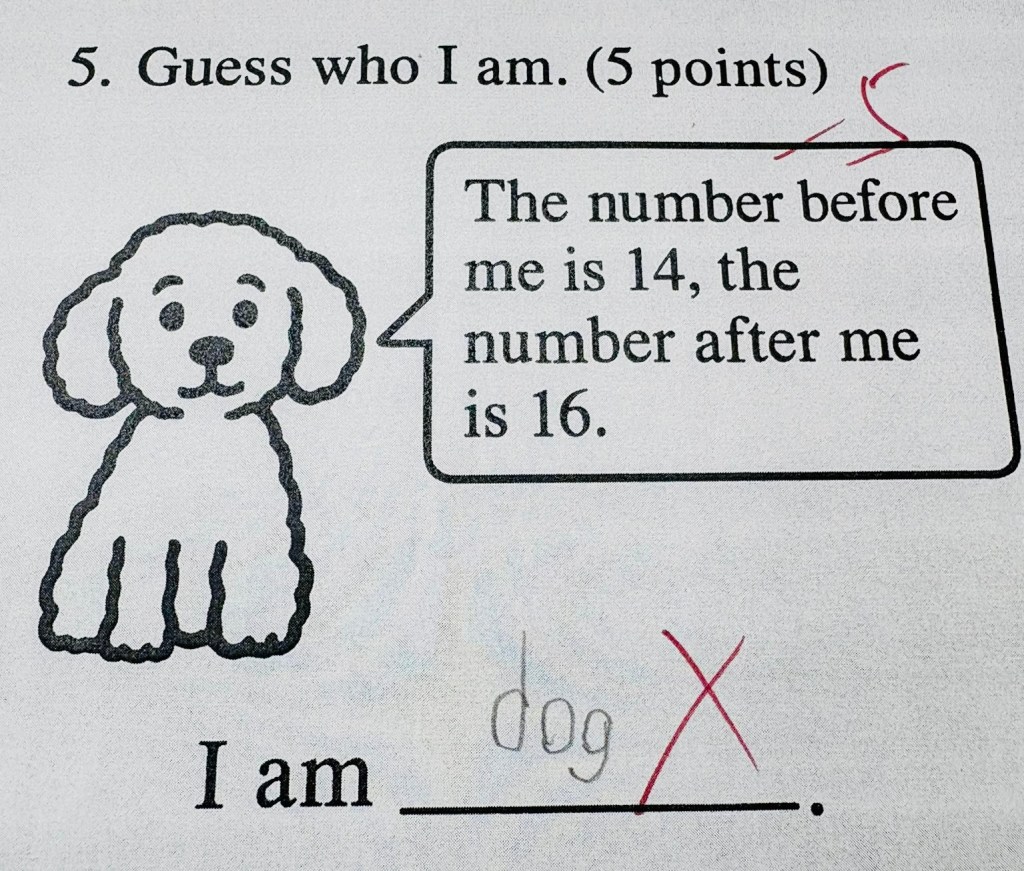
I love everything about this picture that I found on stupid social media. Is the kid wrong? I think the answer ‘I am dog’ is somehow more right than ‘I am Fifteen’. Pedagogically the test has created so many crappy misleading clues for the kid – grammatically (’Guess who I am’), visually (a talking dog is actually a number, stoopid) before we even get started on the dated assumption that all kids learn through words alone and that some will be neurodivergent thinkers etc. But most importantly the teacher is really firm in their opinion that this kid’s answer is a big red-cross WRONG.
We talked in the last session about failure. I’ve come to expect my assumptions to be up-ended in this class which is why I’m loving it. Jonathan presented the idea – ‘do we really learn from failure?’ – and that what happens in the case of being told we’ve failed is more like fight (‘stupid test) or flight (I’m never going there again). The educational system is designed to have us want to get things ‘right’.
I notice to myself that all my life I’ve been trying to do things right, to not be as weird as I imagine people think I am, to achieve in other’s people’s eyes. In the case of my career – to be picked.
I have more to say on this. I have a fleeting idea of making a piece of work about it called ‘Well done Alex’ based on an patronising interaction with a ‘more successful’ peer of mine. I’ll come back to this…
But actually there are lessons from my theatre training on the subject of working with failure. We discussed Keith Johnstone (quoted in my first post), improvisation’s UK forefather and saying yes to the unknown. One of the tenets of improv is to fail gracefully – mistakes are actually a gift. (My company used to improvise whole stories in one night and on one occasion I had forgotten the name of my character’s husband – a perennial improv problem. I dropped John in for good measure, accidentally naming Brian’s character’s husband. Bri said ‘do you mean my John?’ – and thus we had a story of a revealed love affair.). As Jonathan pointed out – we over-accept the offer from failure and run with it.
In clowning training the moment of the failure or ‘flop’ is the moment where we discover real fragility and truthfulness. More another time.
Jonathan tried an experiment where we reframe failure by distancing ourselves in writing about it in the third person. I won’t write it all out here but to sum up. In reframing her failure to manage her time in the ceramic studio, Alex discovers that she could be kinder to herself about her excitement to try too many new things, and actually that time is in fact a huge part of the narrative of clay as a medium. As is slowness, stillness and most definitely unpredictable results and letting go.
Quoting Jonathan (or somebody else) –
the information in failure is a public good, when it is shared society benefits
Provocation this week – do something in your art practice that might not work.
Take a risk. Record it.
Disrupt something, break it open.
 Alex Murdoch, Artist
Leave a comment