Author: Alex Murdoch

  • Risk and Taste

    Some weeks ago we were challenged to take a risk.  I didn’t do it because at the time I couldn’t think about what sort of risk I wanted to take.  My first thoughts about artists taking risks involves them making themselves extremely vulnerable, or exploring things that are really confrontational to people with conservative values (Yoko Ono, Marina Abramovic, Tracey Emin).  Thinking about my own blocks and resistance I noticed that risk, for me, is bound up with taste.  I’ve made a judgement call somewhere along the way where X is ok and Y is not.  

    Somehow particularly in ceramics.  Perhaps I’ve picked this up from other makers I look up to.  

    And partly it’s something about the fact that ceramics is tough badge to earn – it’s very technical, there are no shortcuts to experience, it’s slow and resource-hungry.  You had better get it right.  

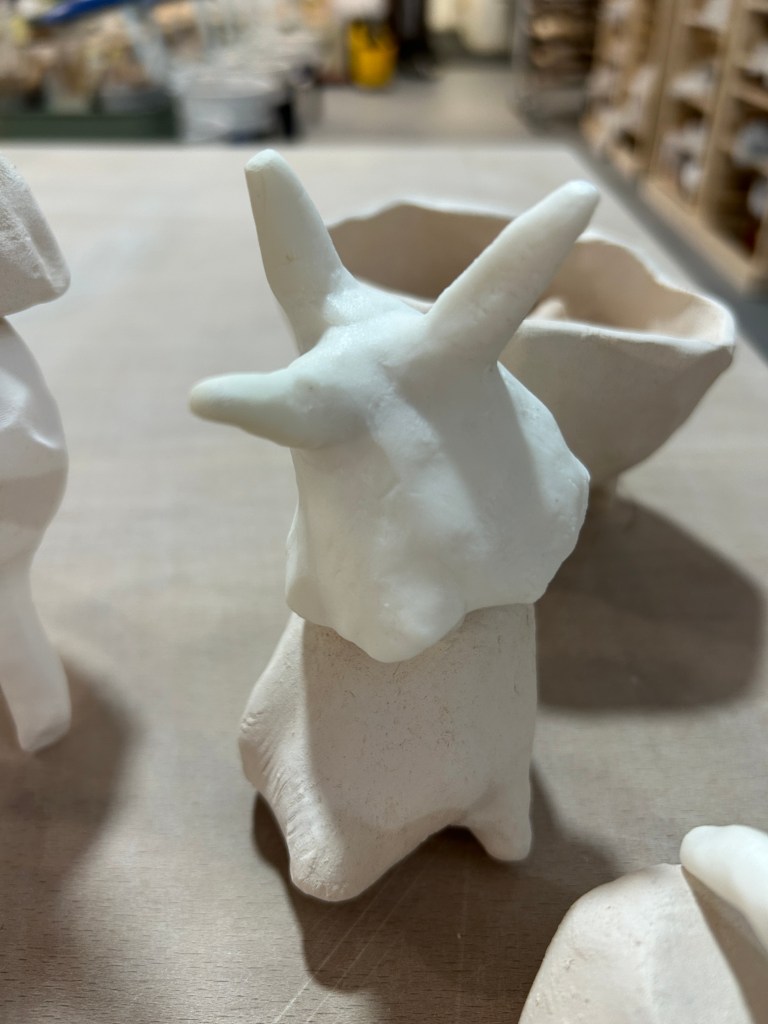
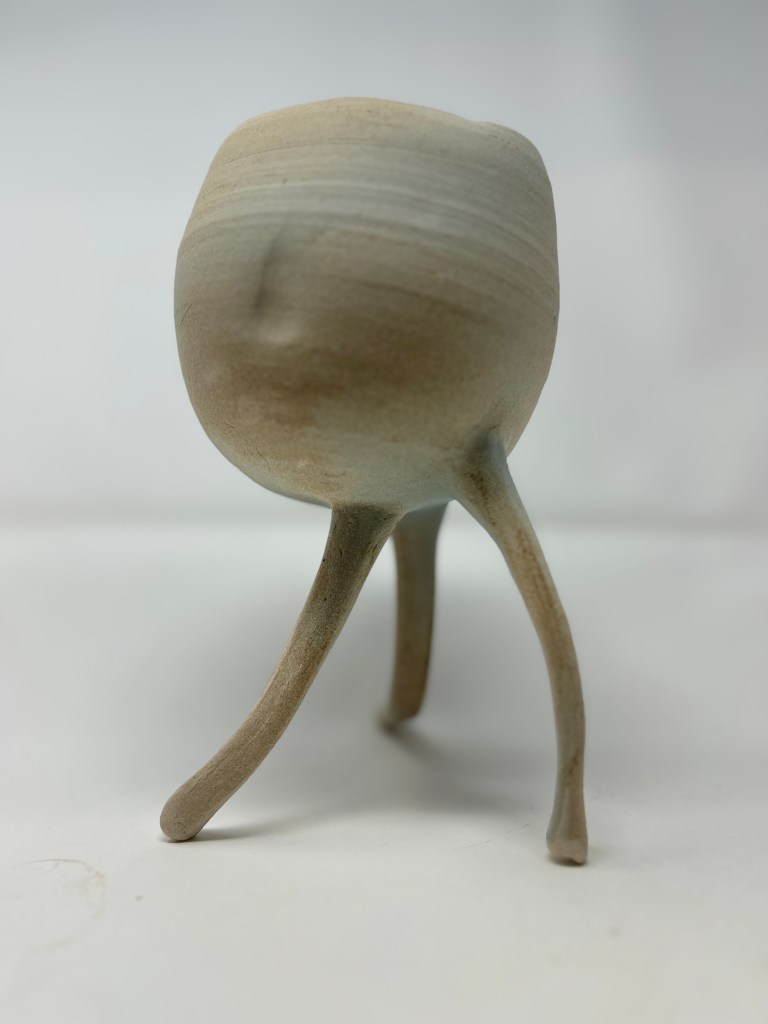
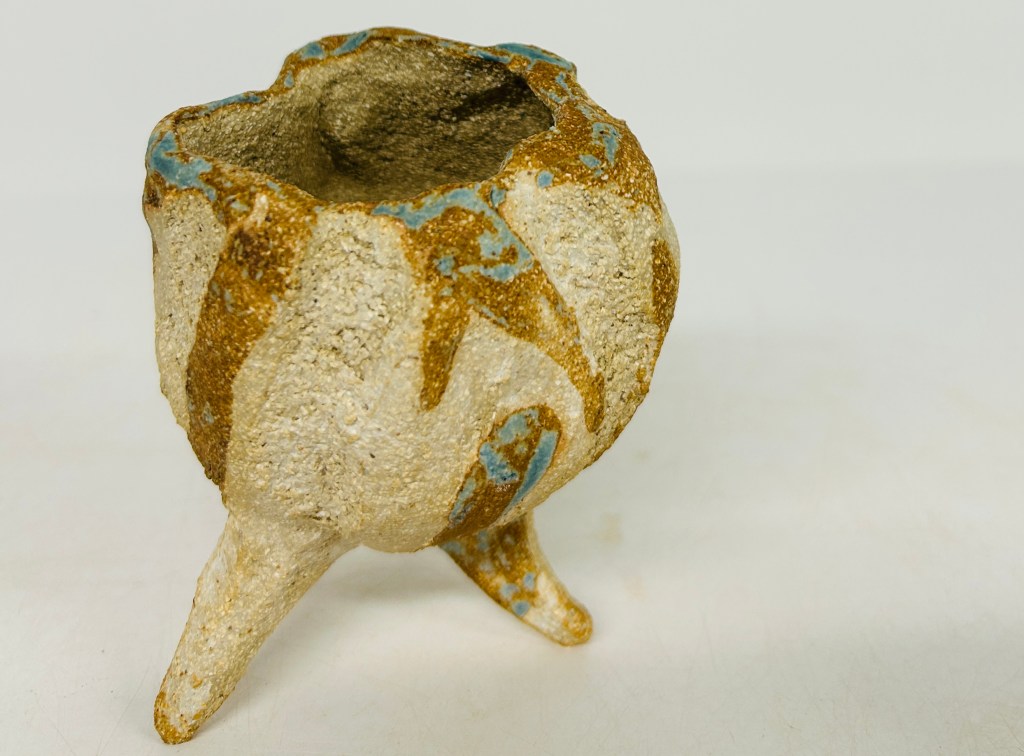
    In my case I am drawn to the human experience – being from a physical theatre and story-telling background.  And yet I think I have an aversion to the figure in figurative ceramics – to capturing a human form.  So thus far I have kind of abstracted that by creating three-legged or pot-like figures.  Which look kind of alien – and that also doesn’t satisfy me.  I also often get the feedback that they’re ‘cute’ which makes me feel sad. 

    So maybe the biggest risk for me is to explore the human form.

    I decide to spend some time with the the human figure.  I get three books out of the library about the human figure in ceramics.  My husband says ‘why are they all so creepy?’

    I guess the human frozen in time is creepy. You can paint a face on a still thing but it remains a still thing. 2D imposed on 3D.  I guess there’s something of the puppet or doll – staple figures in any horror movie.  I wonder if the idea of the clay pot surviving the centuries is inevitably somewhere in our minds when looking at a ceramic object?

    In my theatre practice I have often worked with puppetry and one of the key things about a puppet is to ‘keep it breathing’.  Even when it’s still, we feel the breath.  Puppeteers think about the breath all the time – they breathe with the puppet.  If you stop the puppet’s body from having it’s life breath – say you just sit it down and move away – we say it ceases to ‘live’.

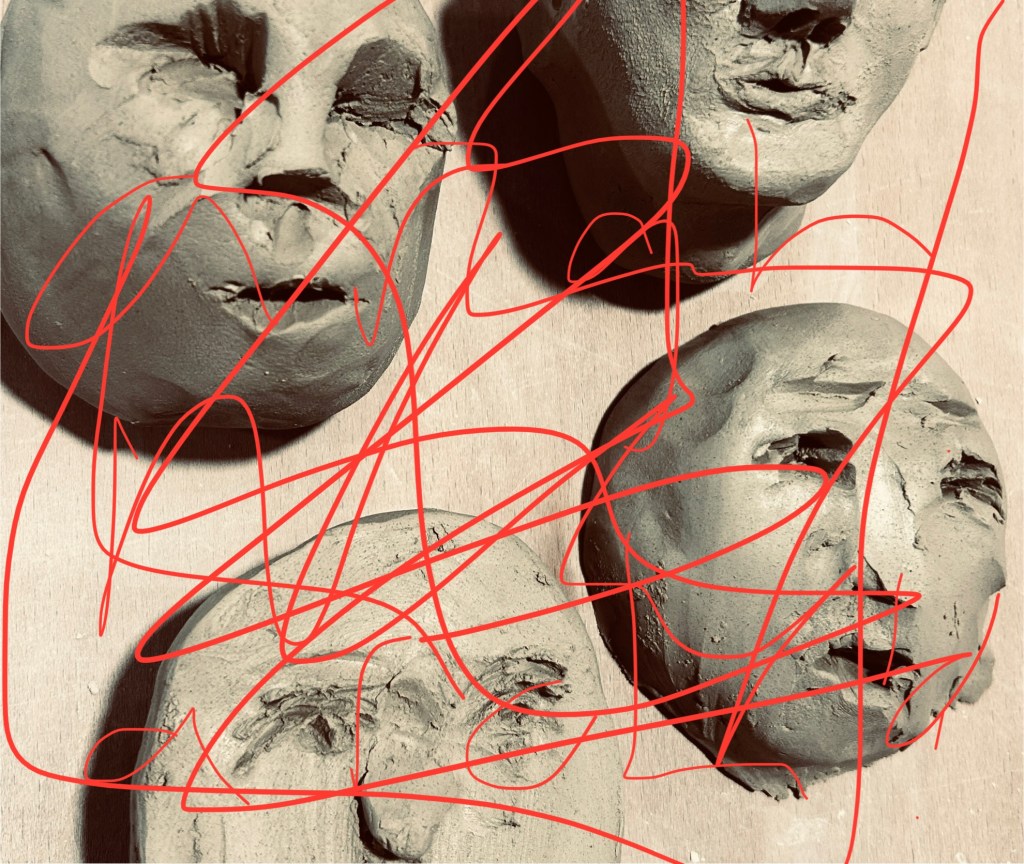
    You might think going into the studio and making a real human face isn’t going to kill me.  (I go to life drawing classes, I enjoy figurative paintings…).  But when I walk into my studio and try to make a figurative head I feel kind of sick.  If I’m honest – I feel kind of cheesy.  I tinker away with the human head and I hate it and hide it in a box.  I explore other less realistic, more abstracted faces.  I dislike them all.

    I enjoy the making.  There are technical considerations that are interesting to me – finishing a head or even a whole body one has to then slice it in half and hollow it out.  If the thing is going to stand on two feet – there has to be consideration of how it balances.  How will it sit in the kiln. It’s arms need to be propped up or they might warp.  I can imagine that making a truly realistic full size bust might be enjoyably challenging. 

    I don’t have a satisfying conclusion to this experiment.  I stop short of firing the things because I hate them so much.

    But I push on and decide to commit to making an angry menopausal wolf-woman, with high heels and a long bushy tail.  I think it might be the ugliest thing I’ve ever seen in my life.  Someone comes a long and says ‘oh, cute!’

    Onwards.

  • Univited Guests

    This week was treated to a visit from imposter syndrome.  All of his friends came too – perfectionism, procrastination, paralysis – the whole gang.

    I have lurched between the identities of six different kinds of artists.  Been haunted by distorted imaginary voices of perfectly supportive ceramicist friends, who think I’ve made bad choices and generally am making a fool of myself.  

    The nature of these thoughts are worth writing down because they are so ridiculous in black and white.  We are not our thoughts.  An idea that seems impossible to grapple with, I believe rooted in mindfulness and therapeutic practices – though at odds with Freud. 

    What am I doing making art?  And in the middle of the night – ‘What IS art? See, you can’t even answer that’.  Well I’m doing a Fine Art Masters, so let’s just see.   I find in these moments of self doubt I scroll on instagram more – it’s a great idea.  My feed shows pristine lifestyle ceramicists throwing pots next to white sofas, desperate influencers showing 3 steps for making abstract art that sells…and even the legit art scene posts seem all about what’s fashionable and what’s correct and accepted right now.  

    And part of the problem also is that everything is acceptable.  I sit down at my life-drawing class (organised by the students union, and excellent) next to a gloomy woman who says that no-one seems to care what art is anymore.  

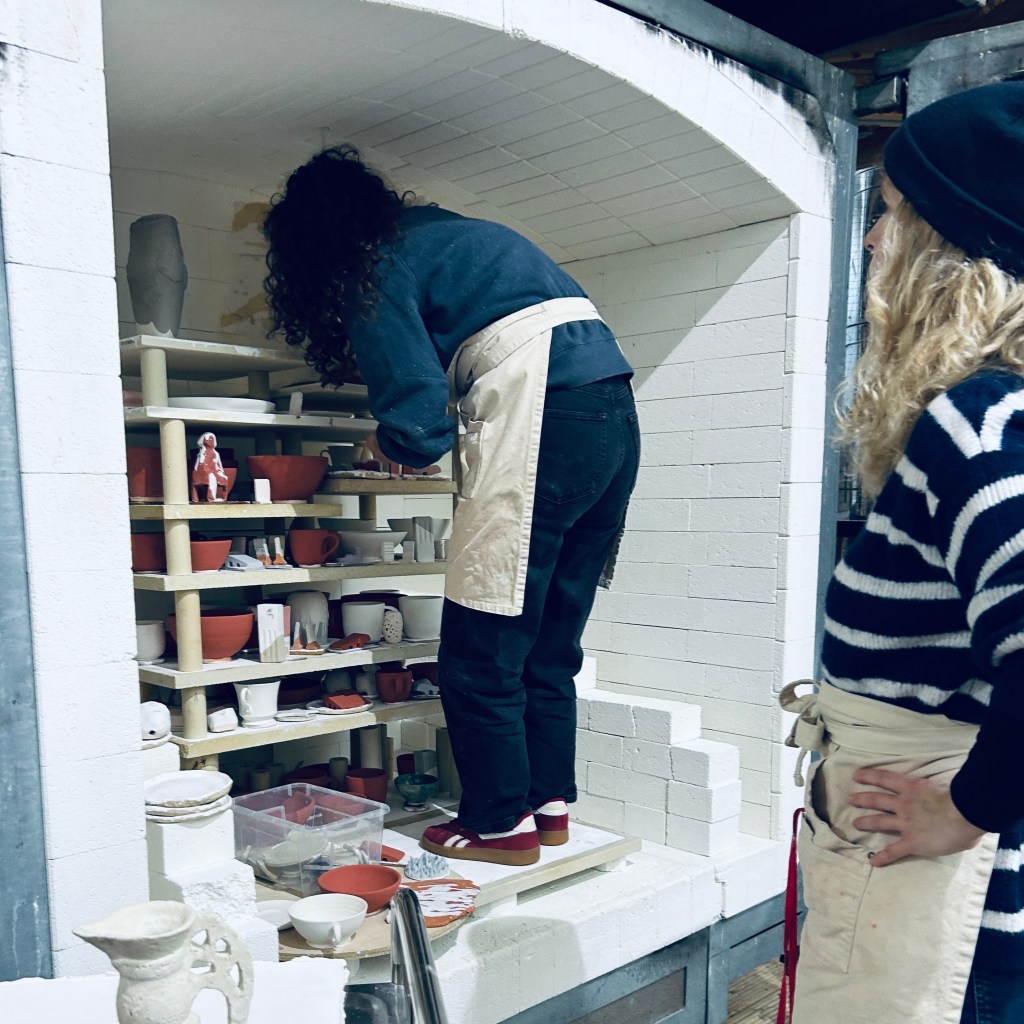
    Under a cloud I head to the studio at County Hall Pottery, where I work as a technician in exchange for studio space. 

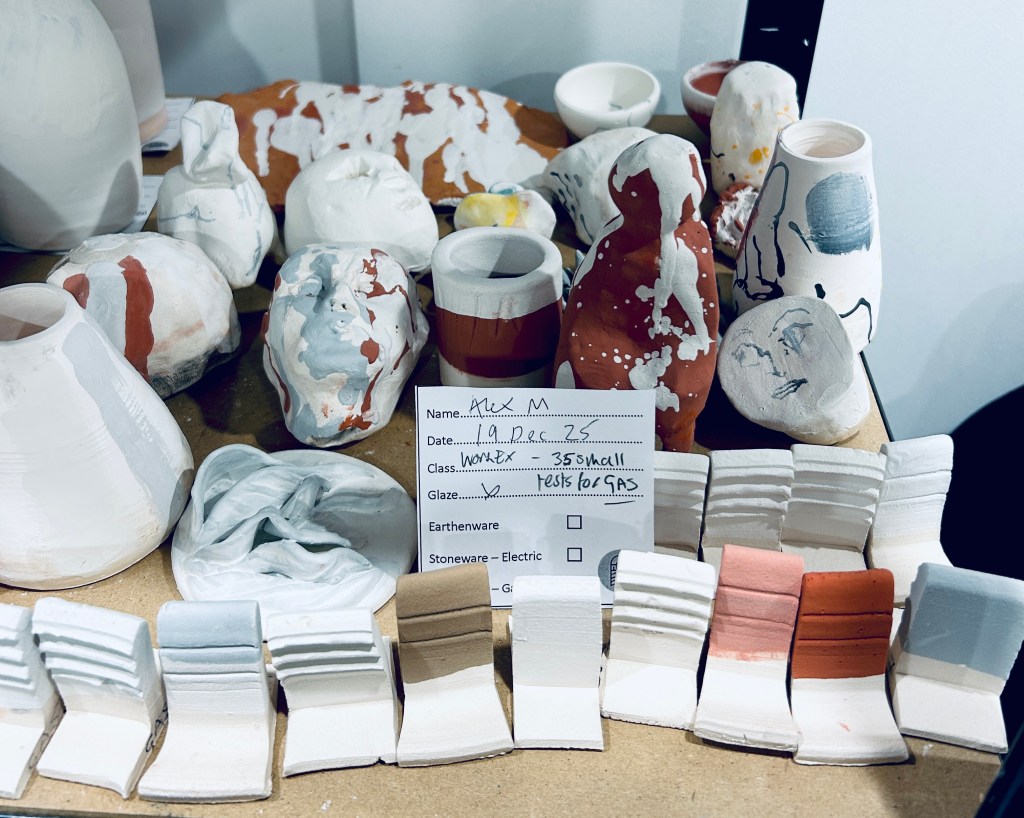
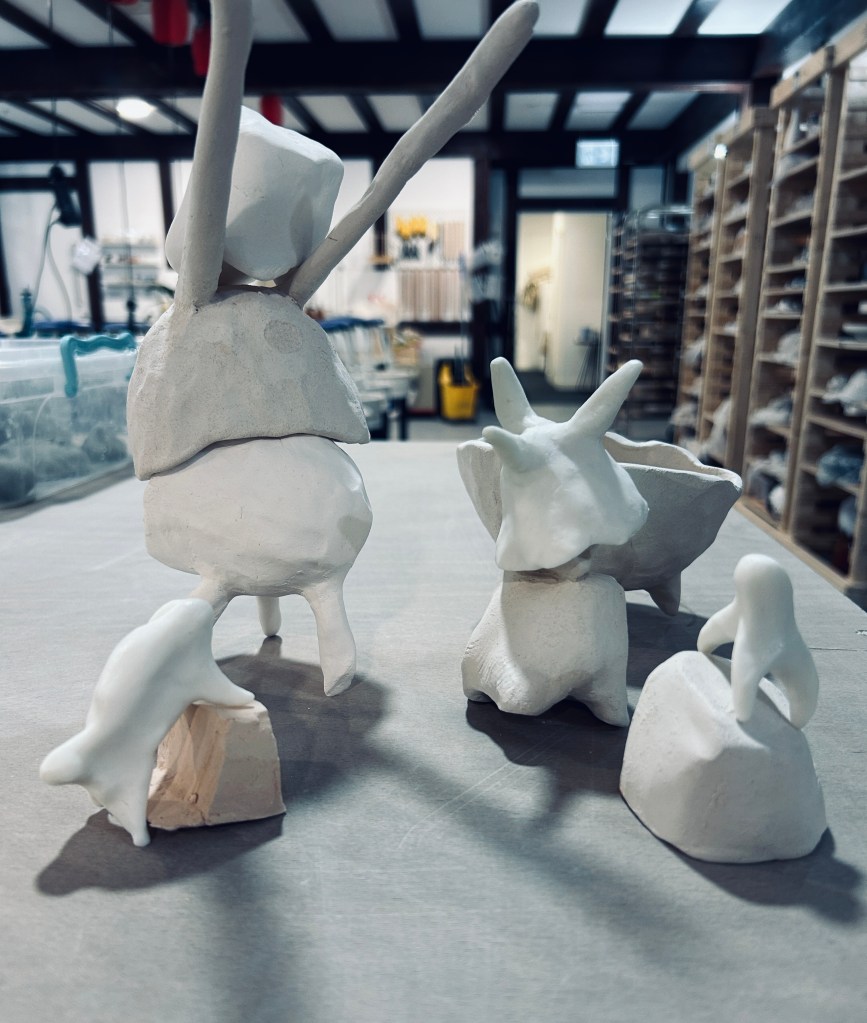
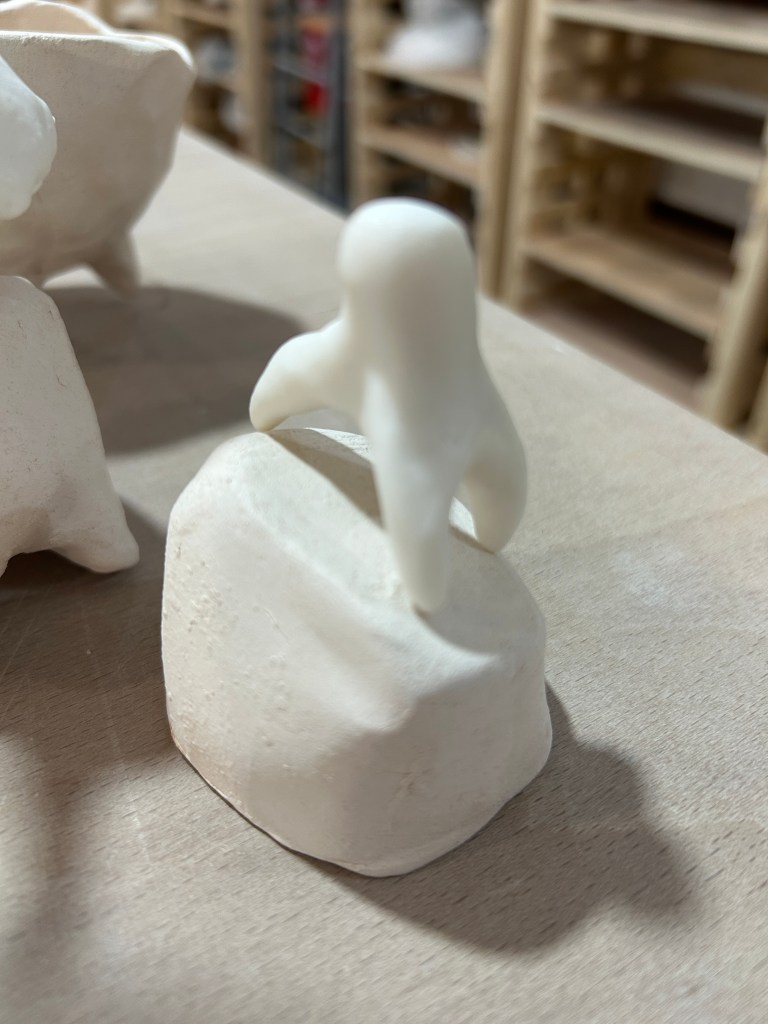
    At the studio Charley Blackburn, the new ceramicist-in-residence, is preparing for an update with the managers.  Her sketchbooks and glaze tests are set out for the meeting and it’s breathtaking work, but also chatting to her, I notice there are more questions than answers.  There’s certainly no end goal.  I show her a box of bisque shapes I’ve been playing with.  And a stop-frame animation I made to document the process.  I might make more stop-frames.  Charley gives me some feedback about what would making a film of them moving add to the work, which she feels already has movement and energy.  I have no idea how she has seen that. 

    While her meeting goes on I listen in to a fantastic conversation from my lovely brilliant colleagues about Charleys work – and I go into hyper focus.  Or flow. Just playing with the shapes.

    One of the challenges of ceramics is the technicality of putting something together, which really requires prototyping, sketching out, planning.  Factoring in the 7-10 different stages of drying time.  But how do I improvise if I have to plan first?  Where is the creativity that comes from spontaneity.  Each ceramicist approaches this chicken and egg in a different way.

    But most importantly something is unblocked by showing up at the studio and my wonderful community and friends at County Hall.  By Charley’s serious generosity and belief.  

    I felt so galvanised by that.  I also want to mention Daniella who has (along with Olga and Hicham) pretty much remotely organised a group show for us in the Good Rice Gallery with a couple of days notice.  She is one of the extraordinary people that just believes, is unfailingly optimistic and generous.   Instead of overthinking this, I go with the flow.

    I think my my thought this week is about community.  If I can’t be kind to myself then to take myself to the people who lift me up.  The studio becomes then not an aspirational space I can’t afford, but an environment I create by people I choose to connect with.

  • Permission, presence, purpose

    Trying at the moment to work from my gut, and trying not think to many steps ahead.  Trying, trying, trying to not try so hard.  We have a discussion about what blocks the imagination, taking as a starting point the word resentment.  Which interestingly turns out to mean re-feeling (French: sentir, Latin: sentio).  This makes me think about presence.  If we are re-feeling, we are cycling past emotions.  And I can see that this can happen with re-feeling in the direction of the future also – being in that stuck place of ‘this will happen, that will happen’ – which will always be cyclical because it doesn’t exist.  There is only now.  And now.  And now. Etc.

    My internal narrative when unhelpful, when not-present, is often littered with questions about validity – what’s good, what’s good enough, what’s excellent, what’s not, what’s ok, what’s correct.  When you write it down it’s pretty ugly.  Again in improv ideas are generated on the foundational premise that there are no bad ideas.  Keith Johnstone (aforementioned improv forefather) would coach actors with ‘be boring’ or ‘too original!’.  I trained as an actor at École Philippe Gaulier, an eccentric but unrivalled master of engendering the essential quality of presence in the actor.  Famous for ordering actors to ‘leave the stage immediately’ seconds after their entrances, because he could ‘see a little idea coming’, it was a school of hard knocks.  We once asked him about talent.  He said ‘There is no such thing as talent.  Only what you authorise in yourself to do’.  I think about this nearly every day. 

    We discuss results of an automatic writing exercise on what blocks the imagination.  The discussion is framed as ‘Where do we need new creativity, new imagination?’.  We think about the ‘we’.   Tim – ‘the lofty idea of the artist as solo genius, artist as hero, that model, Rothko – is really unhelpful’.  We think about the ‘new’ – are there new ideas – probably not.  We think about the ‘need’ – is the work doing the job it is meant to be doing?

    What is that job exactly?

    Jonathan reads a provocation from Ben Okri in the Guardian about the artist’s responsibility towards only working on the subject of the climate emergency.  What does existential creativity look like in our art practice? How do we translate that or interpret it?  Also read out – an extract from Douglas Hine’s ‘At Work in the Ruins’ – about the problem of seeing art only as a tool for getting across a message.

    Art is not a cheap alternative to an advertising agency or a sophisticated extension of the communications department, and the urgency of the message doesn’t change this.

    I really enjoyed Luisa’s response to this ‘our art practice is to protect thinking’.  I take from this that we need to give our audience space.  To not be conclusive.  To leave space for a dialogue – even if the artist has left the room, or the planet – we are in conversation with them through the work.  We remember how shut down we were at school when preached at. 

    Hine quotes in turn playwright Anders Duus – 

    Our job is to complicate matters

    I think this has really helped me think about how I approach meaning.  I’ve worked in a discipline where storytelling is at the centre of things – and clarity is essential in script/playwrighting.  I suppose I am still telling stories but maybe in my art practice in a different way, giving space for the audience yes, and also space for the intangible, as Hine puts it, for the ‘messiness and strangeness of life’.

  • Thinking or Feeling?

    We talked last week about David Cross and Matthew Cornford’s The Lion and the Unicorn, working on a response to a white cube space, thinking site-specifically, filling the space with coal, creating an environmental statement – and the ethics and integrity of that.  This week we were shown around – via live feed – Bobby Dowler’s exhibition with found and rejected canvases belonging to other artists that Bobby has appropriated, doctored and left open to live curation by visitors who can move and place them as they wish.  Dowler is talking about who own’s art (can these pieces be sold etc) and the place of commerce in the art world.

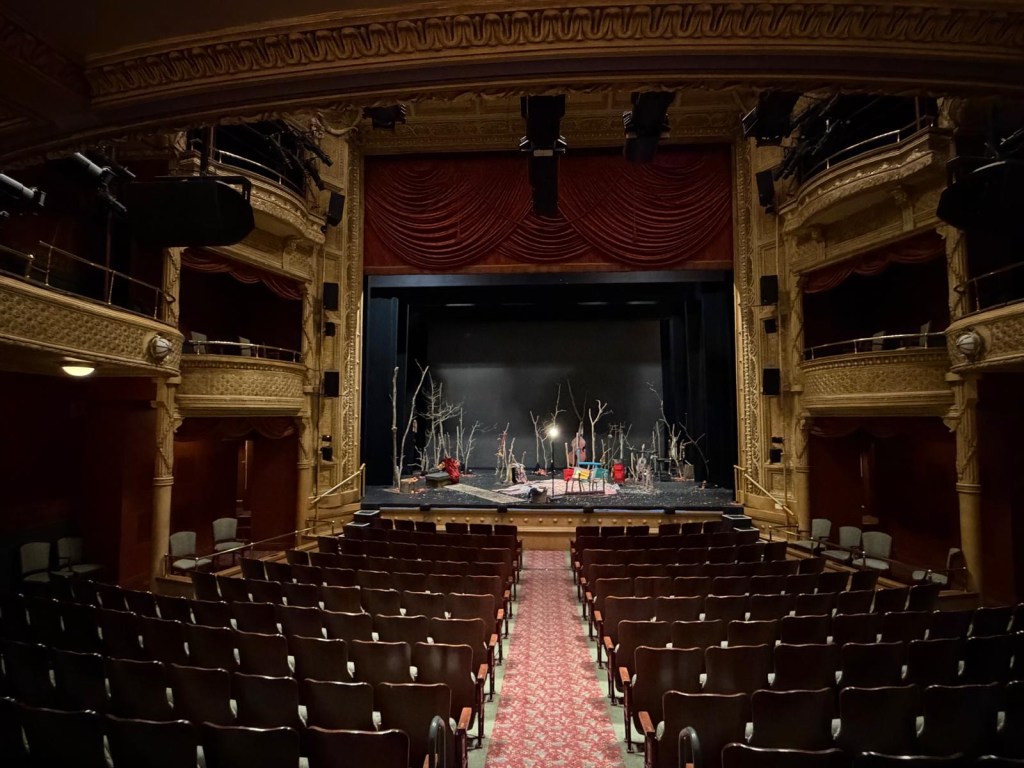
    Two site-based responses.  This is a language I know – my theatre company made shows on allotments, in shopping centres, working men’s clubs etc.  At the time I thought deeply about audience – and how the cultural dynamic was changed by going to the spaces owned by the audience rather than having them come to our traditional theatre buildings with their red velvet, ornate architecture and weighty cultural baggage and behaviours.

    I also feel now that ‘immersive theatre’ practice has full-circle turned back on it’s original more community-focused and democratising intentions – where now the term ‘immersive’ theatre is guaranteed to bring a set of excluding behaviours, arguably equally elitist as the traditional theatre dynamic, where very knowing audiences are well used to ‘joining in’.  And I feel a little tired of that.

    This all made me think about intention and meaning.  How all-encompassing the idea of concept is in art now, can we even begin to move away from the analysing and deconstructing of ideas, can we ever experience pure feeling in an abstract sense?  I’m interesting in digging into this because while I enjoy pulling apart the artist’s intentions and the success of the realisation of those intentions, I also feel sometimes feels duped by art that is purely a talking thing, a tricksy and gimmicky thing.  

    And what does this all mean for process?  For the sketchbook, for the prototypes, for the technical stuff…especially pertinent in the demands of ceramics as a practice.  

    What do I want to say and how will I want to say it?

  • Shaped or found?

    First tutorial with Jonathan, a totally brilliant and surprising and far-reaching conversation.  Trying here to get it all down but actually it’s going to be more like a list I think, of chapters to dip into as I go along.  

    I guess the main headline is what has my path been before, is it going to beautifully joined up (as I’ve been thinking) or is it going to be healthily separated.  What do I want out of this practice?  What can I take with me and what can I leave behind.  

    Why have I chosen clay now, or rather as I see it sometimes clay has chosen me?  I know there is something about my theatre practice being about liveness, physicality, spontaneity and movement – and there being something about clay being the opposite of that – a material that when fired transforms into ceramic material that is fixed in time for thousands of years.  

    Something about holding onto something?  About anchors?  About trying to bring something to stillness?

    All of my practice so far has been collaborative.  It has been ‘we’.  That the ideas of the collective can – or must? – be more rich than the individual.  But is that true?  Is that still true for me?  Where am I in that?

    It has just popped into my head that a text-driven theatre director associated with Battersea Arts Centre many years ago called devised practice ‘fuzzy compromised theatre born out of antagonism’.

    This still makes me laugh.

    We laugh when we recognise something painful and true.

    Anyway.

    Clay.  Clay is also a tricksy collaborator – it’s needy, unpredictable, it actually remembers wrong decisions you’ve made and changed and it throws those bad decisions back at you when you open the kiln door.  And it is also compelling, essential, honest, solid, real.

    We talk about being comfortable with process.  I notice when thinking about what I want to make I am looking for a finished idea.  I visualise a kind of finished thing.  But there is something here to borrow from theatre practice – a phrase we use ‘don’t jump through the steps’ – when actors don’t see all the steps or beats in the story or moment.  

    How can I bring that sense of movement to my practice, rather than go straight to end product.  Of course improv has lessons for me here.  This translates to what processes I am using in the studio – the mesmerising pull of the wheel versus the time it takes to master the wheel.  Perhaps hand building might offer me more freedom right now?  Collaborating and ‘yes and…’ing with the clay itself.

    Also we discussed the kind of things I feel blocked by – work I like and don’t like – what does it feel like when my practice is going well.  

    There is something about essence.  About kind of finding the seam, moving between different ideas and thoughts towards something particular and tiny that feels true.  You know true when you see it.  I remember bursting into tears when I saw an Edward Hopper painting in the Smithsonian Washington DC, from some distance away.  Tracey Emin’s scratchy nudes.  You feel something at a guttural level.  Maybe I just need to dial back and notice what does speak to my gut, and what doesn’t.

    Essence.  I don’t love all the work I make but I do love the placement of a leg on one of my three legged triped pots.  

    We decide it might be useful just to focus on that. 

  • Dolphins and Otters

    Completely surreally I am in New York in a show on 42nd Street. I am doing what I know, I guess I am being in my element in many ways, it’s kind of dreamlike, like literally a dream you have as a child – and it’s fun as hell and I’m working the stupid long hours, living on sugar and carbs and it’s stressful.  I am so tired and my eyes kind of hurt in their sockets. 

    And I’ve got to say I am pumped up because I’m making hundreds of folk laugh and doing it well.

    I don’t know why I am writing this apart from it’s going to be all joined up.  I don’t know how.  How do I use what I know so far, about play, about clowning, about improv, about acting and about stories.  How does this all fit together?

    What I am doing here is the thing that I know and understand in my bones.  When I started to make independent theatre I didn’t know what the hell I was doing.  I worked from my hungry 25 year old gut instinct – and the things I made were some part made in thrall of the artists I admired and the other part made in punk reaction against the kind of theatre I hated.   How was it then? 

    Some of those admired theatre peers are still doing exactly the same thing,  So sure of their practice they will say things like ‘this is acting / that is not acting’ with such conviction.  I used to admire that and wished I was so certain about what my practice was, to wish I wasn’t so messy and so magpie-like in my tastes.  Perhaps if I was like them I’d be more…legit?

    There is a story about artists that I like that says we are either dolphins or otters, I think it was from Neil Gaiman.  

    If the dolphin does something successful and everyone applauds / throws him a fish etc – the dolphin will repeat the action.  Again and again.  More fish.  More applause.  

    The dolphin will put on the dolphin show.

    The otter will always do something new.  For the fun, for the curiosity.  The otter isn’t interested in repeating the thing to be thrown a fish.  You can’t really train an otter.  The otter wants to play.

    I watch the recording back of our session last week.  About keeping moving, about not knowing being the foundation of critical thinking.  About questions without a finite answer.

    Something also clicks for me when Sofi does her presentation.  Sofi’s work is beautifully raw and serious but also…it’s funny.  She uses humour.  She brings levity to serious ideas – from what I see so far.  

    I feel excited that this will all join up.  

  • You did it wrong.

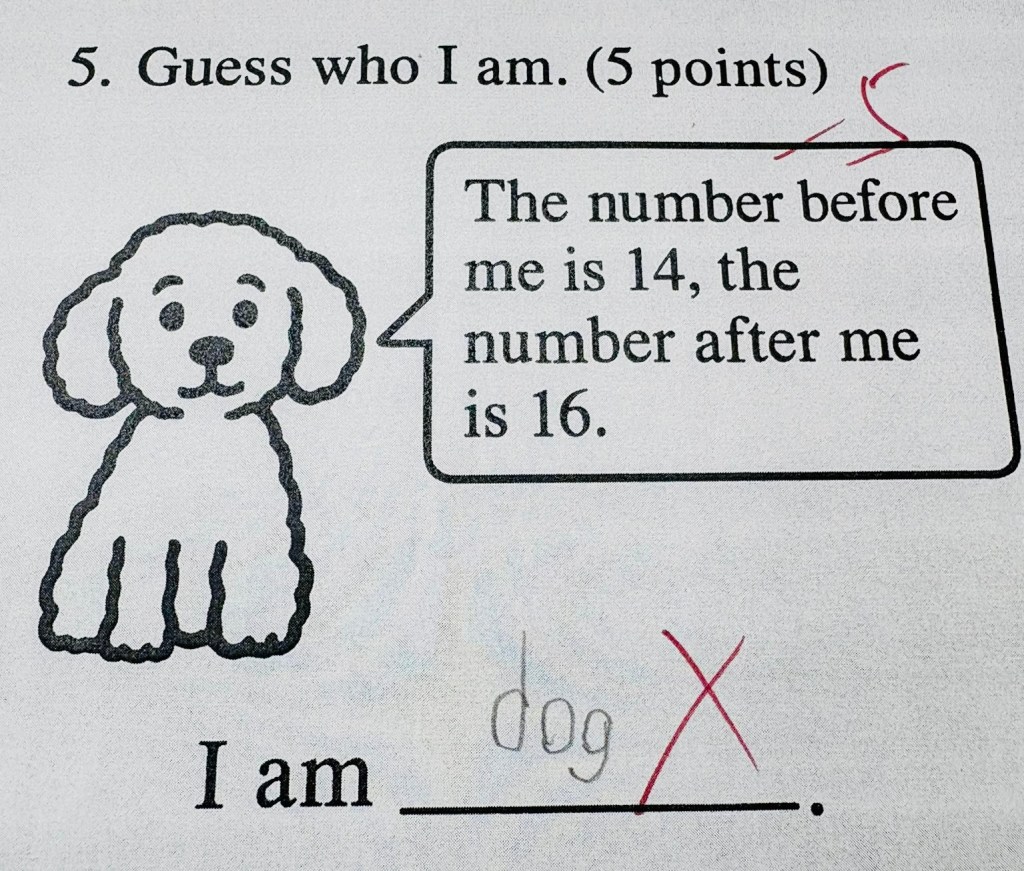
    I love everything about this picture that I found on stupid social media.  Is the kid wrong?  I think the answer ‘I am dog’ is somehow more right than ‘I am Fifteen’.  Pedagogically the test has created so many crappy misleading clues for the kid – grammatically (’Guess who I am’), visually (a talking dog is actually a number, stoopid) before we even get started on the dated assumption that all kids learn through words alone and that some will be neurodivergent thinkers etc.  But most importantly the teacher is really firm in their opinion that this kid’s answer is a big red-cross WRONG.

    We talked in the last session about failure.  I’ve come to expect my assumptions to be up-ended in this class which is why I’m loving it.  Jonathan presented the idea – ‘do we really learn from failure?’ – and that what happens in the case of being told we’ve failed is more like fight (‘stupid test) or flight (I’m never going there again).  The educational system is designed to have us want to get things ‘right’.

    I notice to myself that all my life I’ve been trying to do things right, to not be as weird as I imagine people think I am, to achieve in other’s people’s eyes.  In the case of my career – to be picked.

    I have more to say on this.  I have a fleeting idea of making a piece of work about it called ‘Well done Alex’ based on an patronising interaction with a ‘more successful’ peer of mine.  I’ll come back to this…

    But actually there are lessons from my theatre training on the subject of working with failure.  We discussed Keith Johnstone (quoted in my first post), improvisation’s UK forefather and saying yes to the unknown.  One of the tenets of improv is to fail gracefully – mistakes are actually a gift.  (My company used to improvise whole stories in one night and on one occasion I had forgotten the name of my character’s husband – a perennial improv problem.  I dropped John in for good measure, accidentally naming Brian’s character’s husband.  Bri said ‘do you mean my John?’ – and thus we had a story of a revealed love affair.).  As Jonathan pointed out – we over-accept the offer from failure and run with it.

    In clowning training the moment of the failure or ‘flop’ is the moment where we discover real fragility and truthfulness.  More another time.

    Jonathan tried an experiment where we reframe failure by distancing ourselves in writing about it in the third person.  I won’t write it all out here but to sum up. In reframing her failure to manage her time in the ceramic studio, Alex discovers that she could be kinder to herself about her excitement to try too many new things, and actually that time is in fact a huge part of the narrative of clay as a medium.  As is slowness, stillness and most definitely unpredictable results and letting go.

    Quoting Jonathan (or somebody else) – 

    the information in failure is a public good, when it is shared society benefits

    Provocation this week – do something in your art practice that might not work.

    Take a risk.  Record it.

    Disrupt something, break it open.

  • Where am I now?

    Really interesting lecture from the Art in Context series run by Dean Kenning.  About diagrams as a methodology.  Diagrams being ‘synoptic’ – you see everything at once.  How we think in terms of a diagram creating order but there is not necessarily an order. 

    A timeline is the most basic diagram.  It spatialises time.

    Diagrams like timelines use metaphors to do with directions of travel – we say ‘go forward’ ‘go back’ – arrows towards some kind of end point.

    This joined up with Jonathan’s lecture for me about the reflective process as a cyclical plan – reflect, plan, achieve, observe > new question now, reflect, plan, achieve, observe etc.  Rinse and repeat.  And how that is problematic with art because ‘continual progress’ and a ‘final end point’ is deceiving.  It looks more like messy, tangential, zig-zagging.  Rito’s ‘radical incompleteness’.

    Dean Kenning showed us some examples of timelines that demonstrate that they are always …that word ‘partial’ again…always selecting, never neutral.

    Joseph Priestley’s New Chart of History – (1769?) – a view of the history of the world from the point of view of the Empire.  Alfred Barr’s graphic of the relationships that make up – in his view – the story of Modern Art.  As the founder of MOMA NY he should know – but like all custodians of artwork he is partial, selective.  

    (Note to self here – to check out ‘System’s Theory’. And the Zeno Paradox – where you are only ever halfway to a point, always halfway to another point etc to infinity.)

    So anyway.  No arrow.  Just the rewriting of a story in particular and personal terms.

    What to take from this?

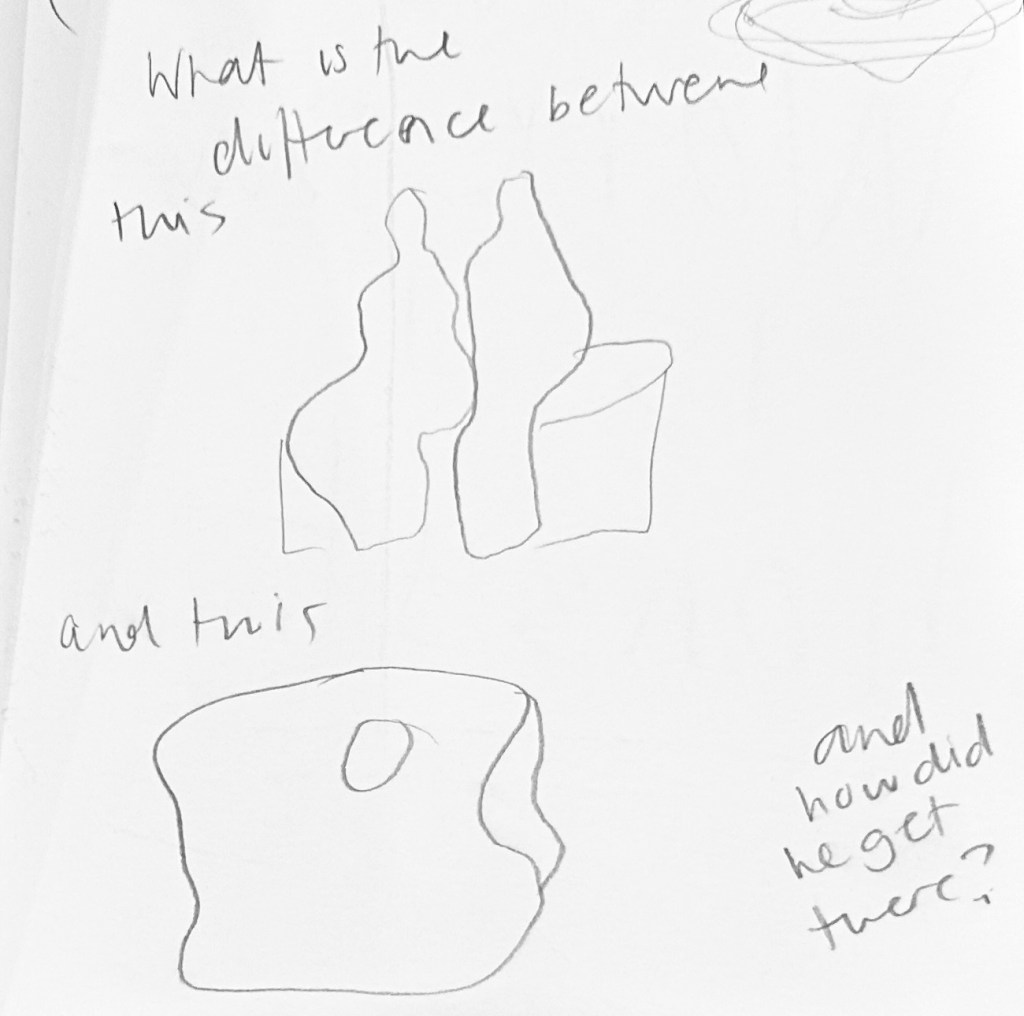
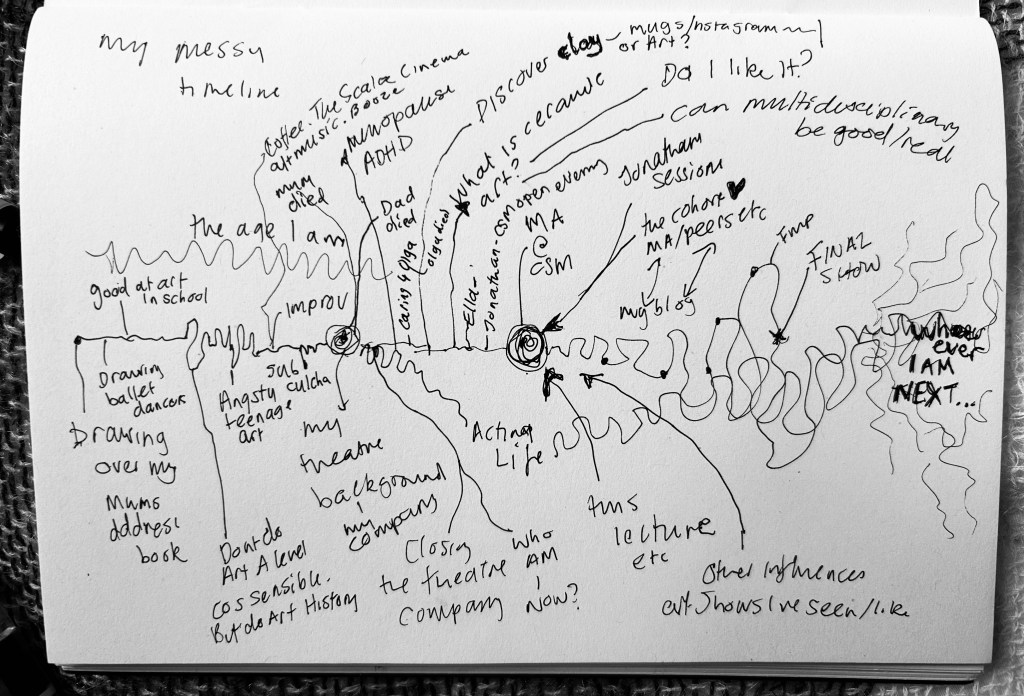
    The above messy timeline of my own.  I notice I didn’t place my now in art history terms, just in terms of my journey and what got me here now.   All the influences that make up me.  Looking at it again I see that I have blown some things up and minimised other events and I guess this would look completely different say 5 or 10 years ago. I feel excited about what things will become important and prominent in the next 5 or 10 years time. I have no idea.

  • Partial and Errant

    I took the bus to Camberwell to go to Jonathan’s lecture IRL.  I was flooded by really specific memories of starting university, some kind of wave of nostalgia for the start of an adventure.  The building was full of awkward, cool, lost-looking young people.  Not for the first time in recent weeks (but that’s another story) I felt like I had accidentally time-travelled and was experiencing my life being played back over again.  I notice I am not that different in many ways – certainly awkward, maybe not cool, lost definitely.  I lost my favourite jacket on the bus.  Same person I ever was.

    The lecture was called ‘A Messy Introduction to Practice-based Research’.  I want to know what that means – having once gone through a lengthy process to apply for Practice-led Research with the Arts and Humanities Research Council only to be rejected with the infuriating ‘feedback’ – It reads like an artist wanting to have money  (or something like that. That’s what I took from it).  Tangent.

    Tangents are messy so not a tangent.

    We had to collaborate in pairs to discuss what how one might research the impact of eating fruit on 100 economically disadvantaged children.  I braved it and spoke to a 20 year old girl who said it didn’t apply to her because she’s a painter so she wouldn’t be doing that.  I suggested it was maybe a hypothetical situation.  I tried to apply a healthy attitude to collaboration at this point but my enthusiasm was a bit dulled.

    I guess though incidentally (or not) this had revealed a point that Jonathan was making about being both an artist and a researcher.  Which we technically are by dint of enrolling in an art school masters.

    What is the difference between research if it’s carried out by a scientist or an artist?  Jonathan pointed us to the work of Kurt Lewin who was a founder on the subject of Action Research, the task being not to interpret the world but to change it. Although Lewin’s work isn’t directed at artists as such, he’s asking us to raise questions rather than just solve problems.  Changing the world could be said to be the job of art – it’s certainly a validating job if art needs validating which is does now and again.   The example was given of the film of Kesey’s One Flew Over the Cuckoo’s Nest – and the shocking experience of witnessing electroconvulsive therapy leading to it’s eventually falling out of favour as a practice.  

    I remember, when I first made my theatre work, spending time being conflicted because the work that got most easily funded (there I was trying to make a living again, how dare I?) was issue based and ‘worthy’.  Someone pointed out that where I was putting my work at the time (village halls, site specific, non-theatre based) was political with a small ‘p’.  

    Sometimes change in the world might be change in your world’. I think this was a quote from Jonathan, maybe Lewin…  

    …that there is a ripple effect caused by finding your unique voice, and if you can put it into your art, you are changing the world because no-one else can do this – in this way – as you do.

    I put off writing plays for decades because I was insecure about the validation of my voice.  

    I also wrote down – Jonathan I think you were paraphrasing who here? – 

    There is a moment for each artist in which a particular truth can be found and if it is not found then, it will never be found

    I also underlined these words from Carolina Rito. 

    Practice research is…partial and errant…tentative and opaque…it moves through the radical incompleteness of the subject.

    There was a lot more to return to in the lecture but for now I just want to underline here

    …the words about time in this…

    there is a moment

    if it is not found then….

    So I am noting to myself – can I please get out of my own way and seize this moment? Messy though it is and massively insecure-making and unknown.