Category: figurative

  • The Opposite is Also True

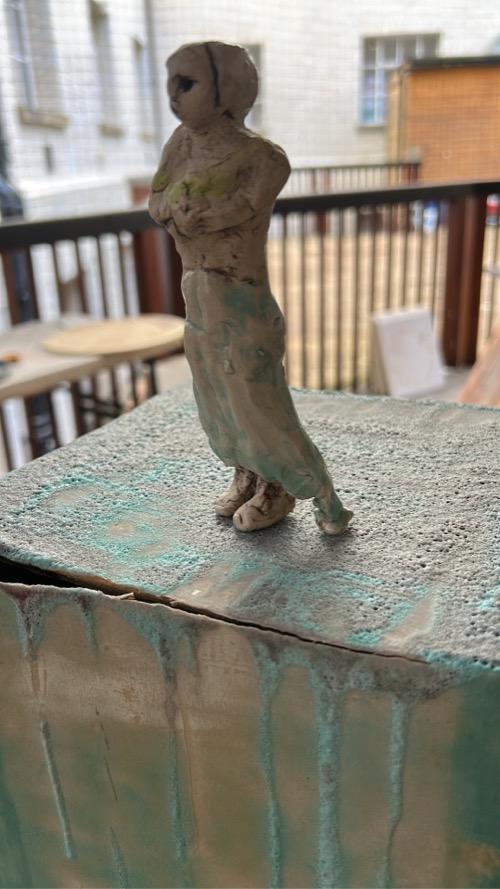
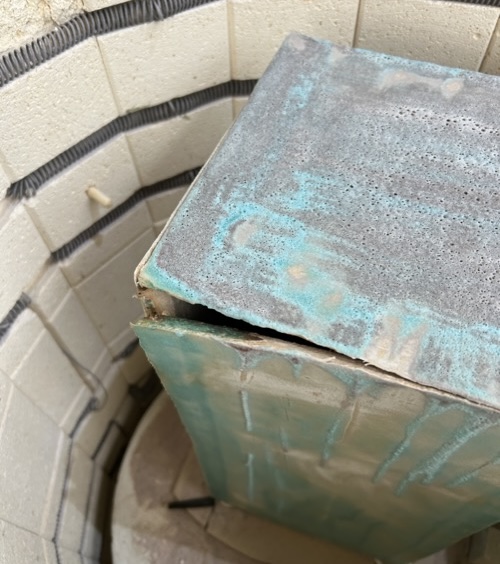
    So finally after all the challenges of firing schedules and making I opened Baby Diana the smaller kiln (being D or ABC – Agnes, Barbara and Collette – names which sound like cool and distant goddesses to me) which I’d tenaciously had to negotiate in this less than ideal process.  

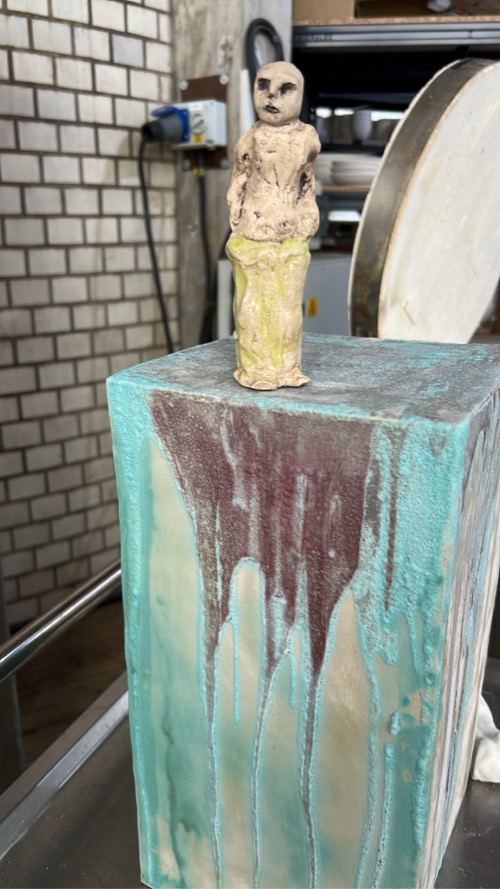
    First of all – the glaze on the large slab built box is the most beautiful effect.  Swamp lichen – a reactive glaze with Crater over it. It looks like water and foam and swimming pools which is a thing colour wise that has been emerging for me for this project.  (I’ve become interested in an extraordinary film called Ten Meter Tower a 17 minute short film training the camera on Swedish people considering jumping off a very high tower in a local pool – which I think is another whole post…)

    It also has a giant crack across the corner side seam.  Where the box fell and was reassembled during making.  When this sort of thing happens (scaling up slab building, the box was tricky) it’s kind of inevitable that even though you fix the seam beautifully, inside and out, and then you even add a little vinegar slip when it’s drying…the clay remembers like a damaged child.  It all comes out when it’s all grown up. 

    So part of a breakthrough was that I was going to explore fragility.  That breaking things may be part of it. It’s almost poetic justice in a way.  But also the perfectionist that haunts and hampers me says – remember that girl on your course last year who used to present all thrown and failed pots as intentional…well…her…

    All sorts of narratives appear such as – ‘hey all the ceramicists know about this kind of crack’.  It’s not a beautiful accident – it’s poor making.  

    I feel at once full of hatred and joy.  Shame and excitement.  Disappointment and triumph.   Is this what making visual art is?  All art?  I remember the knot in my shoulders after listening to my first play read-through at RSC – it felt like the worst two hours of my life.  Even though everyone loved it and thought it went really well and my agent was crying.  (In a good way haha…)

    So.  

    I have things to play with, which is what I’m interested in anyway right?  Currently I have four different elements in my work which I could use – they don’t hang together in ay concievable coherent way.  In my opinion.  Right now. 

    The figures – some of them have an interesting quality.  Some are just ‘cute’.

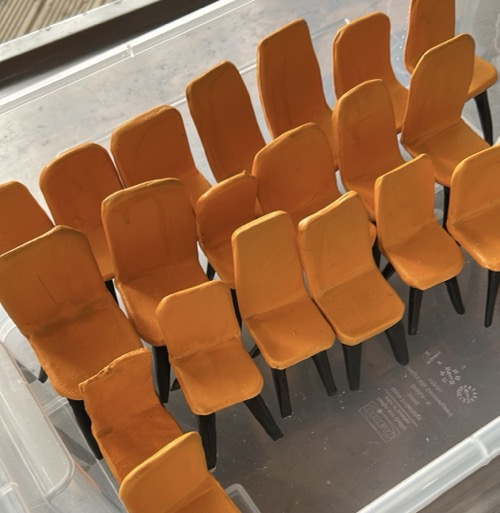
    I have made lots of tiny orange chairs.  They have no visual or stylistic connection to the other bits.  Apart from municipal swimming pools.  They might be good to play with.  

    The parian figures that I had to try so hard to get fired – they need a slow ramp to temperature – but can be fired in one glaze fire no bisque.  They’re…just.  I don’t like them.  They feel like tests that I should have finished ages ago.  I think they’re not going to be any part of whatever happens next.

    Another thing I could do is take a hammer to the whole thing.  

    Gaby – who I wrote of earlier – is teaching throwing on Tuesday in the Ceramics Gallery / Studio I work in – I will ask her what she would do.  Gaby reassembles the detritus of kiln firings.  I notice a small part of this is me wanting Ceramicsworld to give me an acceptable answer.

    Anyway.  Off to work…

    …and in the afternoon my friend Trui Malten walks into the Gallery.  Trui is an extraordinarily smart and funny theatre lighting designer.  I showed her my pictures of the beautiful glaze and the big crack.  And my Fine Art insecurities.  And she says – 


    “What would theatre say?  Put it in the space.  See what it means”

    She says it’s right that the crack is like it is.  Accidents and change have always been part of my practice.  That’s actually what I’m writing about according to my Study Statement.    

    ‘My friend is a theatre designer who got so sick of the transient nature of theatre he had to become an architect’. Trui is really funny and really smart as I say. 

    Chance.  Is there if you are open to it.  It’s always there.  

    Today as working am only able to join Jonathan’s session during my lunch break and it’s about ‘Dérive’.  The Situationist’s idea of wandering, drifting, following one’s nose.  And it’s not just a creative whim – it’s anti-capitalist.  It’s as if not more urgent now as the world is imploding into mediocrity, fake news and identikit shopping centres.  Alongside the rise of structural disenfranchisement, extremist right-wing politics, extremist misogny etc etc etc etc etc.

    Suddenly talking to Trui a whole multi-disciplinary chain of connections opens up.

    Maybe if I was riffing on my thoughts today, the class that I was half in and out of, the surprise inspiration from Trui it might look something like this 

    • my work, acceptable or not to the ceramicist world, to the art world, what does Gaby think, what does Collect 2026 think, that will be positive inspiration at least, but also overwhelming, my class is exploring ‘dérive’ and following their noses, it’s different to not be in the class I miss it, oh Trui arrives, she’s not in Italy, she’s bringing cakes and I forgot to pack snacks, theatre sets get thrown in a skip what a waste, what’s sustainable, damaged creative ceramic children, ah once again theatre has the answers for me, break everything and start again, it will be ok, why am I making this work that looks like theatre sets, that’s not ceramic art, then a guy walks in to the Gallery, he really enjoyed Collect will I be going (yes), look out for his work, he’s from Nova Scotia, Trui and I google him, Neil Forrest, oh look his work looks like theatre sets, little figures, I love ceramics, I hate ceramics.

    My friend Niall Ashdown is maybe one of the best improvisors in the world.  We teach together sometimes.  He often says when people question the ‘rules of improv’ that he wants to get a t-shirt made that says – 


    The Opposite is Also True
  • Immaculate Heart College Art Department Rules

    Been turning over in my mind the 10 rules from Corita Kent’s Immaculate College of Art that we looked at in the last session.  It occurs to me that Kent’s rules are so fresh precisely because she wasn’t (for a long time) accepted or part of the art establishment, that her outsider status gave her permission.  That somehow not being accepted can actually be a freeing thing.   Being outside of something being a ‘point of departure’ – to return to Alex Schady’s quote (see earlier blog) that comforted me when I was worrying about being from a different art discipline.  I recently watched ‘Maudie’ – a biopic of outsider artist Maud Lewis played beautifully by Sally Hawkins.  Maud Lewis just painted images everywhere she could find, over the furniture and the walls of her tiny Nova Scotian hut.  In terms of the collective judgement of the art establishment Lewis had a lot in common with Kent – no recognition until much later in life – and a delegation to the ranks of ‘outsider’ status.  Problematic word – ‘Outsider Artist’.  What defines the Inside, if you put aside more cynical ideas such as class, money, contacts and a nice stable upbringing that means you can work the room at a Private View…?  Something defined must have rules or there is no definition.  But artists break rules – don’t they?  Shouldn’t they?

    What’s refreshing about Lewis and Kent is they keep making.  Rather like wise Yoda’s – they either do or do not, there is no try.  Keep putting things down on paper, or any surface.  Make.  Don’t think.  Try trusting.  Rule no. 1 is that you try trusting for a while.

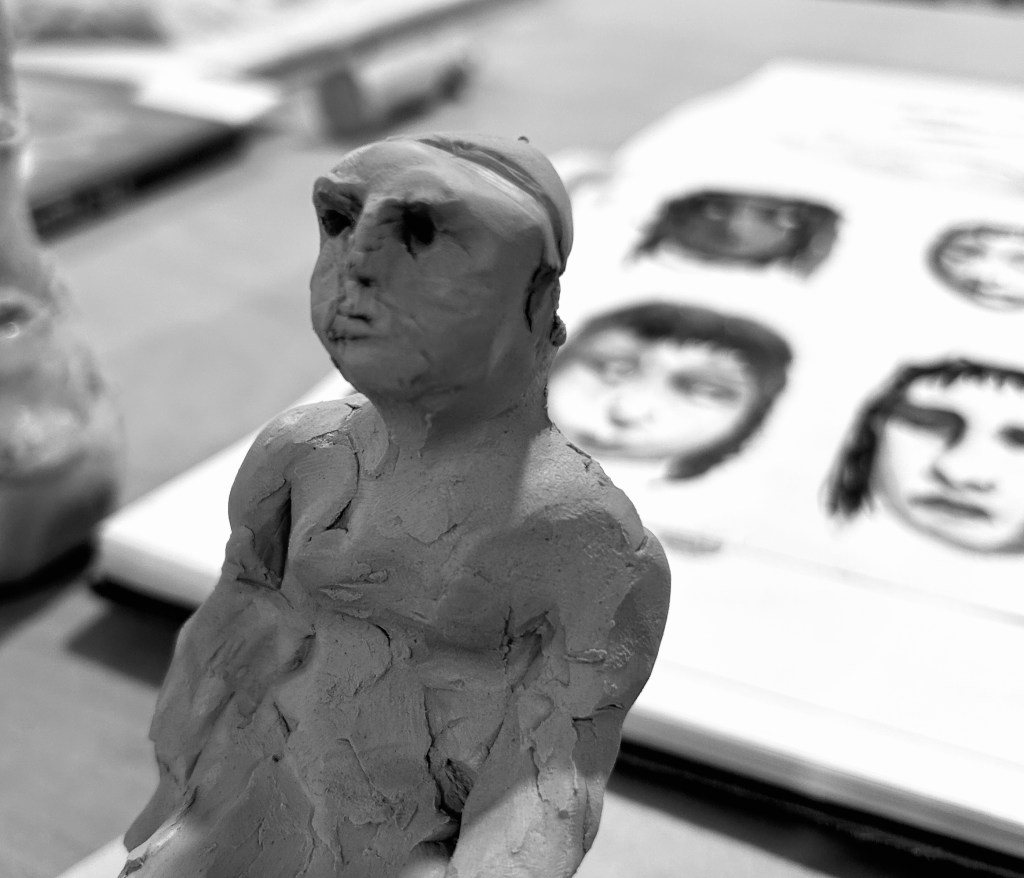
    Yesterday I forgave the sorrowful kind of realistic figures I was making (which I am resisting because of what…taste, trends, some sense of what’s ok to do – and that literally nobody has told me not to do).  I just committed to them and I believed that if I endow them with seriousness and validity – then maybe they would have this.  

    Actors do this also.  When they don’t commit – or they half commit – everything falls apart. So again, the other discipline contributes to my work.

    Rule No 8* (which should be tattooed on my forehead) – 

    “Don’t try to create and analyse at the same time.  They’re different processes.”

  • Really in the Sauerkraut

    Had the most amazing and generous tutorial with Jonathan.  I’ve been feeling really stuck, whilst at the same time because of the complexities of the firing schedule at my studio (as detailed in my earlier blog) I’m having to press on and make regardless of stuckness, in order to have something for the interim show.  Not a great way to nurture my developing practice.

    During the tutorial, where we talked a lot about my multi-disciplinary practice and what that brings, I talked about the situation in devised theatre processes where it’s agreed that we’re stuck and we’ll have to wait.  In my company I used to refer to it as ‘waiting outside the cave until the dragon wants to come out’.  Mike Shepherd from Kneehigh frequently used the phrase ‘hold your nerve’.  And Kasia Zaremba-Byrne, a brilliant polish movement director, will often pause during choreo sessions and say ‘we’re really in the sauerkraut’.

    Am trying to refine what I want to explore here.  Pull the threads together.   There’s something that’s very clearly pertinent to my positionally as a ceramicist – given that ceramics once fired are fixed in time – and that I’ve come from a theatre background.  A theatre background specifically rooted in liveness and improvisation.  So it feels like time is going to be important.  Theatre is ephemeral, transient, here and now and then gone.  Ceramic is fixed in time, it survives thousands of years.  Being one of man’s first discoveries it sits deep in our consciousness that ceramic endures.

    But at the same time – the opposite is also true – ceramics break.

    Liveness, ethereal, transient…here and gone…fragility.

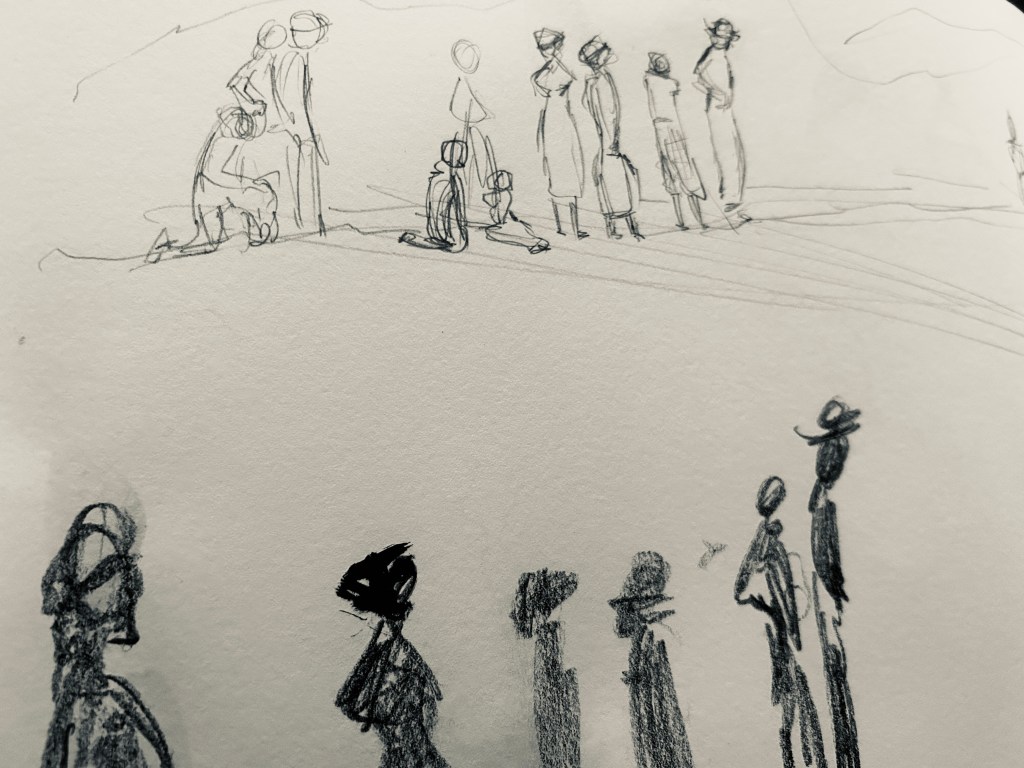
    The other – not unrelated – interest is movement.  My theatre background is largely physical, and so far I have choreographed my ceramic figures in dynamic spatial relationships.  Which does in turn create story.

    I’m aware of ceramicists who have a performative element to their work.  My pal Shane Keeling climbs on ladders to drop his pots to the ground.  And the artist Vidya Thirunarayan I met at the talk recently incorporates raw clay into her dance performances.  There is more to explore there, but I notice I am not drawn to performing in my fine art practice.  The challenge for me is finding the place where my performance experience intersects with my ceramic practice, without ceramics becoming consumed into my performance practice. 

    Jonathan asks – is it about the concepts, the shape or the material itself that you’re interested in?

    We talk about am I looking at movement in a phenomenological sense, or putting in mechanics so things move? Maybe movement isn’t the right word – maybe it’s more about space and distance and relationship.   The capture of the quality of movement (as per The Futurists explorations) seems too literal.

    Previously I thought about Puppeteers keeping puppets ‘live’ by breath-work. 

    Maybe the word is breath.

    Breathing space.

    Breath = life force.

    I keep returning to an assumption that I’m somehow obliged to abstract the figure because that’s what ceramicists do… (This is where trends and fashion are unhelpful).  A counter to that assumption is Claire Partington, a powerful ceramic artist that I love who…makes extraordinary ceramic figures.  Satirical, feminist, referencing flouncy 18th Century porcelain figurines – and with a theatricality and sense of space that I can relate to.  

    And that leads us to porcelain, how I have become captivated by this self-glazing kind called Parian.  And how I felt when I opened the kiln door, how perfect my Parian pots were (to me).  Want to note here this was quite an emotional session, my recent ADHD diagnosis came to the fore again because I’m seeing that my hampering perfectionism is infact me compensating for something / everything. When you’ve just discovered an entirely different truth about who you’ve been your whole life, trying to find what’s authentic is hard.  

    But also I am still me.

    I want to capture here somehow how meandering this tutorial / conversation is, because writing it down from my notes, it’s useful to notice that process of circling past the idea and back again.  

    Jonathan says that this kind of grappling does come before a breakthrough.

    Then I have this thought that if the ceramics are fixed maybe something else moves them, the floor perhaps.  A designer Jon Bausor that I worked with when directing a Ionesco play ‘The New Tenant’ at the Young Vic created a mechanism to vibrate the floor so that furniture could move by itself.  (This cuts a very long story short – the Tech was an all-nighter!)

    Jonathan finds me an instructable site about making a Chladni Plate, which uses low-frequency sound to create vibrations.  And tells me about an experimentation where bass sound caused an artwork he made, involving toy cows in a fish tank of milk, to move into formation. (I am nearly dismantling my bass amp at the end of this tutorial but then remember…it’s my bass amp).

    And then things come full circle for me because the missing piece is about the audience.  If I don’t want to perform but want to leave my work in a place for the audience to experience something, how do I create that sense of liveness, that sense of spontaneity, that transient quality that gives the audience space to dream, experience and feel? To be agents of their own interpretation.  I tell Jonathan about Yuki Nakamura’s ‘Fragile Like Life’ – the temporality of the deflated porcelain-cast footballs in a place where people are considering life and death.  The reference to life – and actually to breath – and to play and joy. 

    Maybe that’s why I’m currently drawn to porcelain.  It’s ethereal, nebulous and it feels fragile and precious.  People have a visceral reaction to the idea of porcelain breaking.

    Perhaps my figures move on this vibrating surface.  And they might fall off and break.  I might orchestrate that, or leave it entirely to chance.  I could even fire something once – they’d be fragile but that’s ok.

    Finding the something that allows the audience some breathing space. Jonathan reminds me that I’d spoken about placing objects in the space, the space between, the sharing of space and the dialogue between. 

    Gaby Mlynarczyk at the talk spoke about the negative space.  Painters understand negative space.  But I’m not sure it’s something we often think about with ceramics because the focus is on the thing, the material, the object itself.

    I began this tutorial full of panic at my dwindling options due the the firing schedule shenanigans and the time ceramics take.  I leave full of inspiration, with ideas to spare, having waded out of the sauerkraut.

    Jonathan – ‘You know on a foggy morning you know the sun is there.  That lingering in the fog can be really beneficial’.

  • Risk and Taste

    Some weeks ago we were challenged to take a risk.  I didn’t do it because at the time I couldn’t think about what sort of risk I wanted to take.  My first thoughts about artists taking risks involves them making themselves extremely vulnerable, or exploring things that are really confrontational to people with conservative values (Yoko Ono, Marina Abramovic, Tracey Emin).  Thinking about my own blocks and resistance I noticed that risk, for me, is bound up with taste.  I’ve made a judgement call somewhere along the way where X is ok and Y is not.  

    Somehow particularly in ceramics.  Perhaps I’ve picked this up from other makers I look up to.  

    And partly it’s something about the fact that ceramics is tough badge to earn – it’s very technical, there are no shortcuts to experience, it’s slow and resource-hungry.  You had better get it right.  

    In my case I am drawn to the human experience – being from a physical theatre and story-telling background.  And yet I think I have an aversion to the figure in figurative ceramics – to capturing a human form.  So thus far I have kind of abstracted that by creating three-legged or pot-like figures.  Which look kind of alien – and that also doesn’t satisfy me.  I also often get the feedback that they’re ‘cute’ which makes me feel sad. 

    So maybe the biggest risk for me is to explore the human form.

    I decide to spend some time with the the human figure.  I get three books out of the library about the human figure in ceramics.  My husband says ‘why are they all so creepy?’

    I guess the human frozen in time is creepy. You can paint a face on a still thing but it remains a still thing. 2D imposed on 3D.  I guess there’s something of the puppet or doll – staple figures in any horror movie.  I wonder if the idea of the clay pot surviving the centuries is inevitably somewhere in our minds when looking at a ceramic object?

    In my theatre practice I have often worked with puppetry and one of the key things about a puppet is to ‘keep it breathing’.  Even when it’s still, we feel the breath.  Puppeteers think about the breath all the time – they breathe with the puppet.  If you stop the puppet’s body from having it’s life breath – say you just sit it down and move away – we say it ceases to ‘live’.

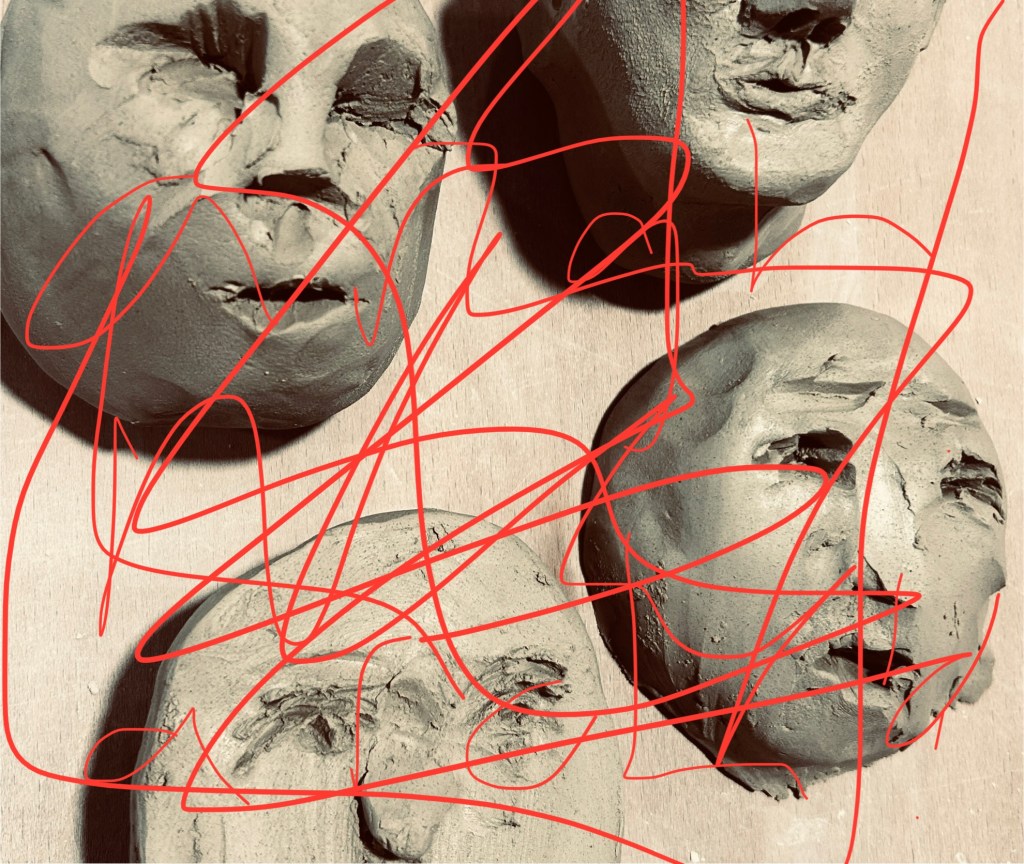
    You might think going into the studio and making a real human face isn’t going to kill me.  (I go to life drawing classes, I enjoy figurative paintings…).  But when I walk into my studio and try to make a figurative head I feel kind of sick.  If I’m honest – I feel kind of cheesy.  I tinker away with the human head and I hate it and hide it in a box.  I explore other less realistic, more abstracted faces.  I dislike them all.

    I enjoy the making.  There are technical considerations that are interesting to me – finishing a head or even a whole body one has to then slice it in half and hollow it out.  If the thing is going to stand on two feet – there has to be consideration of how it balances.  How will it sit in the kiln. It’s arms need to be propped up or they might warp.  I can imagine that making a truly realistic full size bust might be enjoyably challenging. 

    I don’t have a satisfying conclusion to this experiment.  I stop short of firing the things because I hate them so much.

    But I push on and decide to commit to making an angry menopausal wolf-woman, with high heels and a long bushy tail.  I think it might be the ugliest thing I’ve ever seen in my life.  Someone comes a long and says ‘oh, cute!’

    Onwards.