Category: Process

  • Dolphins and Otters

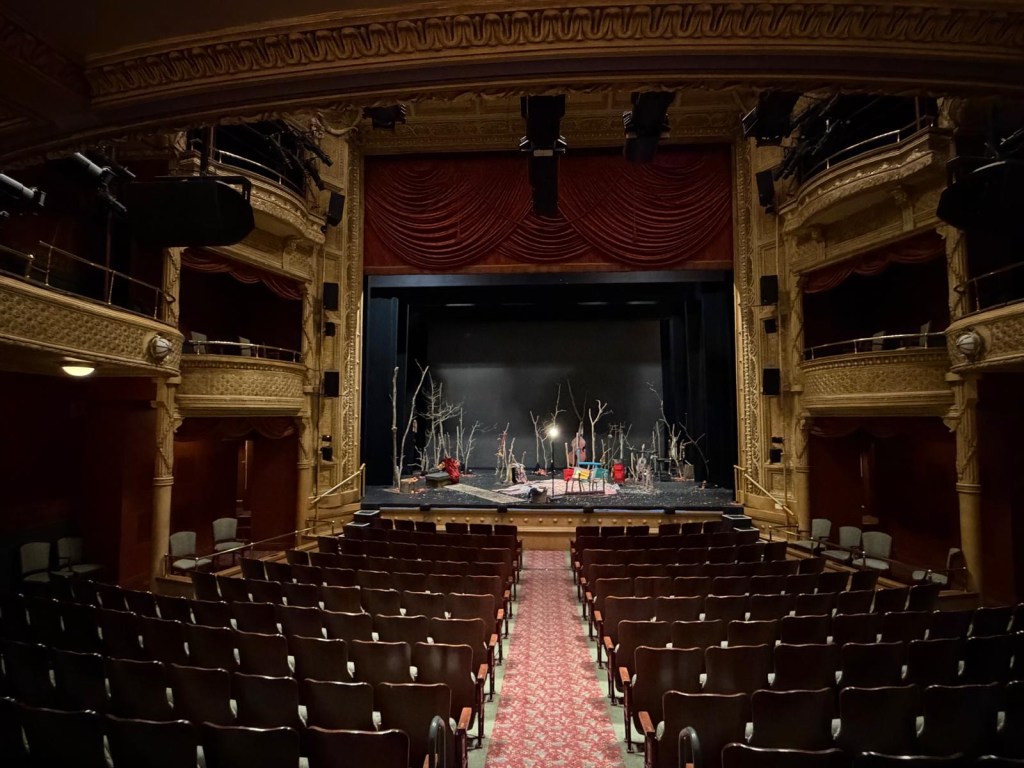
    Completely surreally I am in New York in a show on 42nd Street. I am doing what I know, I guess I am being in my element in many ways, it’s kind of dreamlike, like literally a dream you have as a child – and it’s fun as hell and I’m working the stupid long hours, living on sugar and carbs and it’s stressful.  I am so tired and my eyes kind of hurt in their sockets. 

    And I’ve got to say I am pumped up because I’m making hundreds of folk laugh and doing it well.

    I don’t know why I am writing this apart from it’s going to be all joined up.  I don’t know how.  How do I use what I know so far, about play, about clowning, about improv, about acting and about stories.  How does this all fit together?

    What I am doing here is the thing that I know and understand in my bones.  When I started to make independent theatre I didn’t know what the hell I was doing.  I worked from my hungry 25 year old gut instinct – and the things I made were some part made in thrall of the artists I admired and the other part made in punk reaction against the kind of theatre I hated.   How was it then? 

    Some of those admired theatre peers are still doing exactly the same thing,  So sure of their practice they will say things like ‘this is acting / that is not acting’ with such conviction.  I used to admire that and wished I was so certain about what my practice was, to wish I wasn’t so messy and so magpie-like in my tastes.  Perhaps if I was like them I’d be more…legit?

    There is a story about artists that I like that says we are either dolphins or otters, I think it was from Neil Gaiman.  

    If the dolphin does something successful and everyone applauds / throws him a fish etc – the dolphin will repeat the action.  Again and again.  More fish.  More applause.  

    The dolphin will put on the dolphin show.

    The otter will always do something new.  For the fun, for the curiosity.  The otter isn’t interested in repeating the thing to be thrown a fish.  You can’t really train an otter.  The otter wants to play.

    I watch the recording back of our session last week.  About keeping moving, about not knowing being the foundation of critical thinking.  About questions without a finite answer.

    Something also clicks for me when Sofi does her presentation.  Sofi’s work is beautifully raw and serious but also…it’s funny.  She uses humour.  She brings levity to serious ideas – from what I see so far.  

    I feel excited that this will all join up.  
  • You did it wrong.

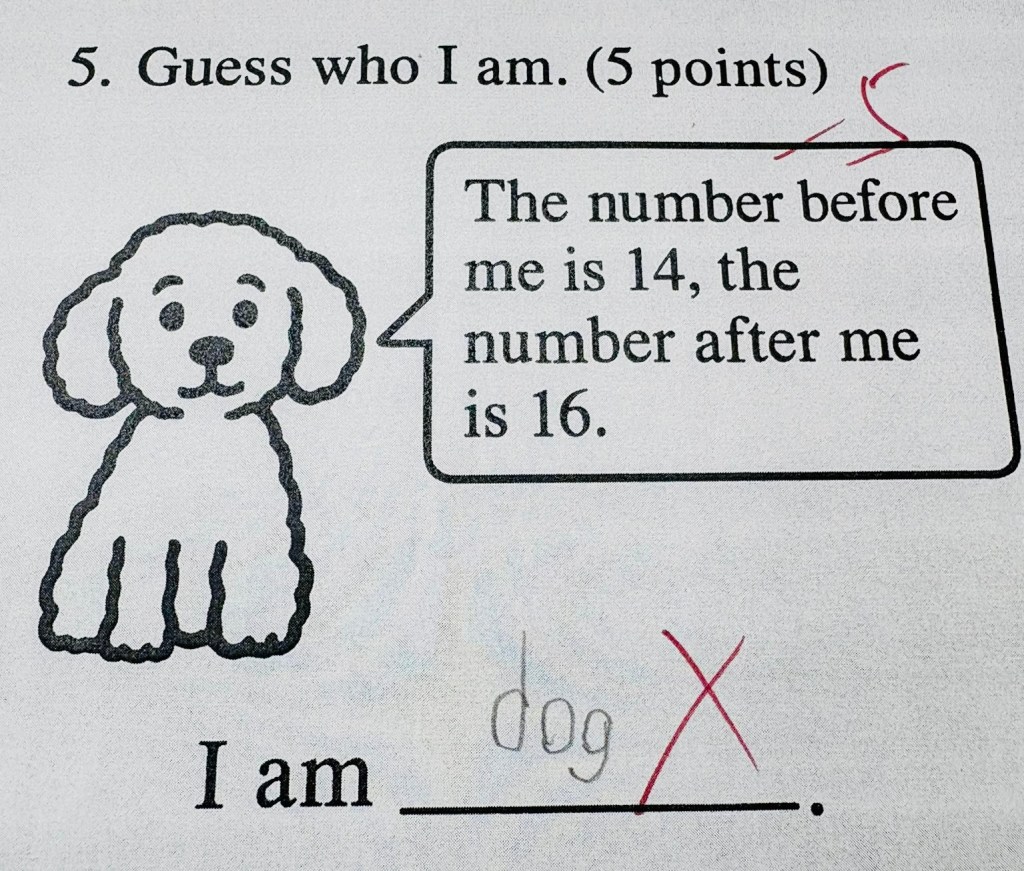
    I love everything about this picture that I found on stupid social media.  Is the kid wrong?  I think the answer ‘I am dog’ is somehow more right than ‘I am Fifteen’.  Pedagogically the test has created so many crappy misleading clues for the kid – grammatically (’Guess who I am’), visually (a talking dog is actually a number, stoopid) before we even get started on the dated assumption that all kids learn through words alone and that some will be neurodivergent thinkers etc.  But most importantly the teacher is really firm in their opinion that this kid’s answer is a big red-cross WRONG.

    We talked in the last session about failure.  I’ve come to expect my assumptions to be up-ended in this class which is why I’m loving it.  Jonathan presented the idea – ‘do we really learn from failure?’ – and that what happens in the case of being told we’ve failed is more like fight (‘stupid test) or flight (I’m never going there again).  The educational system is designed to have us want to get things ‘right’.

    I notice to myself that all my life I’ve been trying to do things right, to not be as weird as I imagine people think I am, to achieve in other’s people’s eyes.  In the case of my career – to be picked.

    I have more to say on this.  I have a fleeting idea of making a piece of work about it called ‘Well done Alex’ based on an patronising interaction with a ‘more successful’ peer of mine.  I’ll come back to this…

    But actually there are lessons from my theatre training on the subject of working with failure.  We discussed Keith Johnstone (quoted in my first post), improvisation’s UK forefather and saying yes to the unknown.  One of the tenets of improv is to fail gracefully – mistakes are actually a gift.  (My company used to improvise whole stories in one night and on one occasion I had forgotten the name of my character’s husband – a perennial improv problem.  I dropped John in for good measure, accidentally naming Brian’s character’s husband.  Bri said ‘do you mean my John?’ – and thus we had a story of a revealed love affair.).  As Jonathan pointed out – we over-accept the offer from failure and run with it.

    In clowning training the moment of the failure or ‘flop’ is the moment where we discover real fragility and truthfulness.  More another time.

    Jonathan tried an experiment where we reframe failure by distancing ourselves in writing about it in the third person.  I won’t write it all out here but to sum up. In reframing her failure to manage her time in the ceramic studio, Alex discovers that she could be kinder to herself about her excitement to try too many new things, and actually that time is in fact a huge part of the narrative of clay as a medium.  As is slowness, stillness and most definitely unpredictable results and letting go.

    Quoting Jonathan (or somebody else) – 

    the information in failure is a public good, when it is shared society benefits

    Provocation this week – do something in your art practice that might not work.

    Take a risk.  Record it.

    Disrupt something, break it open.

  • Where am I now?

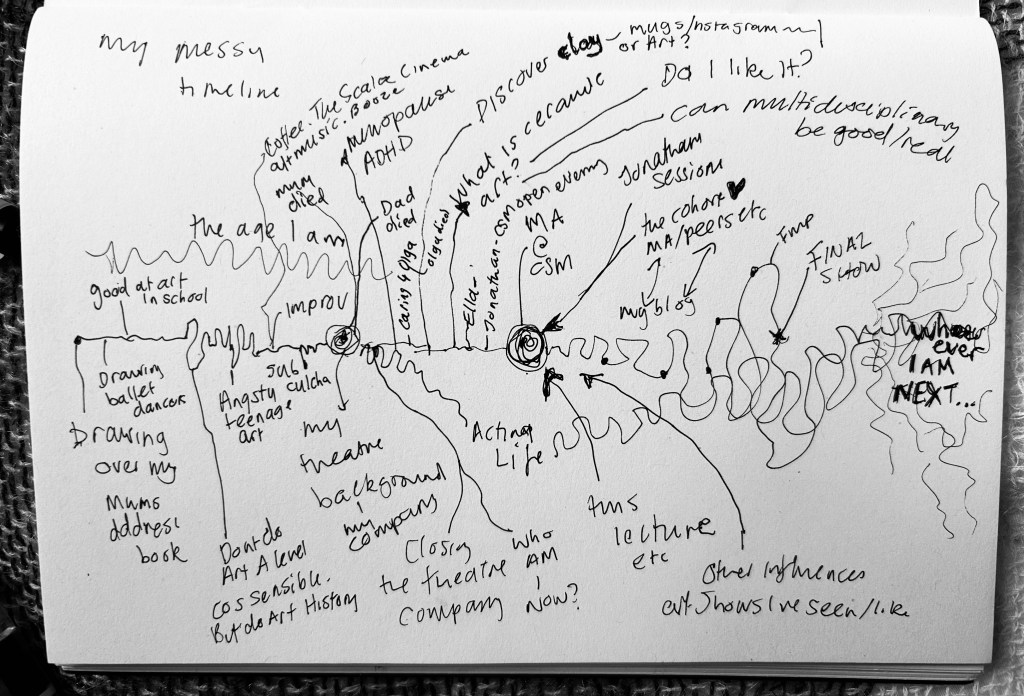
    Really interesting lecture from the Art in Context series run by Dean Kenning.  About diagrams as a methodology.  Diagrams being ‘synoptic’ – you see everything at once.  How we think in terms of a diagram creating order but there is not necessarily an order. 

    A timeline is the most basic diagram.  It spatialises time.

    Diagrams like timelines use metaphors to do with directions of travel – we say ‘go forward’ ‘go back’ – arrows towards some kind of end point.

    This joined up with Jonathan’s lecture for me about the reflective process as a cyclical plan – reflect, plan, achieve, observe > new question now, reflect, plan, achieve, observe etc.  Rinse and repeat.  And how that is problematic with art because ‘continual progress’ and a ‘final end point’ is deceiving.  It looks more like messy, tangential, zig-zagging.  Rito’s ‘radical incompleteness’.

    Dean Kenning showed us some examples of timelines that demonstrate that they are always …that word ‘partial’ again…always selecting, never neutral.

    Joseph Priestley’s New Chart of History – (1769?) – a view of the history of the world from the point of view of the Empire.  Alfred Barr’s graphic of the relationships that make up – in his view – the story of Modern Art.  As the founder of MOMA NY he should know – but like all custodians of artwork he is partial, selective.  

    (Note to self here – to check out ‘System’s Theory’. And the Zeno Paradox – where you are only ever halfway to a point, always halfway to another point etc to infinity.)

    So anyway.  No arrow.  Just the rewriting of a story in particular and personal terms.

    What to take from this?

    The above messy timeline of my own.  I notice I didn’t place my now in art history terms, just in terms of my journey and what got me here now.   All the influences that make up me.  Looking at it again I see that I have blown some things up and minimised other events and I guess this would look completely different say 5 or 10 years ago. I feel excited about what things will become important and prominent in the next 5 or 10 years time. I have no idea.

  • How to begin

    Beginning of my MA Fine Art : Digital at Central Saint Martins. First session.

    Kindness, compassion as ‘psychological safety’ – exploring the idea that these might be the foundations of an art practice as opposed to the idea of progression only coming through the pushy dynamic of ‘challenge’ in a more hard, aggressive way.  I’m really excited by this.  I’ll sign up right away please for psychological safety.  I come from a freelance theatre background, and whilst lip service might be played to ‘safety’ by salaried policy-makers, for the most part one is dealing with rejection and criticism on an almost daily basis – it’s part of the deal.  You have literally signed up as an actor to put your self out there and have your self pulled apart, judged and given the ‘yes’ or ‘no’.  Maybe the visual art world is no different but I’m excited by Jonathan’s choice to put upfront values of compassion and kindness.

    I’m also an improvisor, where saying ‘yes’ opens the portal to creativity.  I have two copies of Keith Johnstone’s 1981 book ‘Impro’.  Underlined in each is the line – 

    ‘There are people who prefer to say ‘Yes’, and there are people who prefer to say ‘No’.  Those who say ‘Yes’ are rewarded by the adventures they have, and those who say ‘No’ are rewarded by the safety they attain’.

    Through my improvisation practice I’ve experienced, hundreds of times, the adventure.  Also the ‘no’ sayers, and the safety dulling and literally blocking the work.  Saying ‘yes’ – to everything – became a foundational idea.  But it is not 1981 and this beautiful, complicated quote contains a lot to be unpacked now – questions about consent, ideas of safety having a value. 

    What does now feel like for me?  The geopolitical world feels like a bin fire.  Closer to home my theatre making practice feels vulnerable-making – and sometimes not in a good way.

    I don’t have any answers here.  This is just the beginning.  This is just asking some questions.  Getting down some notes.

    I don’t know yet what I’m going to put out in the world.  What I’m going to bring with me on the journey.  I do know that I’m going to take (from my theatre practice, from improv) the notion of play.

    Just playing.

    Seriously.  Just playing seriously and just playing for plays sake.

    In the session Olga said a lovely thing about the loss of innocence and play which I roughly remember as ‘when we are adults something is always for something’.

    Art-making is possibly the most vulnerable-making thing.   A community of practice with guiding principles of kindness and compassion held lightly around the edges seems like a fine idea – not to close off challenge but to enable it.  

    As Jonathan said instead of a scarcity mindset we’ll be ‘mindful, hungry, generous…the more we put in, the more there IS’

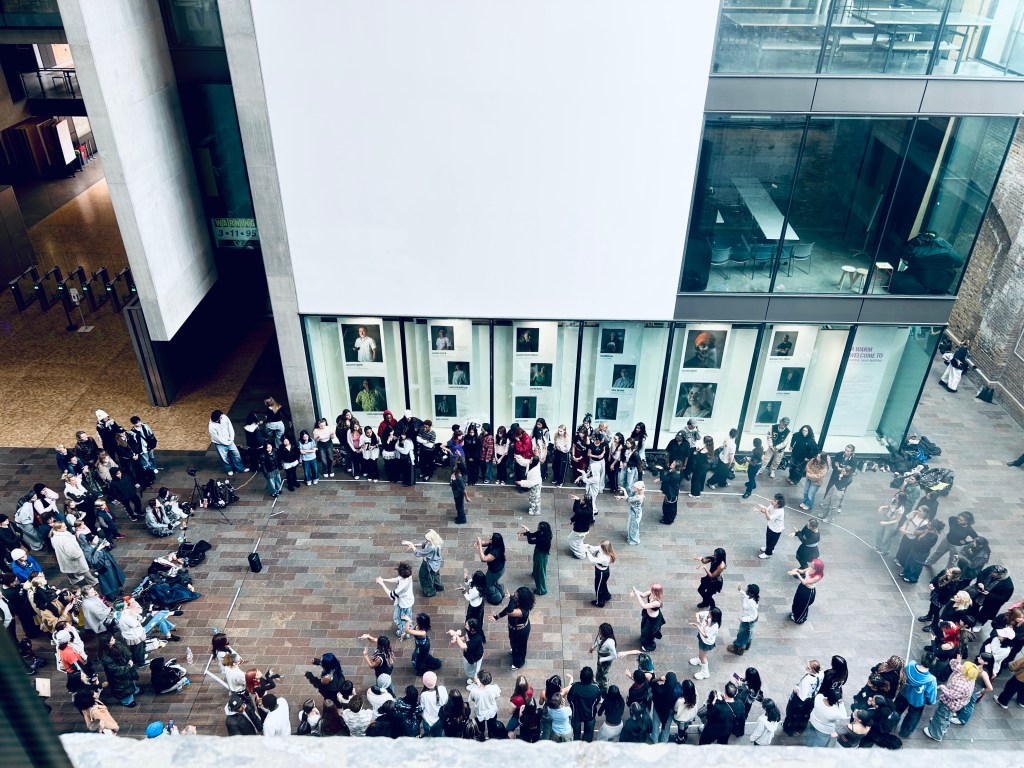
    (image : photograph taken from the library of Central Saint Martin’s students dancing in the Street, 06/10/2025)