Category: What is art for

  • Je ne regrette rien 

    Remembering Philippe Gauler 1943-2026
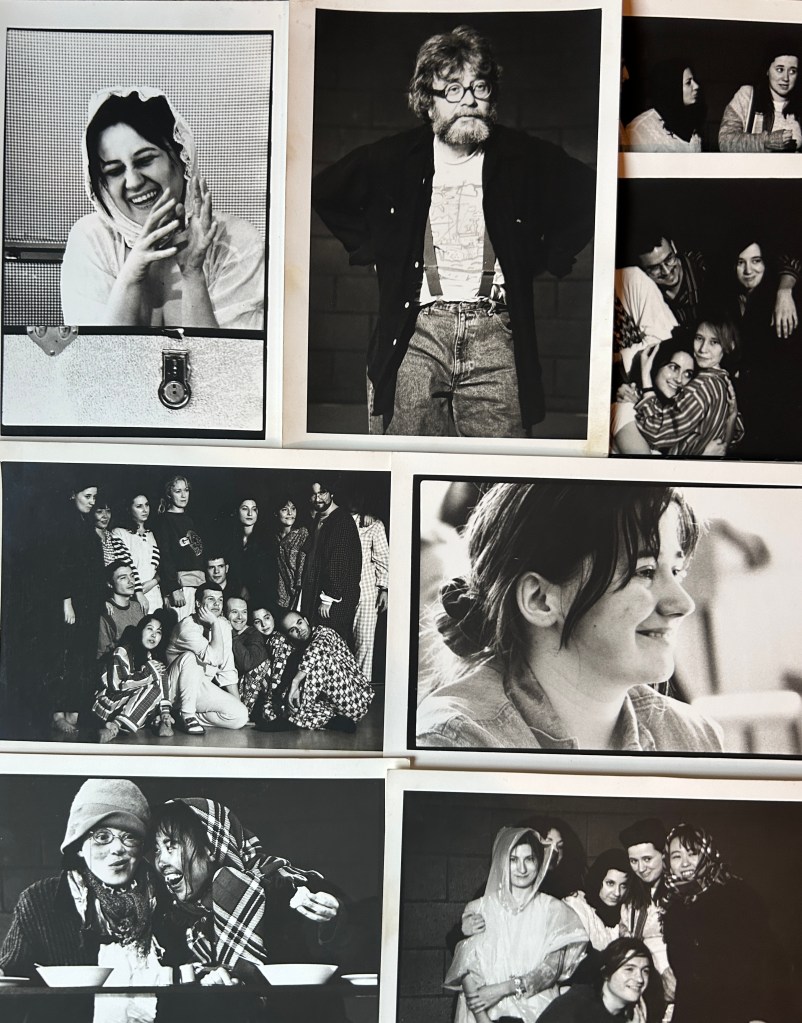
    Yesterday I went to Paris to attend the extraordinary funeral of the teacher who changed the course of my life Philippe Gaulier.  In the sometimes murky world of artist training Gaulier is perhaps the most widely and wildly misunderstood pedagogue of all.  Perhaps we all assembled from around the world yesterday – how many? maybe 600 of us – because we wanted to hold onto that magical thread of his teaching specifically by being together…because we were there…because we know it.  Perhaps we all feel tired by having to listen – every time his name comes up – to the broken record of criticism spewing from the mouths of people who never even went to his school regarding his somewhat unorthodox teaching style. As Simon McBurney put it he was –

    ‘provocative, demanding, deliberately inappropriate and utterly hilarious’ 

    The elusive cornerstone of his school was to find that ‘complicité’ on which McBurney, Arden and Magni founded the namesake company – the inferred danger and delight in being connected (with each other, with the audience) when we play.  Do we have pleasure to be on the stage?  If not why bore us? ’Adios, sit down immediately, my little friend’.  Gaulier actors read audience in a way that no other actors do and that is what I am proud to know. It will be in my bones.  It was in the bones of us, connected together when we – a giant congregation – burst into ‘Non, Je ne regrette rien’ along with Piaf as we saw the old fella off on his way.  And we might be messy and we may not do things ‘correctly’ but we will do it with heart and a kind of passion that is very rarely really seen on stage.  Spontaneous, huge applause, whooping, cheering, Bravo, Bravo went off as he was carried up the long theatrical staircase to disappear into the glittery backdrop of blue-sky mosaics of La Coupole in Pere Lechaise cemetery.    

    I began at Gaulier’s school aged 25, just two months after losing my mother.  Philippe taught me to feel again and how to be free.

    Why am I writing about this here?  Because what I am looking for is not and should not be definitive or even precisely known.  This is the same for fine art, for performance, for poetry, for playwriting, for art installation, for ceramics, for concept art, for music – definitely not for music – for opera, for dance, for education…for making anything at all really, I think.  
  • Univited Guests

    This week was treated to a visit from imposter syndrome.  All of his friends came too – perfectionism, procrastination, paralysis – the whole gang.

    I have lurched between the identities of six different kinds of artists.  Been haunted by distorted imaginary voices of perfectly supportive ceramicist friends, who think I’ve made bad choices and generally am making a fool of myself.  

    The nature of these thoughts are worth writing down because they are so ridiculous in black and white.  We are not our thoughts.  An idea that seems impossible to grapple with, I believe rooted in mindfulness and therapeutic practices – though at odds with Freud. 

    What am I doing making art?  And in the middle of the night – ‘What IS art? See, you can’t even answer that’.  Well I’m doing a Fine Art Masters, so let’s just see.   I find in these moments of self doubt I scroll on instagram more – it’s a great idea.  My feed shows pristine lifestyle ceramicists throwing pots next to white sofas, desperate influencers showing 3 steps for making abstract art that sells…and even the legit art scene posts seem all about what’s fashionable and what’s correct and accepted right now.  

    And part of the problem also is that everything is acceptable.  I sit down at my life-drawing class (organised by the students union, and excellent) next to a gloomy woman who says that no-one seems to care what art is anymore.  

    Under a cloud I head to the studio at County Hall Pottery, where I work as a technician in exchange for studio space. 

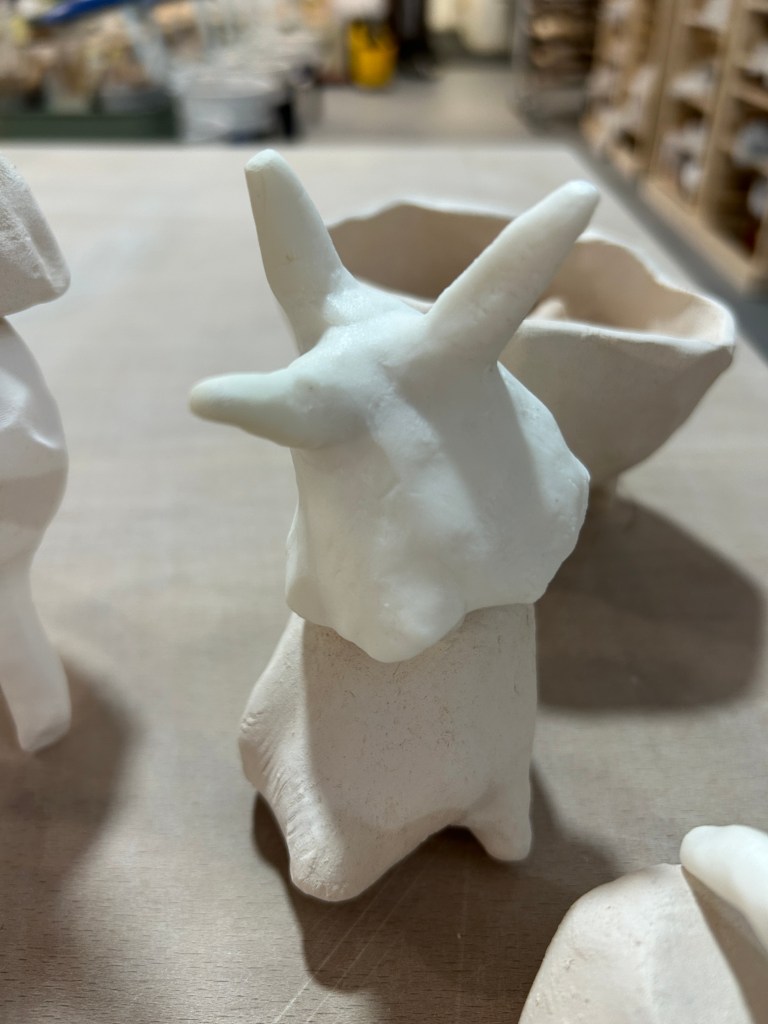
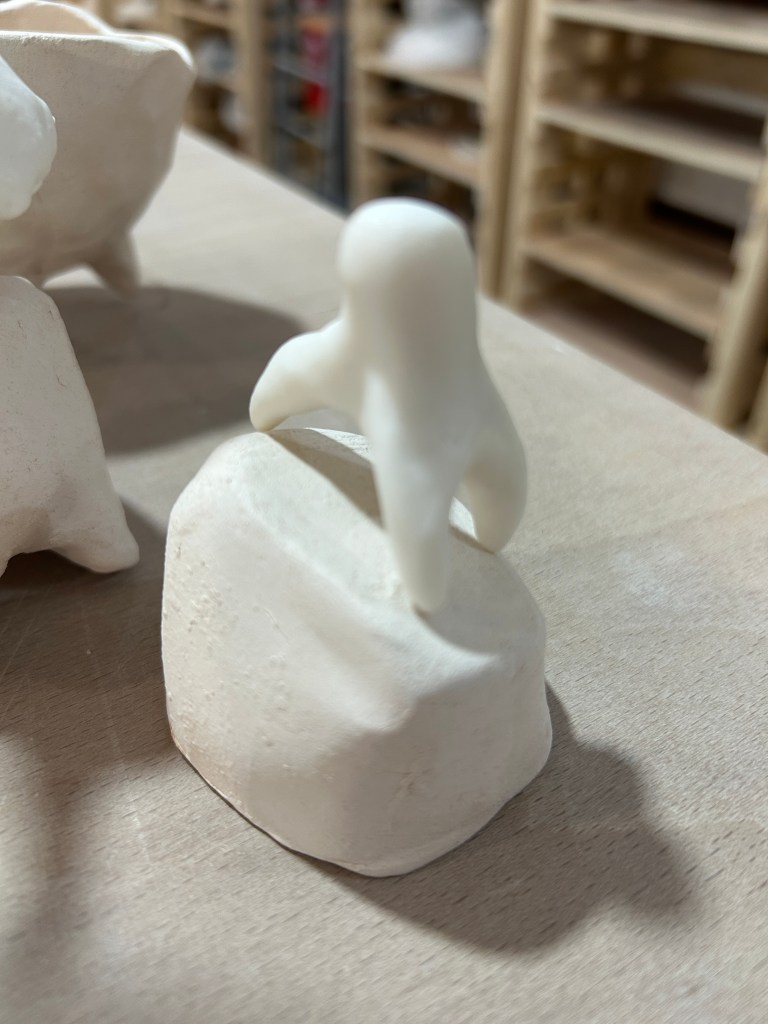
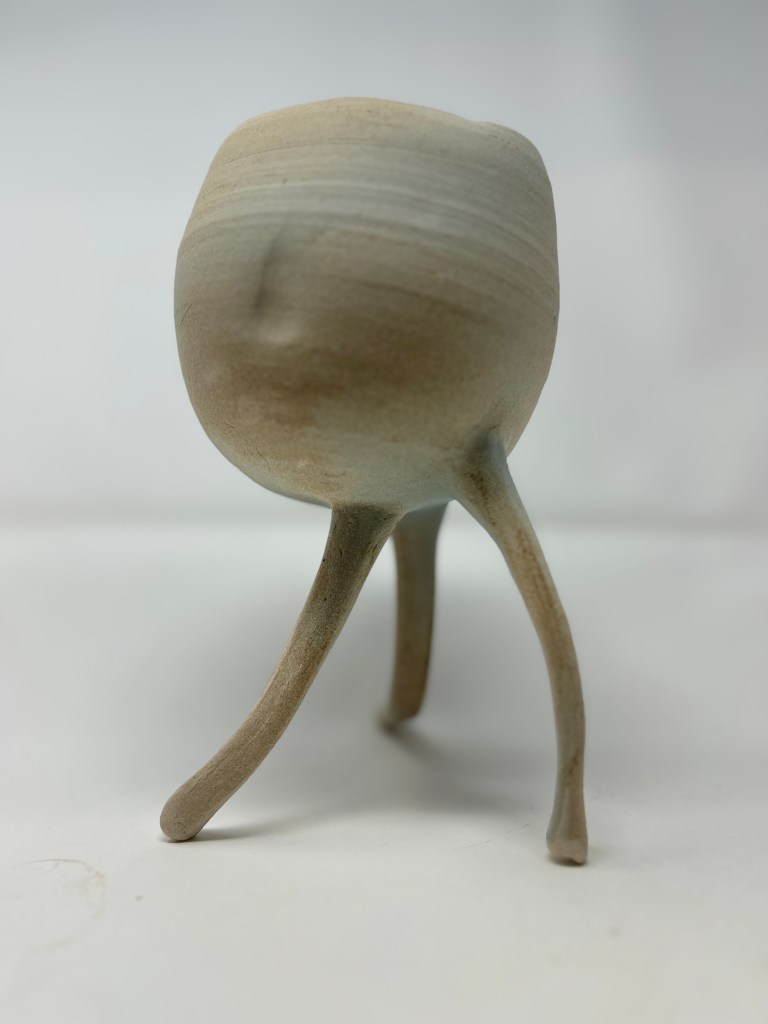
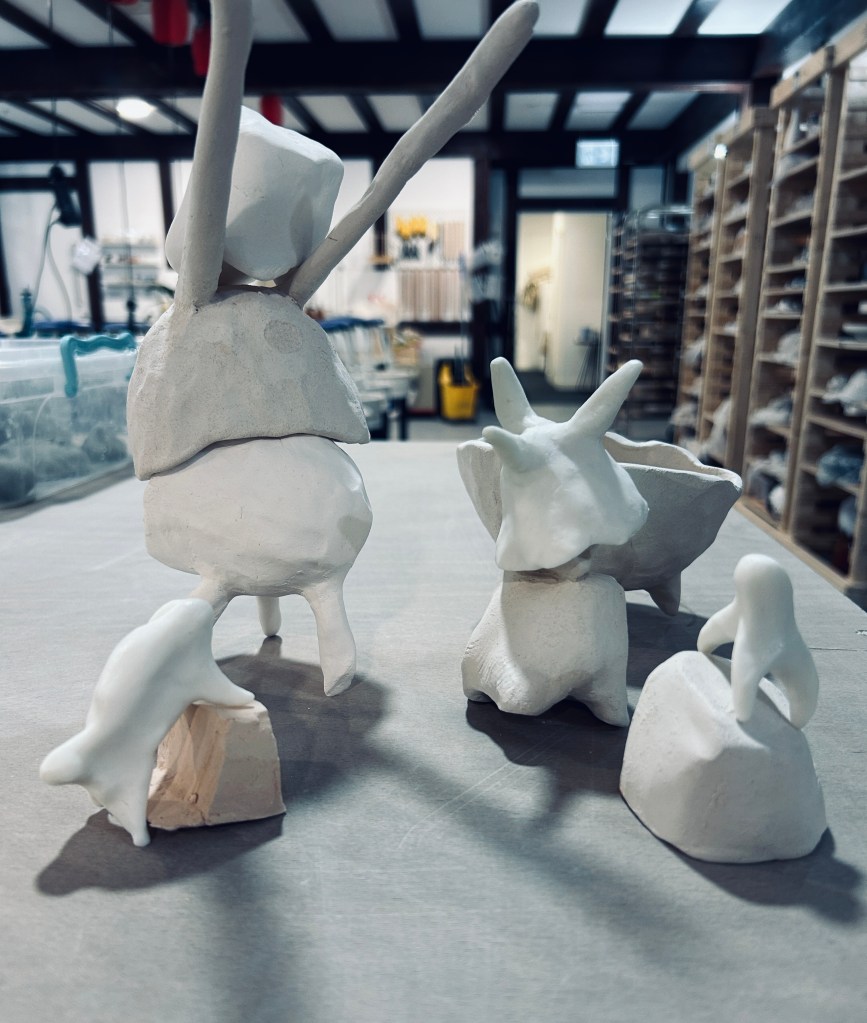
    At the studio Charley Blackburn, the new ceramicist-in-residence, is preparing for an update with the managers.  Her sketchbooks and glaze tests are set out for the meeting and it’s breathtaking work, but also chatting to her, I notice there are more questions than answers.  There’s certainly no end goal.  I show her a box of bisque shapes I’ve been playing with.  And a stop-frame animation I made to document the process.  I might make more stop-frames.  Charley gives me some feedback about what would making a film of them moving add to the work, which she feels already has movement and energy.  I have no idea how she has seen that. 

    While her meeting goes on I listen in to a fantastic conversation from my lovely brilliant colleagues about Charleys work – and I go into hyper focus.  Or flow. Just playing with the shapes.

    One of the challenges of ceramics is the technicality of putting something together, which really requires prototyping, sketching out, planning.  Factoring in the 7-10 different stages of drying time.  But how do I improvise if I have to plan first?  Where is the creativity that comes from spontaneity.  Each ceramicist approaches this chicken and egg in a different way.

    But most importantly something is unblocked by showing up at the studio and my wonderful community and friends at County Hall.  By Charley’s serious generosity and belief.  

    I felt so galvanised by that.  I also want to mention Daniella who has (along with Olga and Hicham) pretty much remotely organised a group show for us in the Good Rice Gallery with a couple of days notice.  She is one of the extraordinary people that just believes, is unfailingly optimistic and generous.   Instead of overthinking this, I go with the flow.

    I think my my thought this week is about community.  If I can’t be kind to myself then to take myself to the people who lift me up.  The studio becomes then not an aspirational space I can’t afford, but an environment I create by people I choose to connect with.

  • Permission, presence, purpose

    Trying at the moment to work from my gut, and trying not think to many steps ahead.  Trying, trying, trying to not try so hard.  We have a discussion about what blocks the imagination, taking as a starting point the word resentment.  Which interestingly turns out to mean re-feeling (French: sentir, Latin: sentio).  This makes me think about presence.  If we are re-feeling, we are cycling past emotions.  And I can see that this can happen with re-feeling in the direction of the future also – being in that stuck place of ‘this will happen, that will happen’ – which will always be cyclical because it doesn’t exist.  There is only now.  And now.  And now. Etc.

    My internal narrative when unhelpful, when not-present, is often littered with questions about validity – what’s good, what’s good enough, what’s excellent, what’s not, what’s ok, what’s correct.  When you write it down it’s pretty ugly.  Again in improv ideas are generated on the foundational premise that there are no bad ideas.  Keith Johnstone (aforementioned improv forefather) would coach actors with ‘be boring’ or ‘too original!’.  I trained as an actor at École Philippe Gaulier, an eccentric but unrivalled master of engendering the essential quality of presence in the actor.  Famous for ordering actors to ‘leave the stage immediately’ seconds after their entrances, because he could ‘see a little idea coming’, it was a school of hard knocks.  We once asked him about talent.  He said ‘There is no such thing as talent.  Only what you authorise in yourself to do’.  I think about this nearly every day. 

    We discuss results of an automatic writing exercise on what blocks the imagination.  The discussion is framed as ‘Where do we need new creativity, new imagination?’.  We think about the ‘we’.   Tim – ‘the lofty idea of the artist as solo genius, artist as hero, that model, Rothko – is really unhelpful’.  We think about the ‘new’ – are there new ideas – probably not.  We think about the ‘need’ – is the work doing the job it is meant to be doing?

    What is that job exactly?

    Jonathan reads a provocation from Ben Okri in the Guardian about the artist’s responsibility towards only working on the subject of the climate emergency.  What does existential creativity look like in our art practice? How do we translate that or interpret it?  Also read out – an extract from Douglas Hine’s ‘At Work in the Ruins’ – about the problem of seeing art only as a tool for getting across a message.

    Art is not a cheap alternative to an advertising agency or a sophisticated extension of the communications department, and the urgency of the message doesn’t change this.

    I really enjoyed Luisa’s response to this ‘our art practice is to protect thinking’.  I take from this that we need to give our audience space.  To not be conclusive.  To leave space for a dialogue – even if the artist has left the room, or the planet – we are in conversation with them through the work.  We remember how shut down we were at school when preached at. 

    Hine quotes in turn playwright Anders Duus – 

    Our job is to complicate matters

    I think this has really helped me think about how I approach meaning.  I’ve worked in a discipline where storytelling is at the centre of things – and clarity is essential in script/playwrighting.  I suppose I am still telling stories but maybe in my art practice in a different way, giving space for the audience yes, and also space for the intangible, as Hine puts it, for the ‘messiness and strangeness of life’.