Category: What is art for

  • Why should we care?

    Things are sort of joining up with my theatre practice.  This is my third tutorial with Jonathan.

    I’ve been compartmentalising the two things which makes no sense.  I talk to Jonathan about the themes in my recent blogs – looking more closely at my theatre making influences. 

    I also enjoyed writing in the Rebecca Fortnum class.  I hadn’t done it in a while because of a block, and a situation with someone which put me off.  But mostly I didn’t write because I felt I didn’t want to make my plays work in the conventional dramatic arc way.  People who commissioned my plays would say they want form-breaking plays but then by the second draft they wanted a dramatic arc.  And actually as a theatre maker I’d always been taking risks with the form.

    I’m pushing about the research question, it’s shifting a bit.  

    It’s becoming more about how the audience has agency.  And the Jennifer Doyle book, the thing about feeling.  And how that is in contemporary art – it’s really slippery – how artists deal with feelings and audience.

    Jonathan – how do you define the difference between audience agency and audience interaction?

    I think in so-called immersive work audience interaction is so ‘pat’ – we did this and that made the audience do that.  It manipulates the audience – it’s like there’s not respect.  It sort of feels as exclusive as how people describe regular theatre.  The people who attend live art or immersive art – it’s like an in-joke.  A club.  It’s inaccessible.

    We talk a bit about how Tim’s play Toto Kerblammo uses binaural sound – and Jonathan has played a lot with that.  The difference being spatial for the sound.  So Tim and his sound designer have imagined how the sound of human feelings are for a dog.  ‘This is what you sound like when you feel abandoned’.  Beautiful. 

    Jonathan – I asked about agency and interaction.  You took audience interaction as an actor interacting.  I was thinking about the work in say an exhibition.

    Interactive art can be quite shallow e.g. digital computing ‘I move and something changes’.  Audience as paint brush.  So is the difference respect – in the word agency?

    I say yes – respect for their intelligence and imagination.  You could say when you control the entire experience – which theatre tries to do, tries to shape – there’s less space for the audience.  But perhaps a piece of abstract art may leave tonnes of space for the audience to do what they want with it.  But also there’s a sort of coolness – ‘make of it what you will’ – that the intentions of the artist is so distant to the response that you could say the artist doesn’t seem to care?

    Jonathan – is time to do with that?  It starts at 7.30pm – is there a fundamental difference there?

    And if you’re not controlling what time the audience spend there, say maybe something happens at 4 but otherwise you can go in and out.   Then what? 

    Jonathan loved the Rachel Maclean show in Liverpool which does loop round and round, but had a clock counting down and if you see it on that particular time there is an experience like theatre.  She uses curtains opening automatically at certain times.  

    I wish I could see it.  

    We talk about actor Ralph Little playing being tortured in a production of The Spy Who Came In From The Cold – which Jonathan saw recently and felt really uncomfortable at.  There is an experience of coming outside of the show/story and being live in a room when Little has his head held underwater.   Are you watching anymore or worrying about being the audience member who witnessed the accidental death of a beloved TV actor?

    Of course it will have been done really safely – a tube, a safe word etc – although it was pretty well done.  Still viscerally different from watching it on film.

    I say that very few film-makers have ever got away with doing ‘meta’ film.  We buy into the game that it is real.  

    We talk about the sense that the audience have more agency in the object animation theatre piece I saw ‘Matter Era’ – because they know more about what’s going on than the puppeteers with magnets under the metal stage.  It was time and time again about jeopardy and failure – and like improv – the audience understood that in the moment.

    I found the design breathtakingly simple.  And it was a really long time before anything happened. Too long in theatre terms.  Playwright / Director David Lan (formerly at the Young Vic) – used to say when a show starts there is a finite amount of time for the audience before they lose interest.  But we didn’t really even notice Matter Era start…just these oily blueberries started to just…be there.  You couldn’t quite say what those things were representing, the furry things that were breathing, the sticks, silly bits of string.  You projected what you saw in it.  

    It pushed the limits of what time should do in theatre.  

    The sound designer was improvising off the action in the room.  

    It was just wild.  

    The way the final image arrived out of the various objects, was kind of an accident, an improvised story sort of, of failure and effort.  

    It felt like the objects had an inner life.

    In collusion with the audience.

    I describe Animo an improvised studio show I used to do with Improbable Theatre, where sometimes we would bring pieces of newspaper to life.

    Matter Era was. Right on the edge of visual art.  And theatre.

    People kind of respected the space, but didn’t interfere – respecting the rules of the game – which was to discover it.  It wasn’t like some performance art piece where it was more ‘I left this here do something with it’

    We talk a bit about the problems of badly done performance art – the lack of consideration of the space, where the audience are to be, how the elements are going to play out and whether that has even been tested. Surely there’s a way of making good quality decisions about how performance art is going to work – even if you then want to break all the conventions and ‘rules’?

    With Matter Era you had that sense of being in safe hands even though they were improvising, and even though they were pushing their control of the work to the limits.

    And yet like improv – if it’s really genuine and you put aside comedy sketches – you have to embrace the possibility of it really failing.  If it’s to be really improvised.  

    There are ways of controlling improv so it doesn’t fail – putting in tricks and landing places, rehearsing stock moves, casting big star improvisors who always make a ‘good night of it’.  All of the mid-scale improv does this.  But real improvised work is different.

    The audience embracing the possibility of failure.  That’s the sweet spot.

    Jonathan makes a note of this – as he feels from his perspective that this line of enquiry could make a research paper that’s really worth reading.  Bringing that theatre maker perspective – how the audience have agency (rather than just interaction), teasing that and understanding that.  That could be really valuable for Fine Art practice. That has implications of what we make. And how we curate and set up exhibitions.  

    A PHD colleague of Jonathan’s – writing about Curation – was thinking about ‘palette cleansers’ – how in a world where we’re bombarded with millions of images – can we visually cleanse the pallets and experience the flavours.  A bit like the theatre – the rituals of the stairs and the tickets and the seats.  Jonathan singing You’ll Never Walk Alone at the football in Liverpool with the years of history collectively – we’re doing something together in the moment.  A lot to tease out and maybe beneficial.

    Coming full circle – I’ve been thinking about this all my life.

    But what are the lessons that can be learned across those boundaries for art practice?

    Because as Doyle says – there’s a sort of coolness – it often feels it doesn’t sort of matter to the artist what happens with the audience experience.  

    It’s about to do with caring about what the audience get.  Without contriving it.  

    I talk about my Improbable Theatre friend Lee Simpson’s idea of finding a perfect moment in theatre.  He tells this story.  It’s like a shy deer has wandered on – and we all hold our breath because a wrong feeling or noise and it will run off.  The key point is liveness.  It’s just wandered in.  Now we could shoot the deer, stuff it, wheel it in on a trolley at the same moment every night.  But it won’t be the same because it won’t be spontaneous.

    There’s a fragility. Allowing the audience’s care to be part of the experience.

    Jonathan – what are the lessons of that for an exhibition that may be open for a month or more?

    There can be some kind of liveness on the opening night, but the rest of the time?

    Could you have the quality of the deer in a piece that stays for a long time with no-one present.

    Is it about time-based work?  Or can you have a sense of spontaneity in the way the work looks or is set up so it has a sense of liveness?

    Gosh I need another year.

    Quote Jonathan found recently – ‘All art is the creation of forms symbolic of human feeling’ – Susan Langer?

    The objects in Matter Era had feeling.  I remember a theatre making peer of mine Paul Hunter (of Told By An Idiot) saying that if a character is angry instead of writing dialogue literally, like you would say in Eastenders, we might just see them burst into flames.

    What’s really speaking to me in Doyle’s work is there’s this coolness in some contemporary art that leaves me cold.  Is it coolness towards the audience?

    There is space and agency for what the audience does with it – do what you like with it… but where does that tip over into ‘I don’t even care what your response is or even if I did anything for you at all – you’re so far away from me’.

    A colleague of Jonathan’s wrote a course called Public Art.  It would sit within socially engaged practice (he notes an essay worth reading that’s very against socially engaged practice).  Joseph Beuys talks of Social Sculpture – the idea of audience and artist are together forming things.  It’s let see what happens – put things in place and see what happens.  Anyway one of his definitions of whether art is public or not (Duchamp said it becomes art when audience sees it) – he said a work of art is not a work of art unless two strangers talk about it together.  

    He was thinking about work in a Gallery.  Can be love, anger or whatever it is that provokes you but you spoke to someone you don’t know and a whole different experience appears.  A thought experiment – it needs that level of engagement before it becomes something real.  

    And I think there’s that thing about access – and how I think a lot of ‘immersive theatre’ is an exclusive club.  Who’s going to turn to the person next to them? A middle class person could do that like a shot. 

    But also non-‘arts attendees’ might say ‘what’s that? My five year old son could do that’

    Who owns it?

    Jonathan talks of a 13th Century painting bought by the city of Hull when it was City of Culture.  It cost 3 million pounds.  He remembers a guy with his kid, didn’t look like he went to shows like this.  He walked straight up to it.  He said to his son ‘That’s ours that is’, then to Jonathan ‘It’s good isn’t it?’  That sense of civic pride.  700 years after the thing was made.

    Jonathan thinks there’s a lot in this line of enquiry.  “It’s a really interesting paper but it plays into your practice, there’s value in it.  

    Accept your expertise and bring that across to this – that is real value – whatever it looks like.

    It’s a big area sure, so you’ll have to narrow it down, but embrace your decades of expertise and all of us will benefit.”  
  • Talking to my Dad about making art

    Session with Rebecca Fortnum, artist and researcher, about ‘correspondence’.  Rethinking how we do research as artists.  Collecting data and other traditional methods may not work – and she raised the question who is the best judge of the work.  Is the audience?  Not always.  The critics?  The artist themself – and at what point?  Retrospectively or immediately after making a thing?  

    Fortnum has made work in ‘correspondence’ with other artists, often marginalised female practitioners, giving voices to say the Practiciennes supported by Rodin.  She explores their voices through letters, through investigating images from a different angle, her viewfinder closing in on large figurative sculpture and honing in on say, a detail in an expression. She gives us another way of looking at a 3D piece by flattening it into a painting.  I write down the word ‘prosopopoeia’ – making the inanimate have a voice.  Are we doing that in what we chose to hone in on?  Giving a moment or a feeling or an idea a form.  I feel that I’ve done that in the past with writing and today is a writing exercise day.  

    When we work in homage to another artist, or in response to or have correspondence with, we are still making our own voices heard.  As Tim brilliantly says ‘you are writing to the significance they have for you’.  

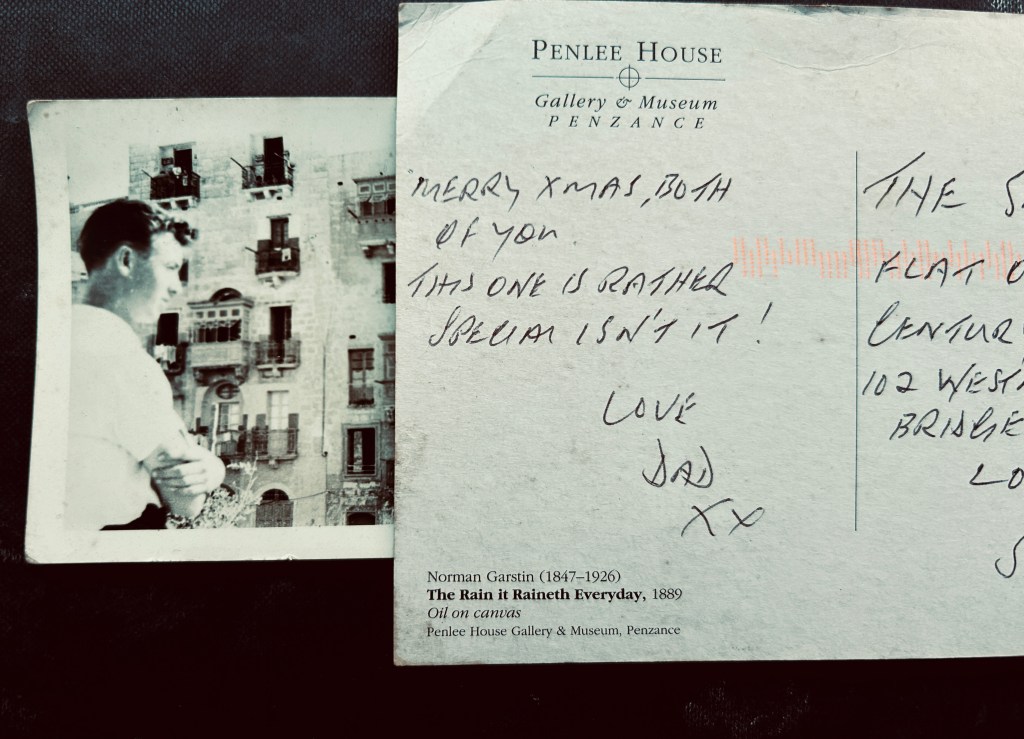
    We are asked who would you like to have a conversation with in relation to your work.  I work on an imagined dialogue with my late father. In his last months he told me about an opportunity he had by chance (coincidence comes up several times today) which saw him and a bunch of other South London kids who’d had a tough life, as part of a progressive education project, transported to the countryside and a classical education.  Something I have tried to research but never got very far with.  Partly maybe I resist that research because he kept this story from me for most of his life for his own reasons.  To me it is a moment of glorious post-war optimism which he chanced upon (how chance could have taken him another way) and that changed who he was and who I am in turn.  

    So I wrote about this and mostly I think I am actually writing about the hopelessness of ever getting a full answer from him now that he’s left us.  He was an unreliable narrator at the best of times.  

    *******

    Talking to my Dad about making art.

    But what did you make Dad?

    It was a golden time.  One of the tutors there was a contemporary of Henry Moore you know, very respected.  

    You said

    And then it was all over and Nan came to fetch me and we went back to Camberwell.  She was with Stan then.  Grandad Stan.  I didn’t like him.  

    But what did you make Dad?

    Well, that was it, it was all over.  It was the same when I got into Grammar School.  When I passed the eleven plus.  She got the hump about that.

    I know

    She had to fork out for a uniform and she was livid.  

    And that was Wilson’s Grammar School.

    What is Camberwell Art School yes.  Terrible place, Wilson’s.

    And Johnny said you had an exhibition in the little library on Camberwell Green?

    Yes

    What was it of Dad?

    Paintings.

    What kind?

    Near Kennedy’s Butchers.  Best sausages.

    In the whole of London.  But what were the paintings of Dad?

    It was a golden time at that school, the one I went to.  We listened to opera and read Shakespeare.

    And you learnt sculpture.

    Yes, she was a contemporary of the great Henry Moore.

    What sort of work did you make Dad?  

    I was pissed off when Elsie turned up with Stan. Nasty piece of work Stan.  

    And you went to Cambridge?

    I enrolled in the poly and I was a milkman.

    Did you still make art Dad?

    Lovely city Cambridge.  Full of people and ideas.

    Maybe you could have made some art later on.

    No Al, no.

    Why not Dad?

    Never time.

    Would you make some art now Dad, if you were still here?

    Maybe.

    What would we do today Dad?

    We would take a trip into town and see Rose Wylie if it’s still on.  A feast of colour. 

  • Je ne regrette rien 

    Remembering Philippe Gauler 1943-2026

    Yesterday I went to Paris to attend the extraordinary funeral of the teacher who changed the course of my life Philippe Gaulier.  In the sometimes murky world of artist training Gaulier is perhaps the most widely and wildly misunderstood pedagogue of all.  Perhaps we all assembled from around the world yesterday – how many? maybe 600 of us – because we wanted to hold onto that magical thread of his teaching specifically by being together…because we were there…because we know it.  Perhaps we all feel tired by having to listen – every time his name comes up – to the broken record of criticism spewing from the mouths of people who never even went to his school regarding his somewhat unorthodox teaching style. As Simon McBurney put it he was –

    ‘provocative, demanding, deliberately inappropriate and utterly hilarious’ 

    The elusive cornerstone of his school was to find that ‘complicité’ on which McBurney, Arden and Magni founded the namesake company – the inferred danger and delight in being connected (with each other, with the audience) when we play.  Do we have pleasure to be on the stage?  If not why bore us? ’Adios, sit down immediately, my little friend’.  Gaulier actors read audience in a way that no other actors do and that is what I am proud to know. It will be in my bones.  It was in the bones of us, connected together when we – a giant congregation – burst into ‘Non, Je ne regrette rien’ along with Piaf as we saw the old fella off on his way.  And we might be messy and we may not do things ‘correctly’ but we will do it with heart and a kind of passion that is very rarely really seen on stage.  Spontaneous, huge applause, whooping, cheering, Bravo, Bravo went off as he was carried up the long theatrical staircase to disappear into the glittery backdrop of blue-sky mosaics of La Coupole in Pere Lechaise cemetery.    

    I began at Gaulier’s school aged 25, just two months after losing my mother.  Philippe taught me to feel again and how to be free.

    Why am I writing about this here?  Because what I am looking for is not and should not be definitive or even precisely known.  This is the same for fine art, for performance, for poetry, for playwriting, for art installation, for ceramics, for concept art, for music – definitely not for music – for opera, for dance, for education…for making anything at all really, I think.  

  • Univited Guests

    This week was treated to a visit from imposter syndrome.  All of his friends came too – perfectionism, procrastination, paralysis – the whole gang.

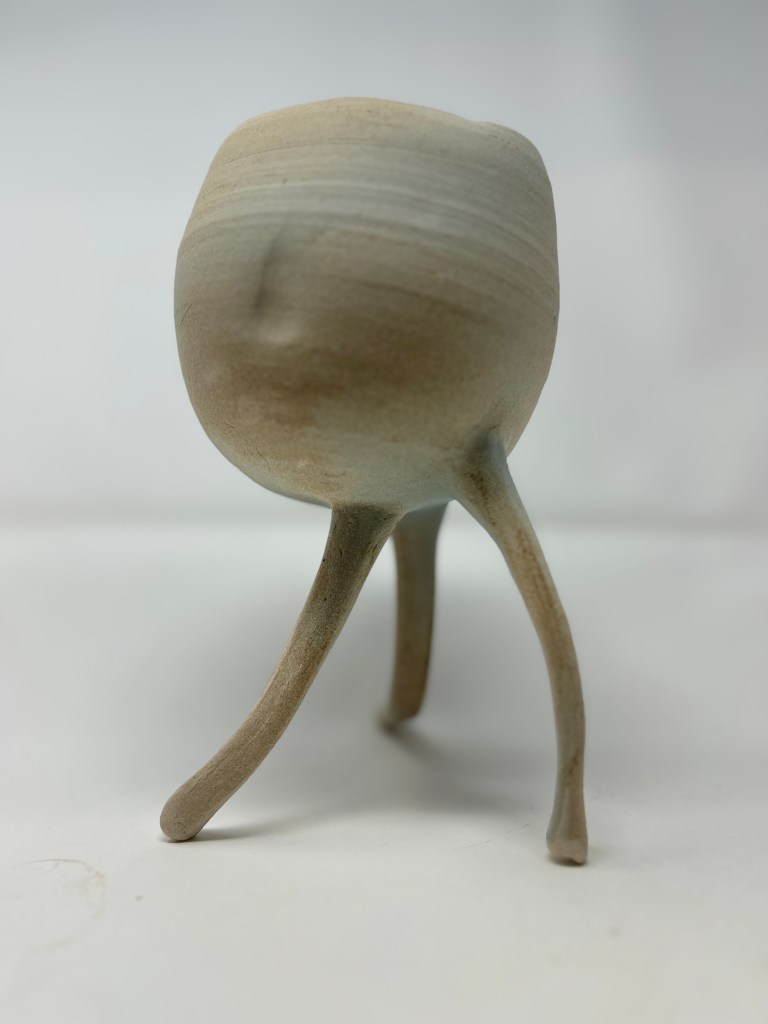
    I have lurched between the identities of six different kinds of artists.  Been haunted by distorted imaginary voices of perfectly supportive ceramicist friends, who think I’ve made bad choices and generally am making a fool of myself.  

    The nature of these thoughts are worth writing down because they are so ridiculous in black and white.  We are not our thoughts.  An idea that seems impossible to grapple with, I believe rooted in mindfulness and therapeutic practices – though at odds with Freud. 

    What am I doing making art?  And in the middle of the night – ‘What IS art? See, you can’t even answer that’.  Well I’m doing a Fine Art Masters, so let’s just see.   I find in these moments of self doubt I scroll on instagram more – it’s a great idea.  My feed shows pristine lifestyle ceramicists throwing pots next to white sofas, desperate influencers showing 3 steps for making abstract art that sells…and even the legit art scene posts seem all about what’s fashionable and what’s correct and accepted right now.  

    And part of the problem also is that everything is acceptable.  I sit down at my life-drawing class (organised by the students union, and excellent) next to a gloomy woman who says that no-one seems to care what art is anymore.  

    Under a cloud I head to the studio at County Hall Pottery, where I work as a technician in exchange for studio space. 

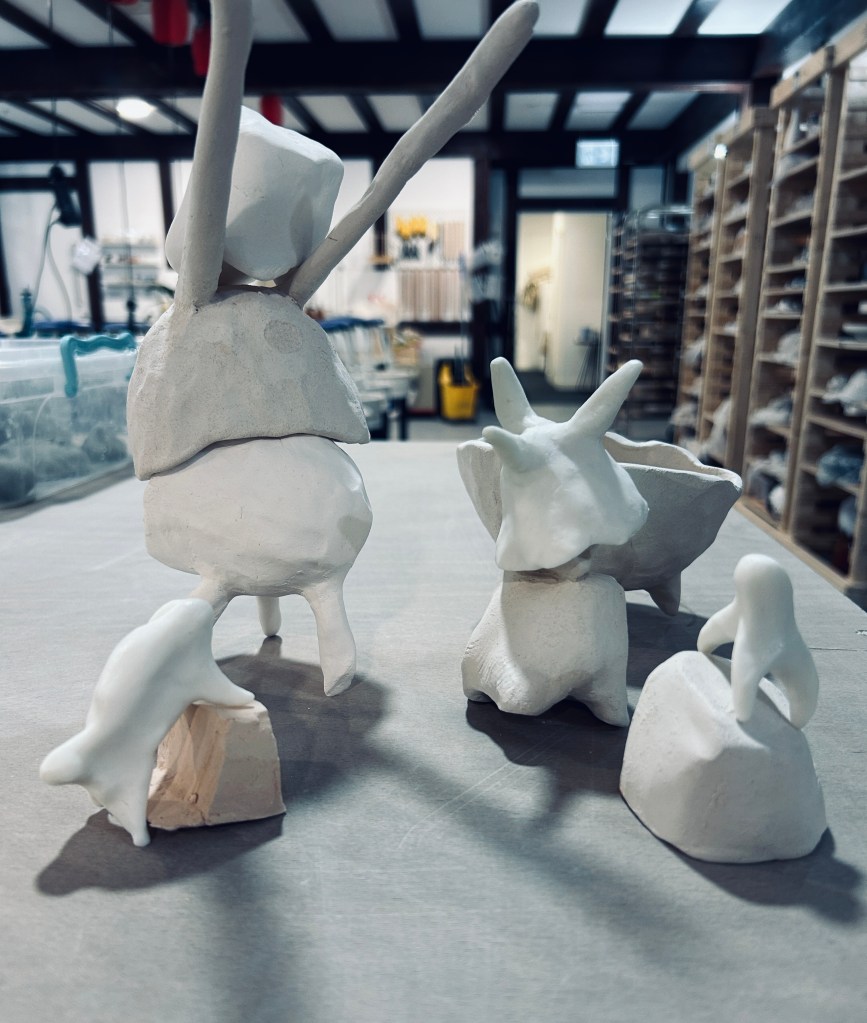
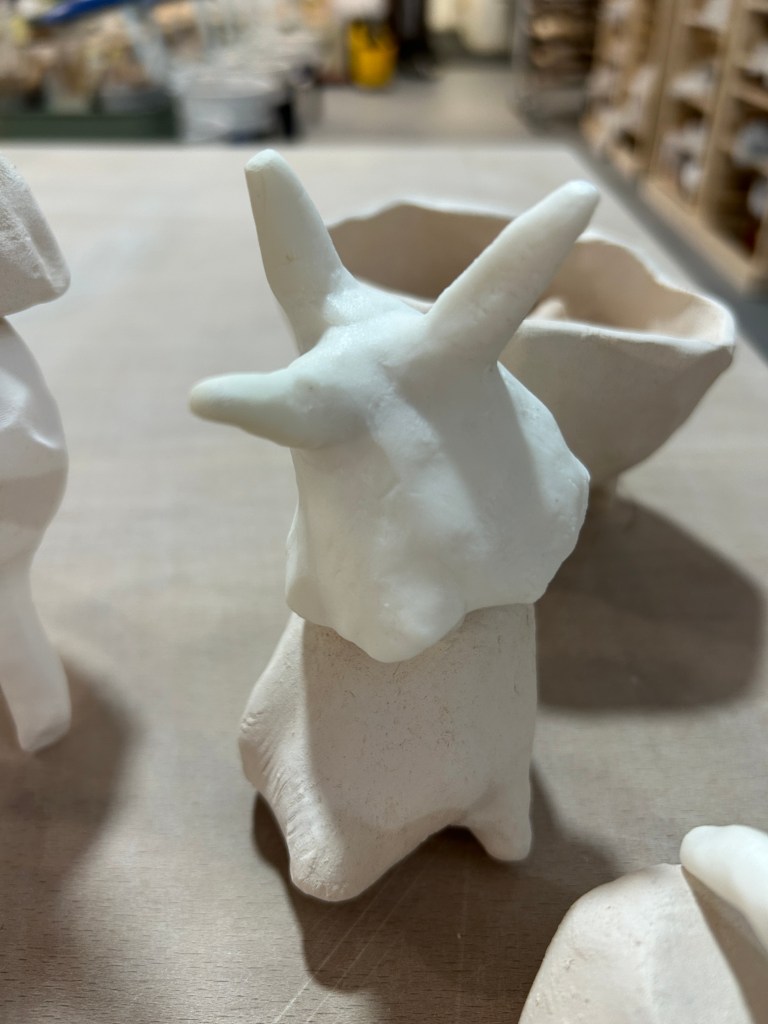
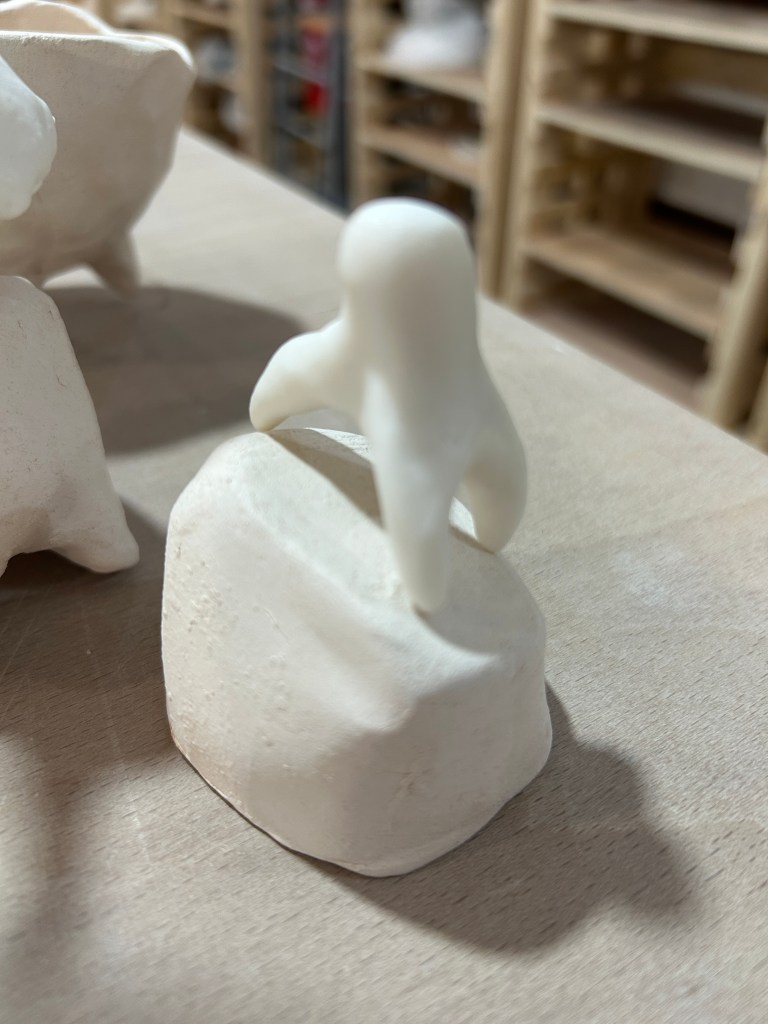
    At the studio Charley Blackburn, the new ceramicist-in-residence, is preparing for an update with the managers.  Her sketchbooks and glaze tests are set out for the meeting and it’s breathtaking work, but also chatting to her, I notice there are more questions than answers.  There’s certainly no end goal.  I show her a box of bisque shapes I’ve been playing with.  And a stop-frame animation I made to document the process.  I might make more stop-frames.  Charley gives me some feedback about what would making a film of them moving add to the work, which she feels already has movement and energy.  I have no idea how she has seen that. 

    While her meeting goes on I listen in to a fantastic conversation from my lovely brilliant colleagues about Charleys work – and I go into hyper focus.  Or flow. Just playing with the shapes.

    One of the challenges of ceramics is the technicality of putting something together, which really requires prototyping, sketching out, planning.  Factoring in the 7-10 different stages of drying time.  But how do I improvise if I have to plan first?  Where is the creativity that comes from spontaneity.  Each ceramicist approaches this chicken and egg in a different way.

    But most importantly something is unblocked by showing up at the studio and my wonderful community and friends at County Hall.  By Charley’s serious generosity and belief.  

    I felt so galvanised by that.  I also want to mention Daniella who has (along with Olga and Hicham) pretty much remotely organised a group show for us in the Good Rice Gallery with a couple of days notice.  She is one of the extraordinary people that just believes, is unfailingly optimistic and generous.   Instead of overthinking this, I go with the flow.

    I think my my thought this week is about community.  If I can’t be kind to myself then to take myself to the people who lift me up.  The studio becomes then not an aspirational space I can’t afford, but an environment I create by people I choose to connect with.

  • Permission, presence, purpose

    Trying at the moment to work from my gut, and trying not think to many steps ahead.  Trying, trying, trying to not try so hard.  We have a discussion about what blocks the imagination, taking as a starting point the word resentment.  Which interestingly turns out to mean re-feeling (French: sentir, Latin: sentio).  This makes me think about presence.  If we are re-feeling, we are cycling past emotions.  And I can see that this can happen with re-feeling in the direction of the future also – being in that stuck place of ‘this will happen, that will happen’ – which will always be cyclical because it doesn’t exist.  There is only now.  And now.  And now. Etc.

    My internal narrative when unhelpful, when not-present, is often littered with questions about validity – what’s good, what’s good enough, what’s excellent, what’s not, what’s ok, what’s correct.  When you write it down it’s pretty ugly.  Again in improv ideas are generated on the foundational premise that there are no bad ideas.  Keith Johnstone (aforementioned improv forefather) would coach actors with ‘be boring’ or ‘too original!’.  I trained as an actor at École Philippe Gaulier, an eccentric but unrivalled master of engendering the essential quality of presence in the actor.  Famous for ordering actors to ‘leave the stage immediately’ seconds after their entrances, because he could ‘see a little idea coming’, it was a school of hard knocks.  We once asked him about talent.  He said ‘There is no such thing as talent.  Only what you authorise in yourself to do’.  I think about this nearly every day. 

    We discuss results of an automatic writing exercise on what blocks the imagination.  The discussion is framed as ‘Where do we need new creativity, new imagination?’.  We think about the ‘we’.   Tim – ‘the lofty idea of the artist as solo genius, artist as hero, that model, Rothko – is really unhelpful’.  We think about the ‘new’ – are there new ideas – probably not.  We think about the ‘need’ – is the work doing the job it is meant to be doing?

    What is that job exactly?

    Jonathan reads a provocation from Ben Okri in the Guardian about the artist’s responsibility towards only working on the subject of the climate emergency.  What does existential creativity look like in our art practice? How do we translate that or interpret it?  Also read out – an extract from Douglas Hine’s ‘At Work in the Ruins’ – about the problem of seeing art only as a tool for getting across a message.

    Art is not a cheap alternative to an advertising agency or a sophisticated extension of the communications department, and the urgency of the message doesn’t change this.

    I really enjoyed Luisa’s response to this ‘our art practice is to protect thinking’.  I take from this that we need to give our audience space.  To not be conclusive.  To leave space for a dialogue – even if the artist has left the room, or the planet – we are in conversation with them through the work.  We remember how shut down we were at school when preached at. 

    Hine quotes in turn playwright Anders Duus – 

    Our job is to complicate matters

    I think this has really helped me think about how I approach meaning.  I’ve worked in a discipline where storytelling is at the centre of things – and clarity is essential in script/playwrighting.  I suppose I am still telling stories but maybe in my art practice in a different way, giving space for the audience yes, and also space for the intangible, as Hine puts it, for the ‘messiness and strangeness of life’.