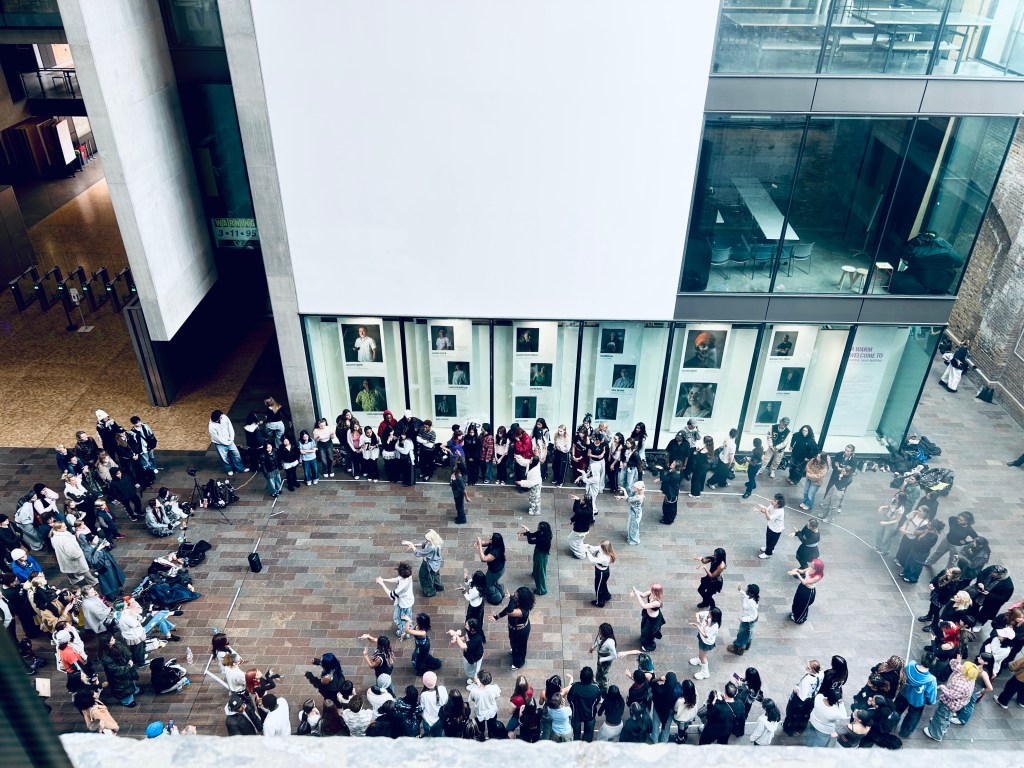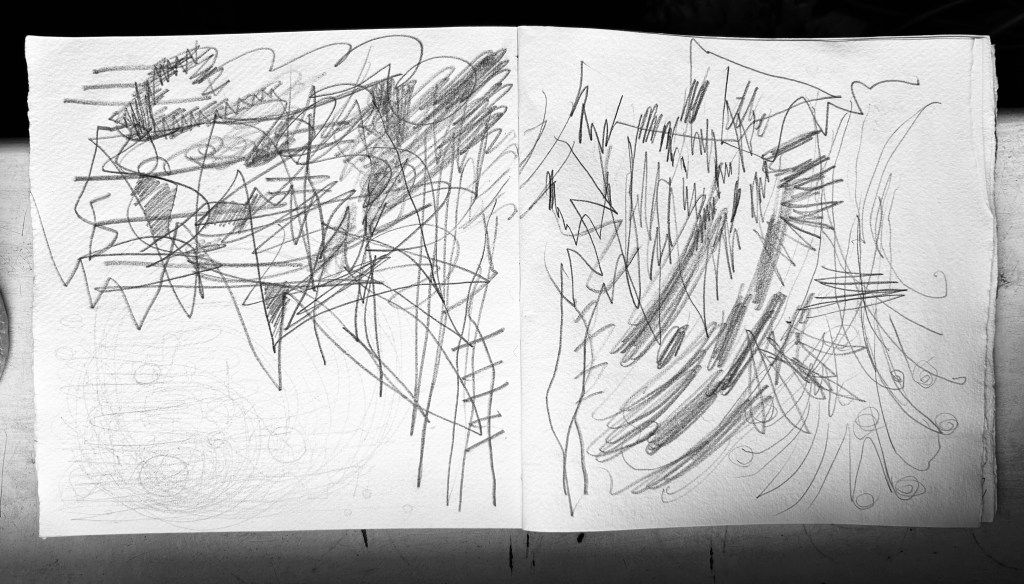
I took the bus to Camberwell to go to Jonathan’s lecture IRL. I was flooded by really specific memories of starting university, some kind of wave of nostalgia for the start of an adventure. The building was full of awkward, cool, lost-looking young people. Not for the first time in recent weeks (but that’s another story) I felt like I had accidentally time-travelled and was experiencing my life being played back over again. I notice I am not that different in many ways – certainly awkward, maybe not cool, lost definitely. I lost my favourite jacket on the bus. Same person I ever was.
The lecture was called ‘A Messy Introduction to Practice-based Research’. I want to know what that means – having once gone through a lengthy process to apply for Practice-led Research with the Arts and Humanities Research Council only to be rejected with the infuriating ‘feedback’ – It reads like an artist wanting to have money (or something like that. That’s what I took from it). Tangent.
Tangents are messy so not a tangent.
We had to collaborate in pairs to discuss what how one might research the impact of eating fruit on 100 economically disadvantaged children. I braved it and spoke to a 20 year old girl who said it didn’t apply to her because she’s a painter so she wouldn’t be doing that. I suggested it was maybe a hypothetical situation. I tried to apply a healthy attitude to collaboration at this point but my enthusiasm was a bit dulled.
I guess though incidentally (or not) this had revealed a point that Jonathan was making about being both an artist and a researcher. Which we technically are by dint of enrolling in an art school masters.
What is the difference between research if it’s carried out by a scientist or an artist? Jonathan pointed us to the work of Kurt Lewin who was a founder on the subject of Action Research, the task being not to interpret the world but to change it. Although Lewin’s work isn’t directed at artists as such, he’s asking us to raise questions rather than just solve problems. Changing the world could be said to be the job of art – it’s certainly a validating job if art needs validating which is does now and again. The example was given of the film of Kesey’s One Flew Over the Cuckoo’s Nest – and the shocking experience of witnessing electroconvulsive therapy leading to it’s eventually falling out of favour as a practice.
I remember, when I first made my theatre work, spending time being conflicted because the work that got most easily funded (there I was trying to make a living again, how dare I?) was issue based and ‘worthy’. Someone pointed out that where I was putting my work at the time (village halls, site specific, non-theatre based) was political with a small ‘p’.
‘Sometimes change in the world might be change in your world’. I think this was a quote from Jonathan, maybe Lewin…
…that there is a ripple effect caused by finding your unique voice, and if you can put it into your art, you are changing the world because no-one else can do this – in this way – as you do.
I put off writing plays for decades because I was insecure about the validation of my voice.
I also wrote down – Jonathan I think you were paraphrasing who here? –
‘There is a moment for each artist in which a particular truth can be found and if it is not found then, it will never be found’
I also underlined these words from Carolina Rito.
Practice research is…partial and errant…tentative and opaque…it moves through the radical incompleteness of the subject.
There was a lot more to return to in the lecture but for now I just want to underline here
…the words about time in this…
…there is a moment…
…if it is not found then….
So I am noting to myself – can I please get out of my own way and seize this moment? Messy though it is and massively insecure-making and unknown.