Tag: audience

  • Perverse conditions

    Had a long chat with Jonathan about the feedback on the Assessment and what is most helpful for me right now.  Unpacking what I mean by something more critical, and tangible to build on.  Especially in regards to research.  Quite rightly he asked what would I tell myself in regards to feedback and this opened up a bigger thought about why I’m doing the MA.  I see my imposter syndrome – in fact I bore myself with the amount of space that takes up in my blog.   And I do feel I’m in the right place in terms of my approach to the journey – and take the encouragement to ‘do more of the same’.  But I guess although the aim is independence in one’s practice I’m here for the critical engagement, and ultimately of course if I’m making art it’s not just for me.  Like a hobby or an indulgence or something that exists just for myself.  It is a public thing.

    I want to find out how my work operates in relationship to the world.  To outside myself.  In dialogue with others.  I want to affect people.  

    So unpacking that really helps clarify things for me.  I am engaging with my own conversation with myself.  But I’m here for the rigorousness of criticality and the outside world.  And that doesn’t have to be in the art school tradition of aggressive critiques (we have enough artists who have been trained to talk impressively about their work in written explanation and I’m not convinced there’s much beyond defensiveness sometimes).  I’m glad that this MA puts kindness at the forefront of the journey.  But I’m here to go on a journey of discovery, and that means not just circling around myself, but to make use of the expertise and knowledge of Central Saint Martins. 

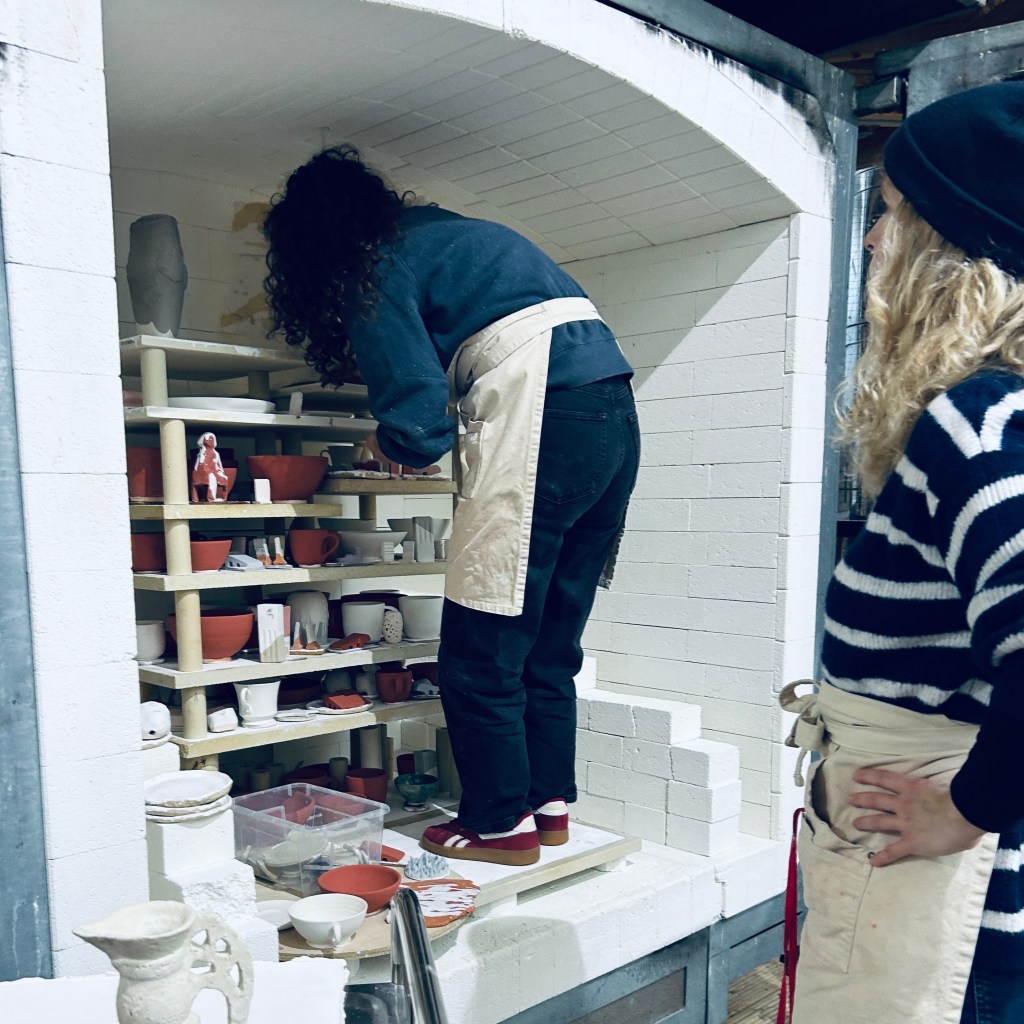
    So we unpacked my aims on the Study Statement – which starts with ‘break open my practice’.  Which sounds dramatic to Jonathan, what do I mean?  Actually that is exactly what I mean, I kind of feel that something is too contained, to subject to the demands of the medium and what I expect I have to do with it, the constraints of the firing schedule (always one step forward two steps back – now the firings are apparently fixed dates – but…every 6 weeks as opposed to the monthly on the contract), I feel like I want to put a bomb under my practice in order to see what remains.  

    I want to own it.  Jonathan – own what exactly?

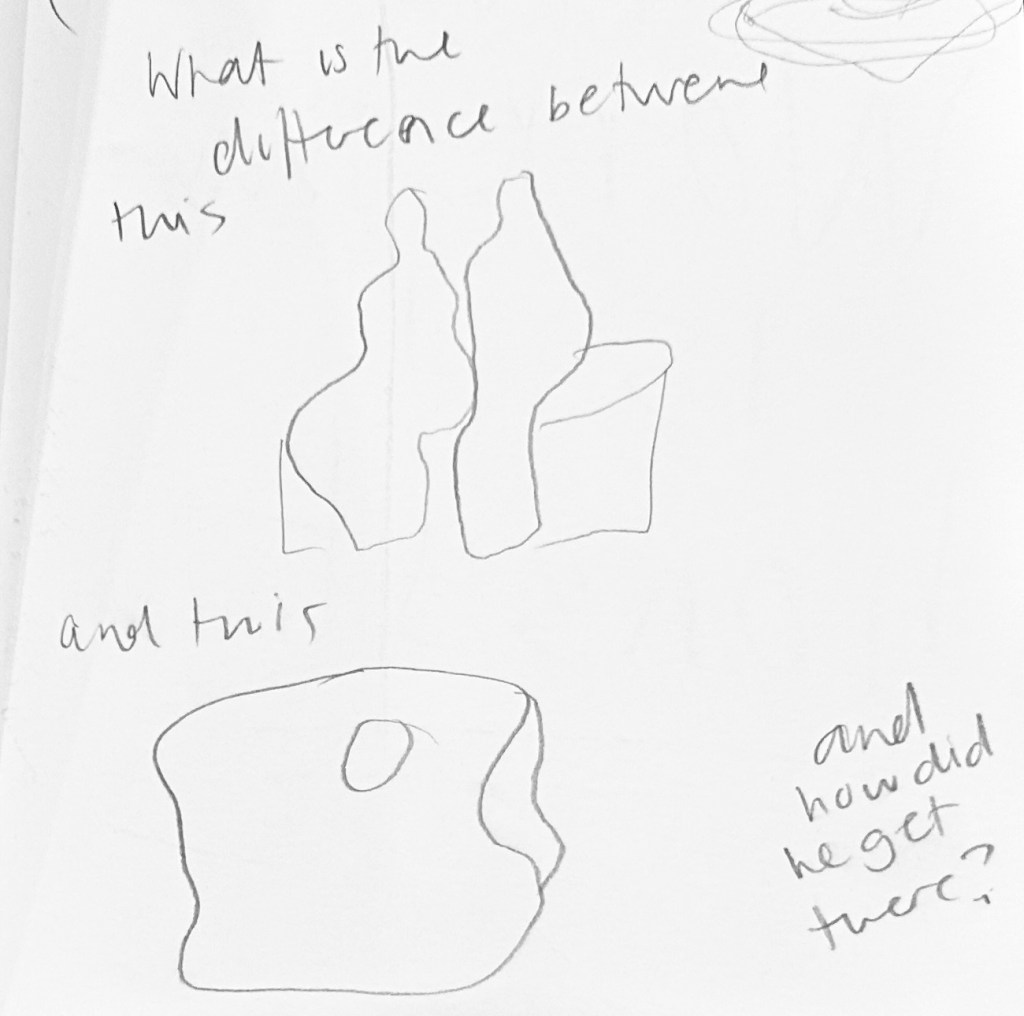
    Well the transition from ideas to making is really clunky.  Sketches to making feels really literal. 

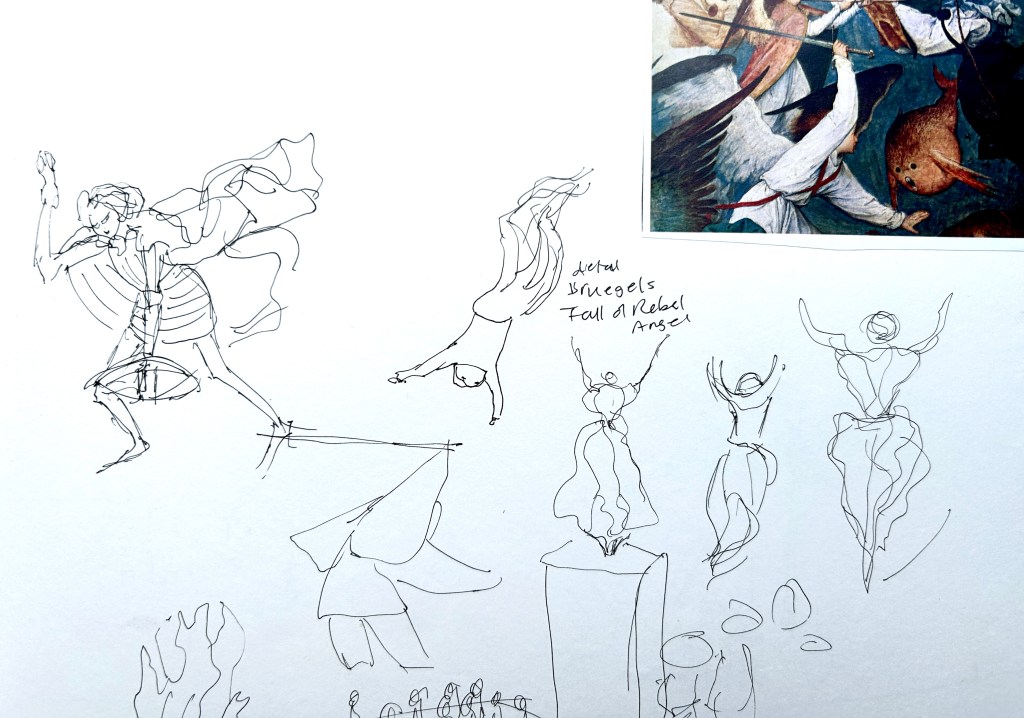
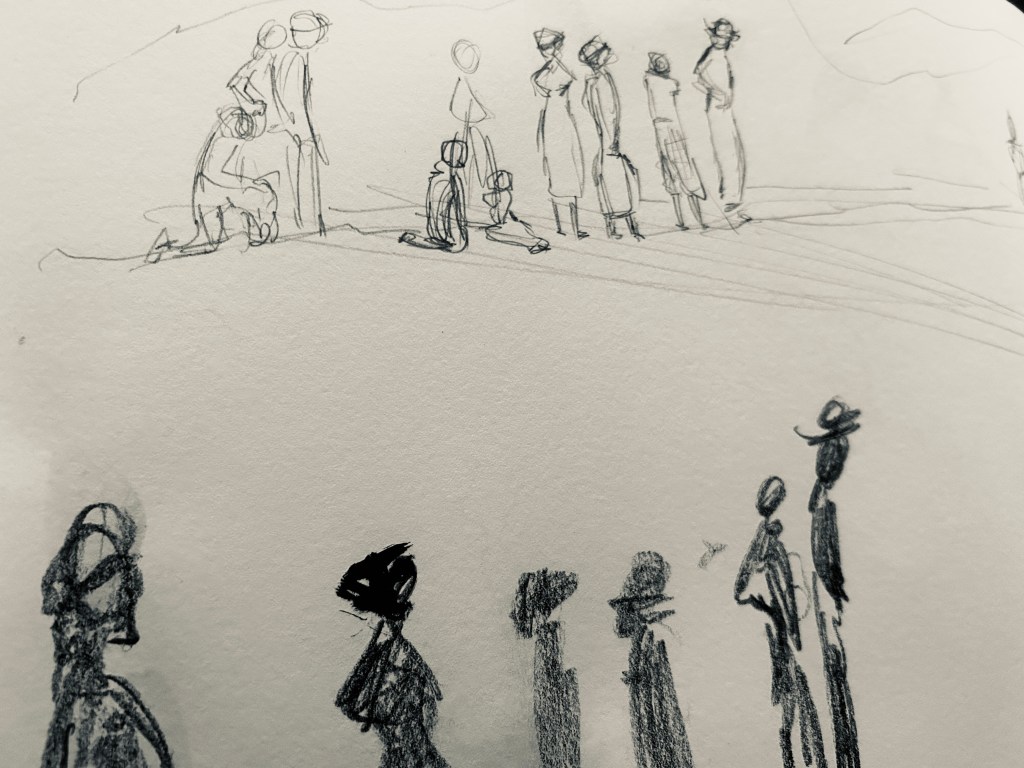
    I talk about the journey from making this thing from ideas to what I presented.  Now as I write this I’m looking in my sketchbook at drawings of Bruegel’s Mad Meg and the Fall of the Rebel Angels.  None of which made it beyond the cutting room floor.  Although actually…the idea of falling did.  So maybe exploring any visual hunch is good.  Blind alleys are maybe more interesting than just sticking to the path.  

    We talked about the qualities of other people’s work that inspires me most – I keep returning to Yuki Nakamura’s ‘Fragile like life’ porcelain footballs.  More than anything I loved with that the concept of play and joy and of breath and life (deflated football) in this sad hospital garden.  And the something so generous about the ‘here and gone’ nature of the installation that speaks to me of the weirdness of time spent in the bubble of caring and hospital visits.  

    I also speak about my friend Tim Crouch’s play An Oak Tree.  I’m going to talk about that in the next blog post (which I was halfway through writing when this Jonathan conversation came in) 

    Tim is an interesting example for me.  An actor turned playwright doesn’t quite sum it up.  Aside from Caryl Churchill he’s probable the most ground-breaking playwright in the UK.   He’s kind of moved playwrighting towards conceptual art.  But what I want to say at this point is – there is this care and attention, simply to Nakamura’s piece, of how the work really works for an audience. Beyond basic curatorial choices, drilling deeper into how and why the audience meets the work in the way that it does.  

    It’s that specificity I am after.  

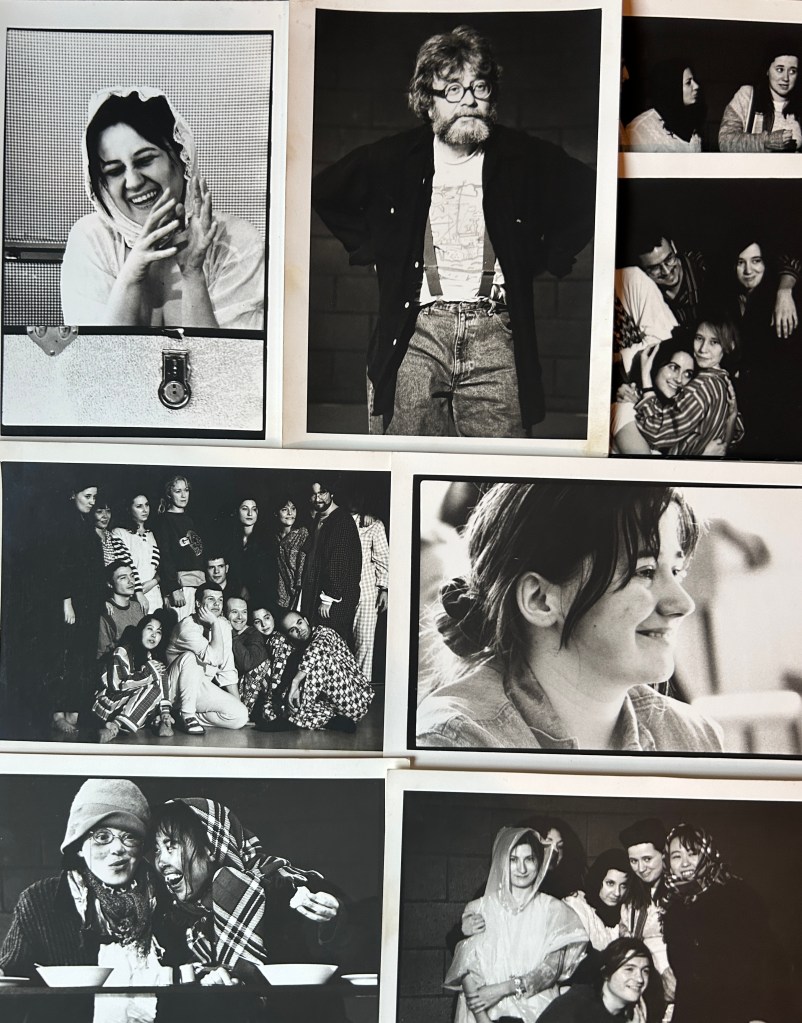
    That maybe what ‘owning it’ would look like.  I understand audience (Gaulier taught me that, improv taught me that, making site specific theatre on beaches and in village halls and working mens clubs, my indie theatre company was all about how to mess with the live experience).  Staging the chairs and the figures and the plinth and being very deliberate about how they were presented in the space was a positive thing.  

    So the space between my experience and what I want to do with my work is at the pull between intention and spontaneity.  

    When it’s out the in the world I can’t control the experience in the way I can with live performance.  Although our long form improv shows were in the the chaos of the unknown we did work in great detail on how we controlled that one sentence set-up at the start for the audience – the only scripted line – in order to allow the audience to put aside their expectations, nervousness and cynicism about whether it’s even improvised at all – so that they could get on with experiencing the thing we wanted them to experience. 

    I think I’m often most creative when I’m creating perverse conditions for my work.  

    And perhaps that’s what I want to break open.  

    Feeling.  Relationship. What relates.  What is affective?

    This is not about controlling meaning.  This is not about starting with the end in mind.  This is definitely not about a textual explanation on a card on the wall.  This is about interrogating the conditions in which the audience meets the work whilst – and this is the paradoxical bit perhaps – whilst giving them space to do whatever they want with it.  

    So to go back to improv – we are letting go of all control over the structure and meaning and in fact also the quality perhaps of the story we tell – in favour of allowing the wild ride of spontaneity.  And we’re allowing them to believe in something that we’re told is impossible – because conventional practice would have us believe it takes one genius man in a room to write a play.   Jonathan reminded me of this quote from Keith Johnstone’s seminal ‘Impro’


    “People try to use what they know. They want to be ‘right.’ But I prefer to see people who don’t know what they’re doing and take strange paths.”

    I worked though some big things in this generous conversation with Jonathan in how my audience meet the work.  Or maybe the question is what is it about the work that allows my practice to meet the audience.

    That’s maybe why I asked the question ‘what’s the most exciting thing that is growing’.  Because that’s what I need to know, and that’s not ‘what’s most exciting’ to me.  That’s an outward seeking question, in relation with my work and the world. 

  • On the outside looking in

    I’m reading ‘Hold it against me’ by Jennifer Doyle about difficulty and emotion in art.  It’s waking something up in me, have only just begun it so maybe I will write more on this later.  It’s making me feel there’s a purpose I can latch onto here.  I know that seems ridiculous – as if there isn’t a purpose when of course there are a million kinds of purpose to the art I might want to make but right now my brain is a bit clouded, overcast.  Too many open tabs.

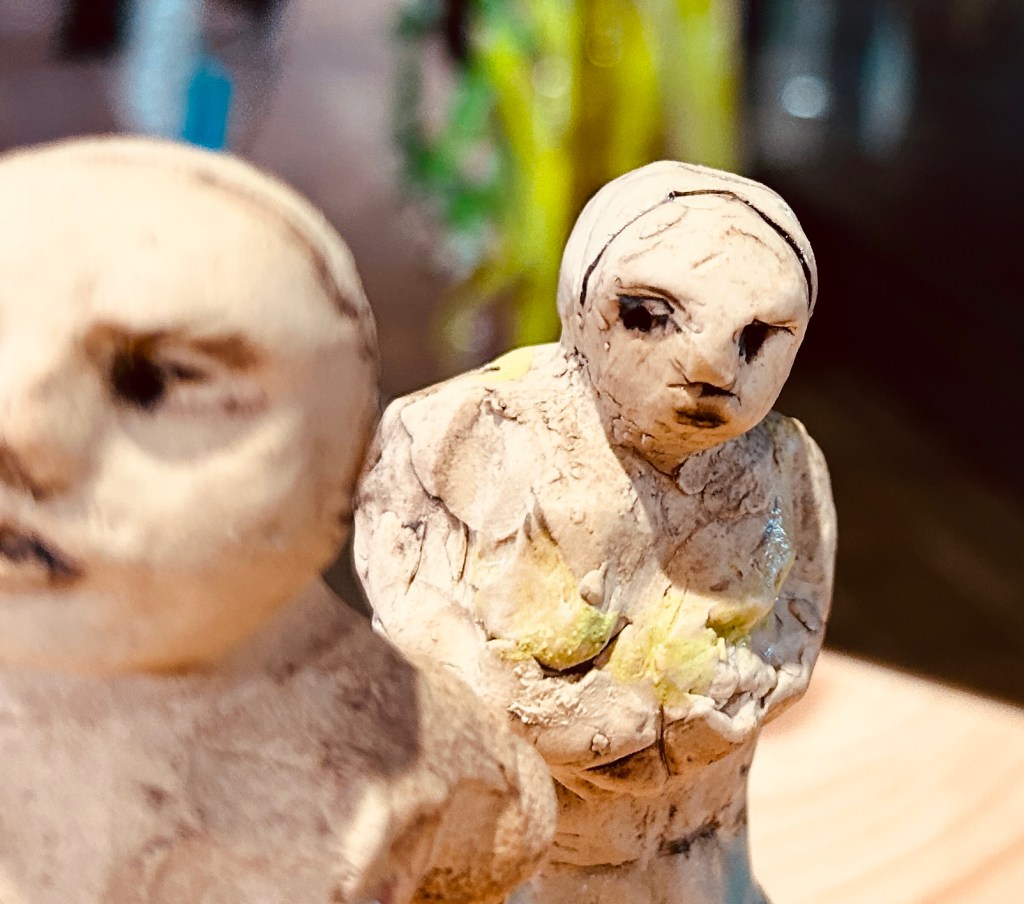
    The interim show was a wonderful experience.  I still feel strangely unattached to what I made although I feel I did resolve it successfully and the piece got a lot of positive responses.  I want to understand why I feel so flat about it.  But also, as art critic Jerry Saltz says – your art is a flatworm (earthworm in UK) – cut it in half and from it grows another piece.  I love this idea.  From the piece I made I am drawn to the the feeling of the figures – and perhaps I should commit to exploring the figure more – people / character is something I’ve studied hard as an actor / theatre maker.  Story.  The relationship with the audience.  I also enjoyed the spatial dynamics, the setting of the multiple chairs.  The box.  I like the glaze.  But why this material?  Why clay?

    I am feeling today at odds with the ceramics world. I’m mentoring for Arts Emergency – and it feels so good to be doing this – I am sick of and angry about how privilege in the arts stores up opportunity for itself and it’s friends and how that depletes the art world for everyone. The theatre world witters on about this while doing nothing in general but the ceramics scene seems entirely unaware about the need to address inequality at all – in this most resource-hungry of practices.  I am trying to find a way to help raise maybe $30k for my mentee who has got into the prestigious acting school Julliard in NYC.  It’s a gargantuan task.  Ironically at the same time I’m not sure if I can pay my rent.  

    I needed a break after the intensity of the first assessments and the interim show.  Brain depleted. RSD. The residency week was glorious.  The cohort continue to inspire and delight me – we are such a cast of characters.  Each one of us so different from the next, and the sense of a community of support and practice is real – I feel so blessed.  It kind of feels like a bit of a dream, to spend a week with these brilliant people.  The printmaking workshop was a highlight and I’m galvanised to make more 2D work and maybe look more at printmaking on clay.  I also saw some really brilliant art shows and discovered some new galleries.  On the subject again of money I had a fascinating conversation with Betty on the bus to Peckham about art that fetishises poverty – or ‘poverty porn’ as we call it when it shows up in playwrighting.  

    An artist who could never make poverty porn, although she will no doubt have been accused of it, is Tracey Emin.  Her Tate show tore me apart.  She speaks about her reality, she is an open wound.  Surprising number of men seem to think she should shut up and stop going on about rape and trauma.  

    She is an artist and she works with the material she has – her life.  Do I, could I, do that? (I remember actually after Nick Cave, yes he’s a man yes, after Nick Cave wrote a beautiful song about the recent death of his son and some girl I know from my hometown said on social media that it was distasteful and I…I have no words to say about that person.  The guy is a f-ing artist)

    I like that Doyle differentiates between two kinds of difficult.  The intellectually challenging ‘difficult’ art turns away from the spectator who feels inadequate, not ‘fully initiated’ into the ‘sociology of contemporary art.’  The only feeling for the spectator I guess is – they are on the outside looking in.  I can relate to that.  And then – and this may relate to my research – she talks of difficult art where the spectator is inextricably complicit in a kind of witnessing that is very personal.

    ‘This is where ideology does it’s most devastating work…This is where we come to know the contours of our selves, our bodies, our sense of soul’

    I’m feeling kind of worked up right now as you can probably hear.  I feel like something is coming and not coming.  I’m blocked.  I wrote to Jonathan to say I was confused about the feedback on Unit One, it was clearly full of praise but nothing solid I could build on, I wanted more specificity.

    I’m really looking forward to the class starting up again after this three week break, to seeing everyone, to find out what’s next.  

    My writing mentor Chris Thorpe once gave me the most useful feedback about a first draft I was making –

    ‘What’s the most difficult thing that this is not saying?’

  • Je ne regrette rien 

    Remembering Philippe Gauler 1943-2026

    Yesterday I went to Paris to attend the extraordinary funeral of the teacher who changed the course of my life Philippe Gaulier.  In the sometimes murky world of artist training Gaulier is perhaps the most widely and wildly misunderstood pedagogue of all.  Perhaps we all assembled from around the world yesterday – how many? maybe 600 of us – because we wanted to hold onto that magical thread of his teaching specifically by being together…because we were there…because we know it.  Perhaps we all feel tired by having to listen – every time his name comes up – to the broken record of criticism spewing from the mouths of people who never even went to his school regarding his somewhat unorthodox teaching style. As Simon McBurney put it he was –

    ‘provocative, demanding, deliberately inappropriate and utterly hilarious’ 

    The elusive cornerstone of his school was to find that ‘complicité’ on which McBurney, Arden and Magni founded the namesake company – the inferred danger and delight in being connected (with each other, with the audience) when we play.  Do we have pleasure to be on the stage?  If not why bore us? ’Adios, sit down immediately, my little friend’.  Gaulier actors read audience in a way that no other actors do and that is what I am proud to know. It will be in my bones.  It was in the bones of us, connected together when we – a giant congregation – burst into ‘Non, Je ne regrette rien’ along with Piaf as we saw the old fella off on his way.  And we might be messy and we may not do things ‘correctly’ but we will do it with heart and a kind of passion that is very rarely really seen on stage.  Spontaneous, huge applause, whooping, cheering, Bravo, Bravo went off as he was carried up the long theatrical staircase to disappear into the glittery backdrop of blue-sky mosaics of La Coupole in Pere Lechaise cemetery.    

    I began at Gaulier’s school aged 25, just two months after losing my mother.  Philippe taught me to feel again and how to be free.

    Why am I writing about this here?  Because what I am looking for is not and should not be definitive or even precisely known.  This is the same for fine art, for performance, for poetry, for playwriting, for art installation, for ceramics, for concept art, for music – definitely not for music – for opera, for dance, for education…for making anything at all really, I think.  

  • Nebulous

    Transience and permanence, the constant

    Monuments + sculpture – marking in time making valid – heaviness

    Transience – ephemeral, nebulous – lightness

    And audience 

    Experience of art – the transient nature of the encounter = becomes validated by memory and the quality of experience

    How it makes you feel

    What you feel is how you remember.  (Often attributed to Maya Angelou – ‘…people will forget what you said, they will forget what you did, but they will never forget how they made you feel’)

    Transience is moving, through time, moving on from, beginnings and endings, here and gone

    Permanence is stillness – rocks, monuments, weightiness, significance

    But in theatre / improv audiences experience of something fleeting – the encounter feels special, unique, personal

    It is a two way relationship.  Not standing in front of.  But dancing with.

    Theatre and improvisation know about the value of transience to audience.  And specifically the shared experience of the moment.  The audience completes the work.

    Museums, archives, monuments, the canon of gold framed paintings, arguably most 2D visual art and all sculpture – deal with fixing in time, history, longevity, statements.  (There is hierarchy at work here – power – who choses what is permanent?)

    Ceramics in particular is elemental – earth and fire.  Survival of Mesopotamian pots – trace of man’s first technological advancement – but also evidence artistic expression.  They tell stories.

    Which is where theatre meets because it tells stories. 

    Time tells stories – beginning middle and end.  

    Without end – no story…?

    Or without end – audience completes story?

    Where is the audiences agency in the work – this is crucial to me. 

    Gilchrist – where we put our attention…attending as a moral act which changes the world…who does the attending?

    Artist role to draw attention.  To focus – to say look, here?  At what I see?

    How do you leave space?

    Notion that when we accept that there is no permanence that everything is changing, we are freed from fear of death and endings – Buddhism.

    Gruf Rhys –

    “Rocks are slow life”

    Even rocks are moving, changing.

    Climate disaster, landscapes shifting, mud moving…clay and earth subject to the elements.

    Toute Bouge (Everything moves / is moving) – Jacques Lecoq text

    Lecoq students study elements – physically.

    Presence in the theatre feels and looks like stillness but isn’t stillness, it’s kind of a vibration.  It’s an energy.  

    You can teach it to actors by making them play Grandmother’s Footsteps – when the child is forced to stand ‘like a statue’ – they are in fact holding themselves in preparation for immediate movement when Grandmother’s back is turned.

    Watch a cat pretend to not be about to catch a bird in the garden. 

    What personally does this mean for me?

    Theatre, improv

    Writing

    Making

    Clay

    Artmaking

  • Really in the Sauerkraut

    Had the most amazing and generous tutorial with Jonathan.  I’ve been feeling really stuck, whilst at the same time because of the complexities of the firing schedule at my studio (as detailed in my earlier blog) I’m having to press on and make regardless of stuckness, in order to have something for the interim show.  Not a great way to nurture my developing practice.

    During the tutorial, where we talked a lot about my multi-disciplinary practice and what that brings, I talked about the situation in devised theatre processes where it’s agreed that we’re stuck and we’ll have to wait.  In my company I used to refer to it as ‘waiting outside the cave until the dragon wants to come out’.  Mike Shepherd from Kneehigh frequently used the phrase ‘hold your nerve’.  And Kasia Zaremba-Byrne, a brilliant polish movement director, will often pause during choreo sessions and say ‘we’re really in the sauerkraut’.

    Am trying to refine what I want to explore here.  Pull the threads together.   There’s something that’s very clearly pertinent to my positionally as a ceramicist – given that ceramics once fired are fixed in time – and that I’ve come from a theatre background.  A theatre background specifically rooted in liveness and improvisation.  So it feels like time is going to be important.  Theatre is ephemeral, transient, here and now and then gone.  Ceramic is fixed in time, it survives thousands of years.  Being one of man’s first discoveries it sits deep in our consciousness that ceramic endures.

    But at the same time – the opposite is also true – ceramics break.

    Liveness, ethereal, transient…here and gone…fragility.

    The other – not unrelated – interest is movement.  My theatre background is largely physical, and so far I have choreographed my ceramic figures in dynamic spatial relationships.  Which does in turn create story.

    I’m aware of ceramicists who have a performative element to their work.  My pal Shane Keeling climbs on ladders to drop his pots to the ground.  And the artist Vidya Thirunarayan I met at the talk recently incorporates raw clay into her dance performances.  There is more to explore there, but I notice I am not drawn to performing in my fine art practice.  The challenge for me is finding the place where my performance experience intersects with my ceramic practice, without ceramics becoming consumed into my performance practice. 

    Jonathan asks – is it about the concepts, the shape or the material itself that you’re interested in?

    We talk about am I looking at movement in a phenomenological sense, or putting in mechanics so things move? Maybe movement isn’t the right word – maybe it’s more about space and distance and relationship.   The capture of the quality of movement (as per The Futurists explorations) seems too literal.

    Previously I thought about Puppeteers keeping puppets ‘live’ by breath-work. 

    Maybe the word is breath.

    Breathing space.

    Breath = life force.

    I keep returning to an assumption that I’m somehow obliged to abstract the figure because that’s what ceramicists do… (This is where trends and fashion are unhelpful).  A counter to that assumption is Claire Partington, a powerful ceramic artist that I love who…makes extraordinary ceramic figures.  Satirical, feminist, referencing flouncy 18th Century porcelain figurines – and with a theatricality and sense of space that I can relate to.  

    And that leads us to porcelain, how I have become captivated by this self-glazing kind called Parian.  And how I felt when I opened the kiln door, how perfect my Parian pots were (to me).  Want to note here this was quite an emotional session, my recent ADHD diagnosis came to the fore again because I’m seeing that my hampering perfectionism is infact me compensating for something / everything. When you’ve just discovered an entirely different truth about who you’ve been your whole life, trying to find what’s authentic is hard.  

    But also I am still me.

    I want to capture here somehow how meandering this tutorial / conversation is, because writing it down from my notes, it’s useful to notice that process of circling past the idea and back again.  

    Jonathan says that this kind of grappling does come before a breakthrough.

    Then I have this thought that if the ceramics are fixed maybe something else moves them, the floor perhaps.  A designer Jon Bausor that I worked with when directing a Ionesco play ‘The New Tenant’ at the Young Vic created a mechanism to vibrate the floor so that furniture could move by itself.  (This cuts a very long story short – the Tech was an all-nighter!)

    Jonathan finds me an instructable site about making a Chladni Plate, which uses low-frequency sound to create vibrations.  And tells me about an experimentation where bass sound caused an artwork he made, involving toy cows in a fish tank of milk, to move into formation. (I am nearly dismantling my bass amp at the end of this tutorial but then remember…it’s my bass amp).

    And then things come full circle for me because the missing piece is about the audience.  If I don’t want to perform but want to leave my work in a place for the audience to experience something, how do I create that sense of liveness, that sense of spontaneity, that transient quality that gives the audience space to dream, experience and feel? To be agents of their own interpretation.  I tell Jonathan about Yuki Nakamura’s ‘Fragile Like Life’ – the temporality of the deflated porcelain-cast footballs in a place where people are considering life and death.  The reference to life – and actually to breath – and to play and joy. 

    Maybe that’s why I’m currently drawn to porcelain.  It’s ethereal, nebulous and it feels fragile and precious.  People have a visceral reaction to the idea of porcelain breaking.

    Perhaps my figures move on this vibrating surface.  And they might fall off and break.  I might orchestrate that, or leave it entirely to chance.  I could even fire something once – they’d be fragile but that’s ok.

    Finding the something that allows the audience some breathing space. Jonathan reminds me that I’d spoken about placing objects in the space, the space between, the sharing of space and the dialogue between. 

    Gaby Mlynarczyk at the talk spoke about the negative space.  Painters understand negative space.  But I’m not sure it’s something we often think about with ceramics because the focus is on the thing, the material, the object itself.

    I began this tutorial full of panic at my dwindling options due the the firing schedule shenanigans and the time ceramics take.  I leave full of inspiration, with ideas to spare, having waded out of the sauerkraut.

    Jonathan – ‘You know on a foggy morning you know the sun is there.  That lingering in the fog can be really beneficial’.

  • Gifts from the Kiln Gods 

    (Clay in Conversation, Ceramic Research Centre, 16th January)

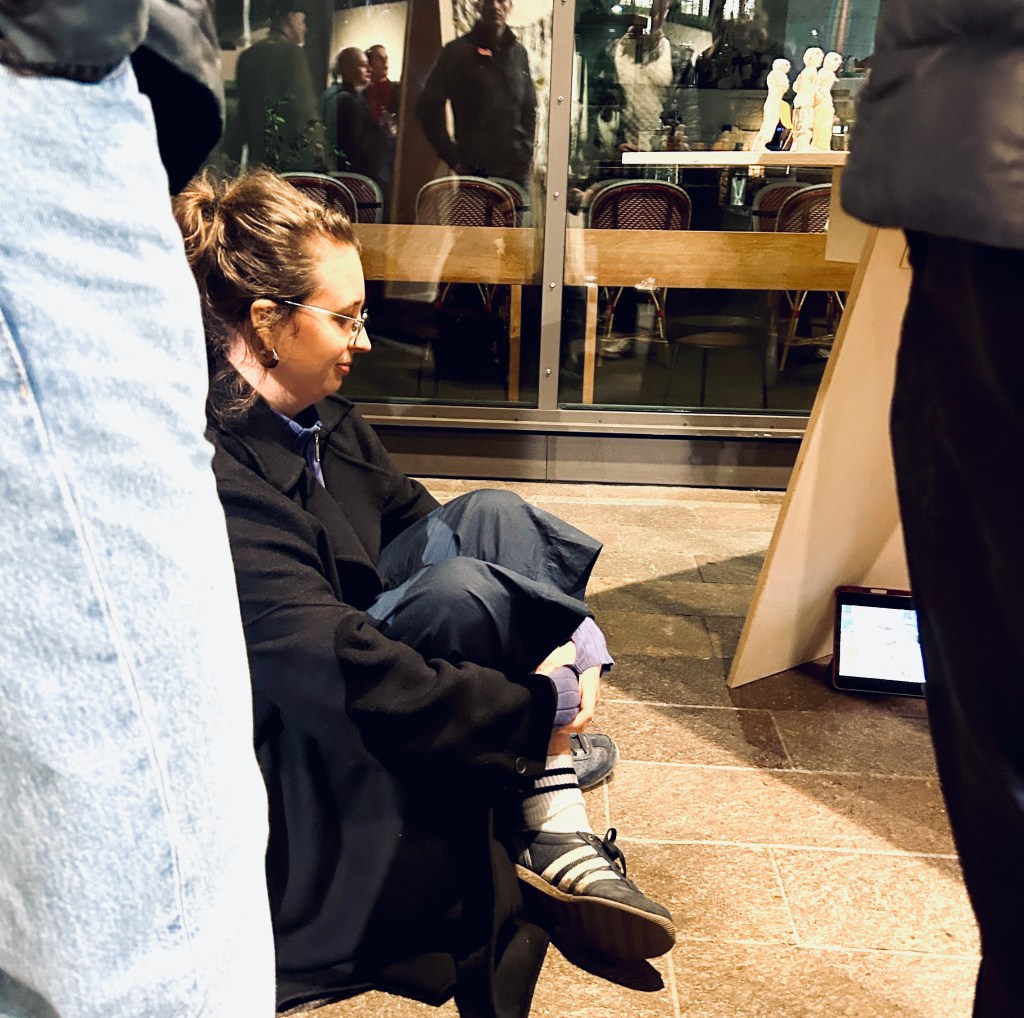
    I went to a really useful talk at the Ceramics Research Centre called ‘Clay in Conversation – Play’. 

    Gaby Mlynarczyk a ceramicist who teaches throwing at my studio makes beautiful work constructed from detritus and accidents from the firing process. ‘Gifted to me by the Kiln Gods’ she says.  She explores environmental concerns, is obsessed by the Great Pacific Garbage Patch – and she’ll cast food waste she’s salvaged in porcelain slip. It’s interesting to me in term of my improvisation practice – she embraces accident in her work, pieces that have fused together in the kiln or disintegrated.  She says it’s a game of trial and error.  ‘I take stuff that has died and try to create a narrative’.

    Gaby talks about the agency of clay – ‘clay is an active partner’.  She also cites Jane Bennett’s Vibrant Matter which by chance comes up several times in this week – in the Art in Context Lecture, in our Thursday session, during my tutorial and then I find the book on Charly Blackburn’s shelf – the aforementioned artist in residence at my studio.

    An idea I’m definitely going to look at is that she starts building one way, then turns the thing over and starts building in another direction.  She calls it Rhizomatic play.  How does she decide it’s finished? ‘I ask myself – has it got energy, is the negative space interesting?’. I’m reminded about bringing my experience of space and audience viewpoint into my work.

    The second talk is Yuki Nakamura.  For ‘Fragile Like Life’ Nakamura used her peculiar collection of deflated footballs.  Cast them in slip and glazes them.  The work was commissioned for a hospital garden, the sort of place where people come to smoke a cigarette having had bad news.  A charged space.  Instead of displaying the artwork on a plinth she rolls the footballs under a hedge, or places them on a bench, or stuck in the branches of a tree.  The work stayed there temporarily – an idea that she was keen on because of the nature of the experience of a number of viewers who stumbled on them for a short moment in time. That might have lifted their spirits.  She observed a doctor trying to kick one and discovering no bounce back, he discovered the piece like a child or an animal, with curiosity and play.

    By chance I get talking to the woman sat next to me Vidya Thirunarayan and she’s writing her PhD  on the relationship of theatre and clay.  We plan to meet and talk more.  

    So again, community.  Serendipity.  Being there and being open.  Noticing threads coming together even if I don’t know how I’ll use them yet. 

  • Thinking or Feeling?

    We talked last week about David Cross and Matthew Cornford’s The Lion and the Unicorn, working on a response to a white cube space, thinking site-specifically, filling the space with coal, creating an environmental statement – and the ethics and integrity of that.  This week we were shown around – via live feed – Bobby Dowler’s exhibition with found and rejected canvases belonging to other artists that Bobby has appropriated, doctored and left open to live curation by visitors who can move and place them as they wish.  Dowler is talking about who own’s art (can these pieces be sold etc) and the place of commerce in the art world.

    Two site-based responses.  This is a language I know – my theatre company made shows on allotments, in shopping centres, working men’s clubs etc.  At the time I thought deeply about audience – and how the cultural dynamic was changed by going to the spaces owned by the audience rather than having them come to our traditional theatre buildings with their red velvet, ornate architecture and weighty cultural baggage and behaviours.

    I also feel now that ‘immersive theatre’ practice has full-circle turned back on it’s original more community-focused and democratising intentions – where now the term ‘immersive’ theatre is guaranteed to bring a set of excluding behaviours, arguably equally elitist as the traditional theatre dynamic, where very knowing audiences are well used to ‘joining in’.  And I feel a little tired of that.

    This all made me think about intention and meaning.  How all-encompassing the idea of concept is in art now, can we even begin to move away from the analysing and deconstructing of ideas, can we ever experience pure feeling in an abstract sense?  I’m interesting in digging into this because while I enjoy pulling apart the artist’s intentions and the success of the realisation of those intentions, I also feel sometimes feels duped by art that is purely a talking thing, a tricksy and gimmicky thing.  

    And what does this all mean for process?  For the sketchbook, for the prototypes, for the technical stuff…especially pertinent in the demands of ceramics as a practice.  

    What do I want to say and how will I want to say it?