Tag: challenge

  • The Opposite is Also True

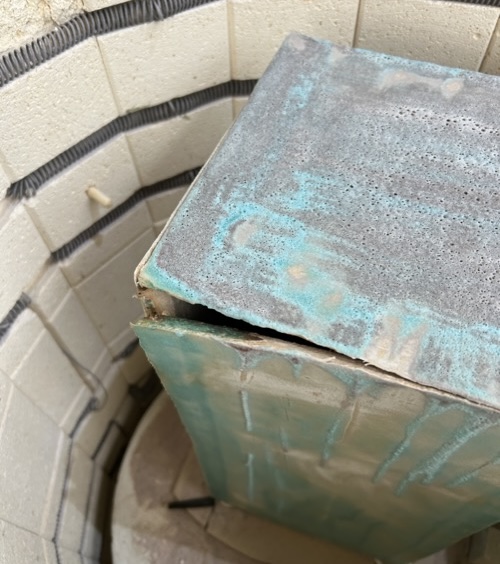
    So finally after all the challenges of firing schedules and making I opened Baby Diana the smaller kiln (being D or ABC – Agnes, Barbara and Collette – names which sound like cool and distant goddesses to me) which I’d tenaciously had to negotiate in this less than ideal process.  

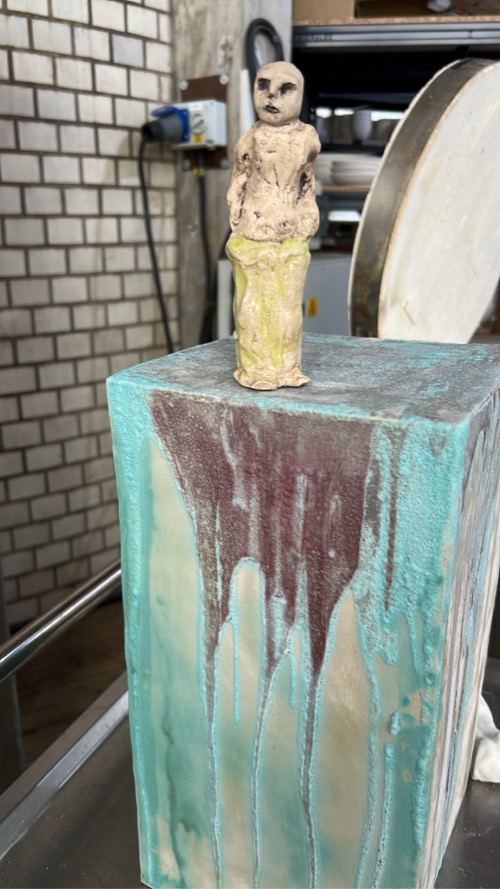
    First of all – the glaze on the large slab built box is the most beautiful effect.  Swamp lichen – a reactive glaze with Crater over it. It looks like water and foam and swimming pools which is a thing colour wise that has been emerging for me for this project.  (I’ve become interested in an extraordinary film called Ten Meter Tower a 17 minute short film training the camera on Swedish people considering jumping off a very high tower in a local pool – which I think is another whole post…)

    It also has a giant crack across the corner side seam.  Where the box fell and was reassembled during making.  When this sort of thing happens (scaling up slab building, the box was tricky) it’s kind of inevitable that even though you fix the seam beautifully, inside and out, and then you even add a little vinegar slip when it’s drying…the clay remembers like a damaged child.  It all comes out when it’s all grown up. 

    So part of a breakthrough was that I was going to explore fragility.  That breaking things may be part of it. It’s almost poetic justice in a way.  But also the perfectionist that haunts and hampers me says – remember that girl on your course last year who used to present all thrown and failed pots as intentional…well…her…

    All sorts of narratives appear such as – ‘hey all the ceramicists know about this kind of crack’.  It’s not a beautiful accident – it’s poor making.  

    I feel at once full of hatred and joy.  Shame and excitement.  Disappointment and triumph.   Is this what making visual art is?  All art?  I remember the knot in my shoulders after listening to my first play read-through at RSC – it felt like the worst two hours of my life.  Even though everyone loved it and thought it went really well and my agent was crying.  (In a good way haha…)

    So.  

    I have things to play with, which is what I’m interested in anyway right?  Currently I have four different elements in my work which I could use – they don’t hang together in ay concievable coherent way.  In my opinion.  Right now. 

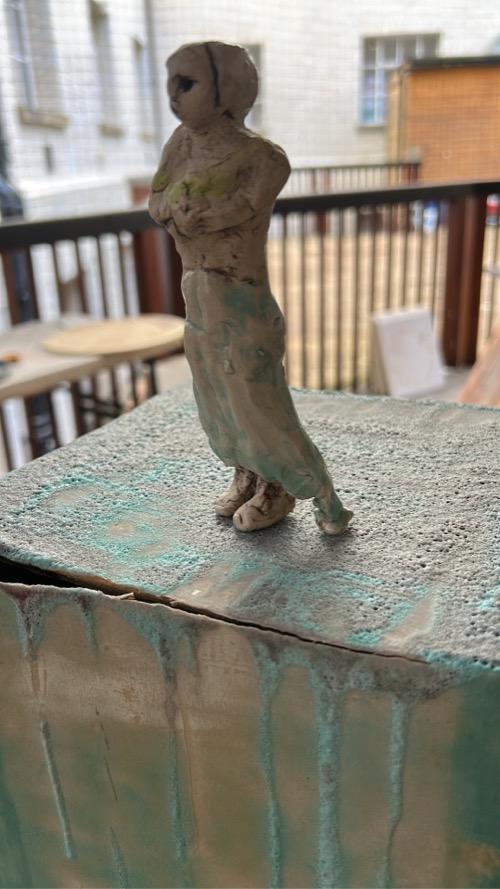
    The figures – some of them have an interesting quality.  Some are just ‘cute’.

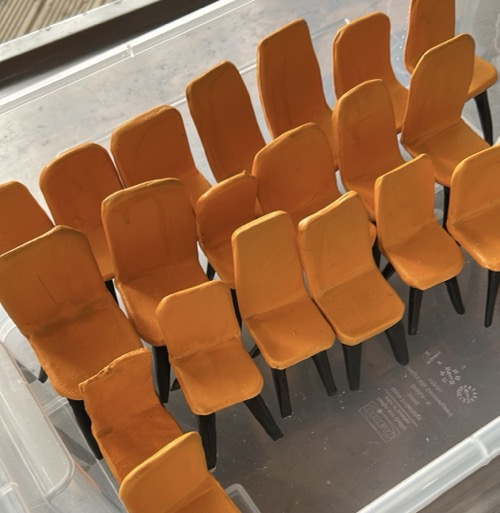
    I have made lots of tiny orange chairs.  They have no visual or stylistic connection to the other bits.  Apart from municipal swimming pools.  They might be good to play with.  

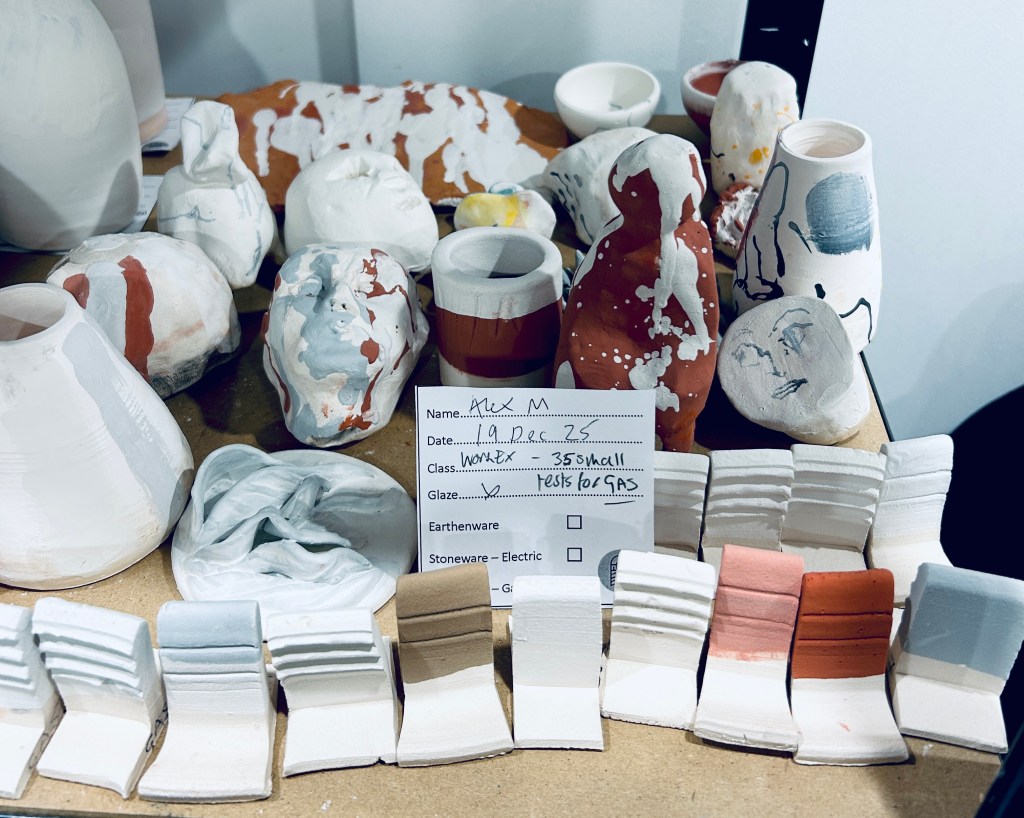
    The parian figures that I had to try so hard to get fired – they need a slow ramp to temperature – but can be fired in one glaze fire no bisque.  They’re…just.  I don’t like them.  They feel like tests that I should have finished ages ago.  I think they’re not going to be any part of whatever happens next.

    Another thing I could do is take a hammer to the whole thing.  

    Gaby – who I wrote of earlier – is teaching throwing on Tuesday in the Ceramics Gallery / Studio I work in – I will ask her what she would do.  Gaby reassembles the detritus of kiln firings.  I notice a small part of this is me wanting Ceramicsworld to give me an acceptable answer.

    Anyway.  Off to work…

    …and in the afternoon my friend Trui Malten walks into the Gallery.  Trui is an extraordinarily smart and funny theatre lighting designer.  I showed her my pictures of the beautiful glaze and the big crack.  And my Fine Art insecurities.  And she says – 


    “What would theatre say?  Put it in the space.  See what it means”

    She says it’s right that the crack is like it is.  Accidents and change have always been part of my practice.  That’s actually what I’m writing about according to my Study Statement.    

    ‘My friend is a theatre designer who got so sick of the transient nature of theatre he had to become an architect’. Trui is really funny and really smart as I say. 

    Chance.  Is there if you are open to it.  It’s always there.  

    Today as working am only able to join Jonathan’s session during my lunch break and it’s about ‘Dérive’.  The Situationist’s idea of wandering, drifting, following one’s nose.  And it’s not just a creative whim – it’s anti-capitalist.  It’s as if not more urgent now as the world is imploding into mediocrity, fake news and identikit shopping centres.  Alongside the rise of structural disenfranchisement, extremist right-wing politics, extremist misogny etc etc etc etc etc.

    Suddenly talking to Trui a whole multi-disciplinary chain of connections opens up.

    Maybe if I was riffing on my thoughts today, the class that I was half in and out of, the surprise inspiration from Trui it might look something like this 

    • my work, acceptable or not to the ceramicist world, to the art world, what does Gaby think, what does Collect 2026 think, that will be positive inspiration at least, but also overwhelming, my class is exploring ‘dérive’ and following their noses, it’s different to not be in the class I miss it, oh Trui arrives, she’s not in Italy, she’s bringing cakes and I forgot to pack snacks, theatre sets get thrown in a skip what a waste, what’s sustainable, damaged creative ceramic children, ah once again theatre has the answers for me, break everything and start again, it will be ok, why am I making this work that looks like theatre sets, that’s not ceramic art, then a guy walks in to the Gallery, he really enjoyed Collect will I be going (yes), look out for his work, he’s from Nova Scotia, Trui and I google him, Neil Forrest, oh look his work looks like theatre sets, little figures, I love ceramics, I hate ceramics.

    My friend Niall Ashdown is maybe one of the best improvisors in the world.  We teach together sometimes.  He often says when people question the ‘rules of improv’ that he wants to get a t-shirt made that says – 


    The Opposite is Also True
  • Je ne regrette rien 

    Remembering Philippe Gauler 1943-2026

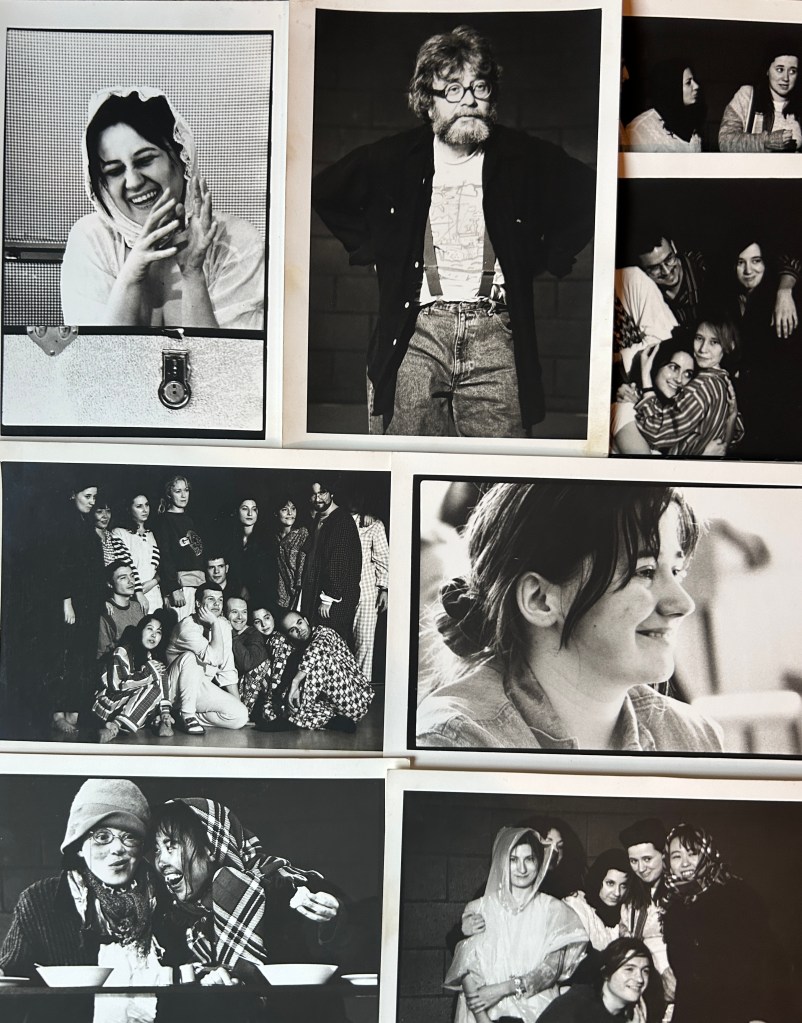
    Yesterday I went to Paris to attend the extraordinary funeral of the teacher who changed the course of my life Philippe Gaulier.  In the sometimes murky world of artist training Gaulier is perhaps the most widely and wildly misunderstood pedagogue of all.  Perhaps we all assembled from around the world yesterday – how many? maybe 600 of us – because we wanted to hold onto that magical thread of his teaching specifically by being together…because we were there…because we know it.  Perhaps we all feel tired by having to listen – every time his name comes up – to the broken record of criticism spewing from the mouths of people who never even went to his school regarding his somewhat unorthodox teaching style. As Simon McBurney put it he was –

    ‘provocative, demanding, deliberately inappropriate and utterly hilarious’ 

    The elusive cornerstone of his school was to find that ‘complicité’ on which McBurney, Arden and Magni founded the namesake company – the inferred danger and delight in being connected (with each other, with the audience) when we play.  Do we have pleasure to be on the stage?  If not why bore us? ’Adios, sit down immediately, my little friend’.  Gaulier actors read audience in a way that no other actors do and that is what I am proud to know. It will be in my bones.  It was in the bones of us, connected together when we – a giant congregation – burst into ‘Non, Je ne regrette rien’ along with Piaf as we saw the old fella off on his way.  And we might be messy and we may not do things ‘correctly’ but we will do it with heart and a kind of passion that is very rarely really seen on stage.  Spontaneous, huge applause, whooping, cheering, Bravo, Bravo went off as he was carried up the long theatrical staircase to disappear into the glittery backdrop of blue-sky mosaics of La Coupole in Pere Lechaise cemetery.    

    I began at Gaulier’s school aged 25, just two months after losing my mother.  Philippe taught me to feel again and how to be free.

    Why am I writing about this here?  Because what I am looking for is not and should not be definitive or even precisely known.  This is the same for fine art, for performance, for poetry, for playwriting, for art installation, for ceramics, for concept art, for music – definitely not for music – for opera, for dance, for education…for making anything at all really, I think.  

  • Risk and Taste

    Some weeks ago we were challenged to take a risk.  I didn’t do it because at the time I couldn’t think about what sort of risk I wanted to take.  My first thoughts about artists taking risks involves them making themselves extremely vulnerable, or exploring things that are really confrontational to people with conservative values (Yoko Ono, Marina Abramovic, Tracey Emin).  Thinking about my own blocks and resistance I noticed that risk, for me, is bound up with taste.  I’ve made a judgement call somewhere along the way where X is ok and Y is not.  

    Somehow particularly in ceramics.  Perhaps I’ve picked this up from other makers I look up to.  

    And partly it’s something about the fact that ceramics is tough badge to earn – it’s very technical, there are no shortcuts to experience, it’s slow and resource-hungry.  You had better get it right.  

    In my case I am drawn to the human experience – being from a physical theatre and story-telling background.  And yet I think I have an aversion to the figure in figurative ceramics – to capturing a human form.  So thus far I have kind of abstracted that by creating three-legged or pot-like figures.  Which look kind of alien – and that also doesn’t satisfy me.  I also often get the feedback that they’re ‘cute’ which makes me feel sad. 

    So maybe the biggest risk for me is to explore the human form.

    I decide to spend some time with the the human figure.  I get three books out of the library about the human figure in ceramics.  My husband says ‘why are they all so creepy?’

    I guess the human frozen in time is creepy. You can paint a face on a still thing but it remains a still thing. 2D imposed on 3D.  I guess there’s something of the puppet or doll – staple figures in any horror movie.  I wonder if the idea of the clay pot surviving the centuries is inevitably somewhere in our minds when looking at a ceramic object?

    In my theatre practice I have often worked with puppetry and one of the key things about a puppet is to ‘keep it breathing’.  Even when it’s still, we feel the breath.  Puppeteers think about the breath all the time – they breathe with the puppet.  If you stop the puppet’s body from having it’s life breath – say you just sit it down and move away – we say it ceases to ‘live’.

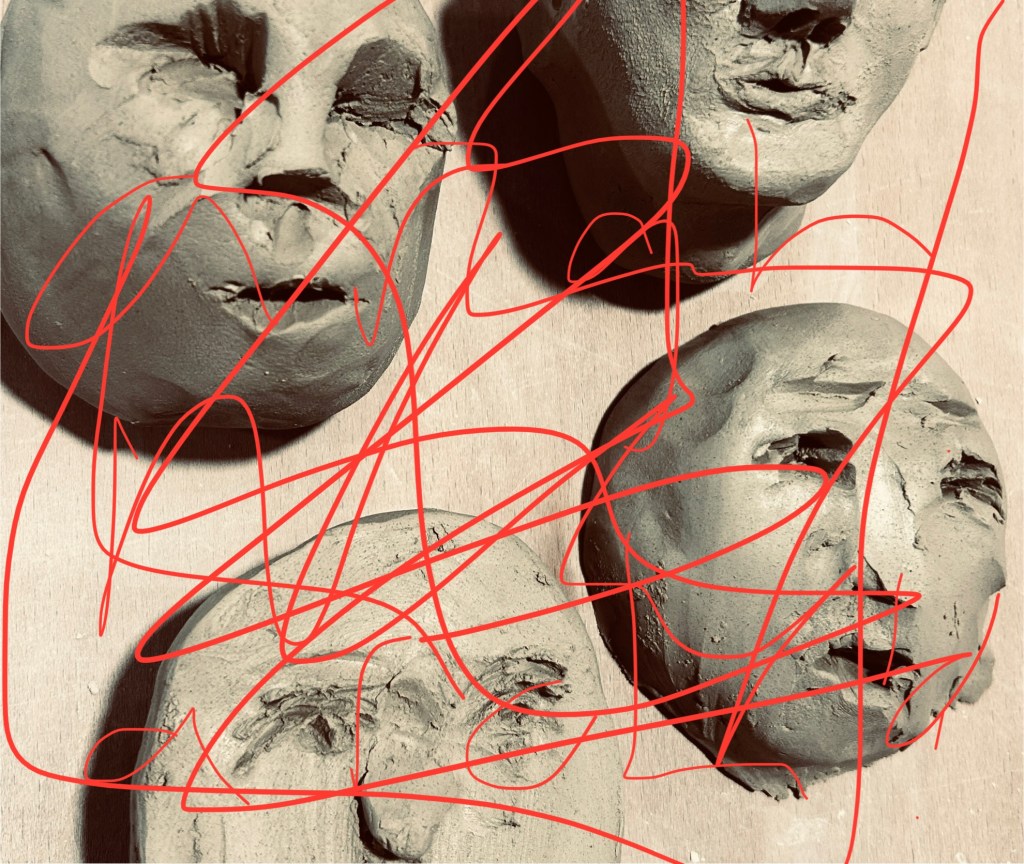
    You might think going into the studio and making a real human face isn’t going to kill me.  (I go to life drawing classes, I enjoy figurative paintings…).  But when I walk into my studio and try to make a figurative head I feel kind of sick.  If I’m honest – I feel kind of cheesy.  I tinker away with the human head and I hate it and hide it in a box.  I explore other less realistic, more abstracted faces.  I dislike them all.

    I enjoy the making.  There are technical considerations that are interesting to me – finishing a head or even a whole body one has to then slice it in half and hollow it out.  If the thing is going to stand on two feet – there has to be consideration of how it balances.  How will it sit in the kiln. It’s arms need to be propped up or they might warp.  I can imagine that making a truly realistic full size bust might be enjoyably challenging. 

    I don’t have a satisfying conclusion to this experiment.  I stop short of firing the things because I hate them so much.

    But I push on and decide to commit to making an angry menopausal wolf-woman, with high heels and a long bushy tail.  I think it might be the ugliest thing I’ve ever seen in my life.  Someone comes a long and says ‘oh, cute!’

    Onwards.

  • How to begin

    Beginning of my MA Fine Art : Digital at Central Saint Martins. First session.

    Kindness, compassion as ‘psychological safety’ – exploring the idea that these might be the foundations of an art practice as opposed to the idea of progression only coming through the pushy dynamic of ‘challenge’ in a more hard, aggressive way.  I’m really excited by this.  I’ll sign up right away please for psychological safety.  I come from a freelance theatre background, and whilst lip service might be played to ‘safety’ by salaried policy-makers, for the most part one is dealing with rejection and criticism on an almost daily basis – it’s part of the deal.  You have literally signed up as an actor to put your self out there and have your self pulled apart, judged and given the ‘yes’ or ‘no’.  Maybe the visual art world is no different but I’m excited by Jonathan’s choice to put upfront values of compassion and kindness.

    I’m also an improvisor, where saying ‘yes’ opens the portal to creativity.  I have two copies of Keith Johnstone’s 1981 book ‘Impro’.  Underlined in each is the line – 

    ‘There are people who prefer to say ‘Yes’, and there are people who prefer to say ‘No’.  Those who say ‘Yes’ are rewarded by the adventures they have, and those who say ‘No’ are rewarded by the safety they attain’.

    Through my improvisation practice I’ve experienced, hundreds of times, the adventure.  Also the ‘no’ sayers, and the safety dulling and literally blocking the work.  Saying ‘yes’ – to everything – became a foundational idea.  But it is not 1981 and this beautiful, complicated quote contains a lot to be unpacked now – questions about consent, ideas of safety having a value. 

    What does now feel like for me?  The geopolitical world feels like a bin fire.  Closer to home my theatre making practice feels vulnerable-making – and sometimes not in a good way.

    I don’t have any answers here.  This is just the beginning.  This is just asking some questions.  Getting down some notes.

    I don’t know yet what I’m going to put out in the world.  What I’m going to bring with me on the journey.  I do know that I’m going to take (from my theatre practice, from improv) the notion of play.

    Just playing.

    Seriously.  Just playing seriously and just playing for plays sake.

    In the session Olga said a lovely thing about the loss of innocence and play which I roughly remember as ‘when we are adults something is always for something’.

    Art-making is possibly the most vulnerable-making thing.   A community of practice with guiding principles of kindness and compassion held lightly around the edges seems like a fine idea – not to close off challenge but to enable it.  

    As Jonathan said instead of a scarcity mindset we’ll be ‘mindful, hungry, generous…the more we put in, the more there IS’

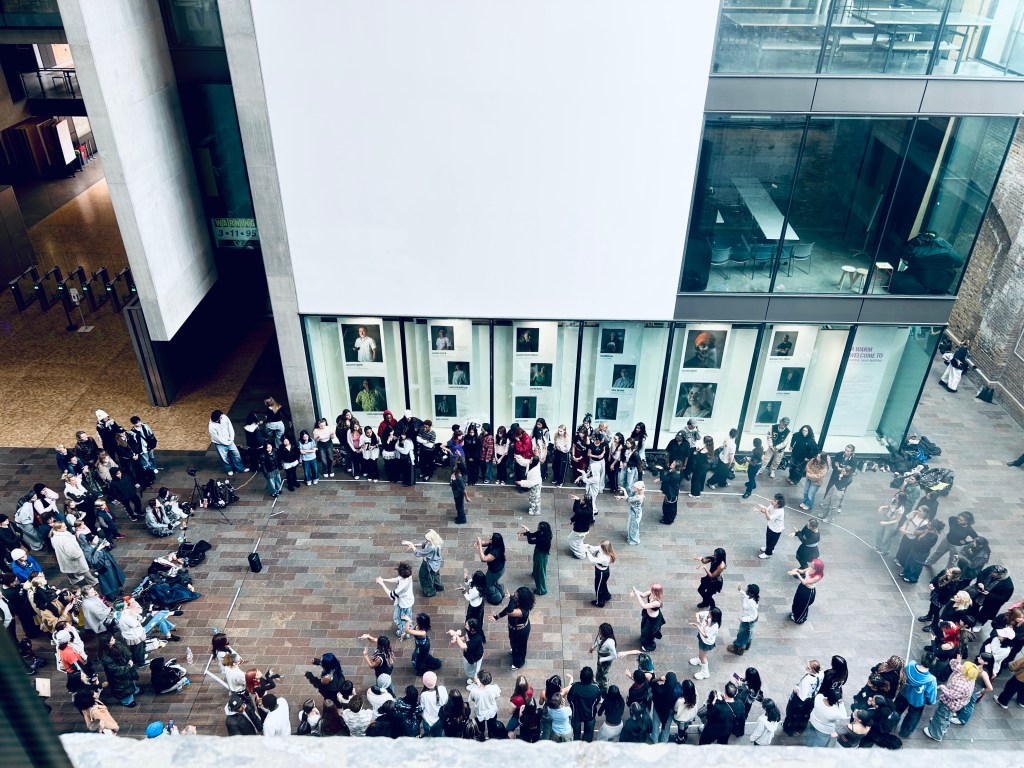
    (image : photograph taken from the library of Central Saint Martin’s students dancing in the Street, 06/10/2025)