Tag: chance

  • Talking to my Dad about making art

    Session with Rebecca Fortnum, artist and researcher, about ‘correspondence’.  Rethinking how we do research as artists.  Collecting data and other traditional methods may not work – and she raised the question who is the best judge of the work.  Is the audience?  Not always.  The critics?  The artist themself – and at what point?  Retrospectively or immediately after making a thing?  

    Fortnum has made work in ‘correspondence’ with other artists, often marginalised female practitioners, giving voices to say the Practiciennes supported by Rodin.  She explores their voices through letters, through investigating images from a different angle, her viewfinder closing in on large figurative sculpture and honing in on say, a detail in an expression. She gives us another way of looking at a 3D piece by flattening it into a painting.  I write down the word ‘prosopopoeia’ – making the inanimate have a voice.  Are we doing that in what we chose to hone in on?  Giving a moment or a feeling or an idea a form.  I feel that I’ve done that in the past with writing and today is a writing exercise day.  

    When we work in homage to another artist, or in response to or have correspondence with, we are still making our own voices heard.  As Tim brilliantly says ‘you are writing to the significance they have for you’.  

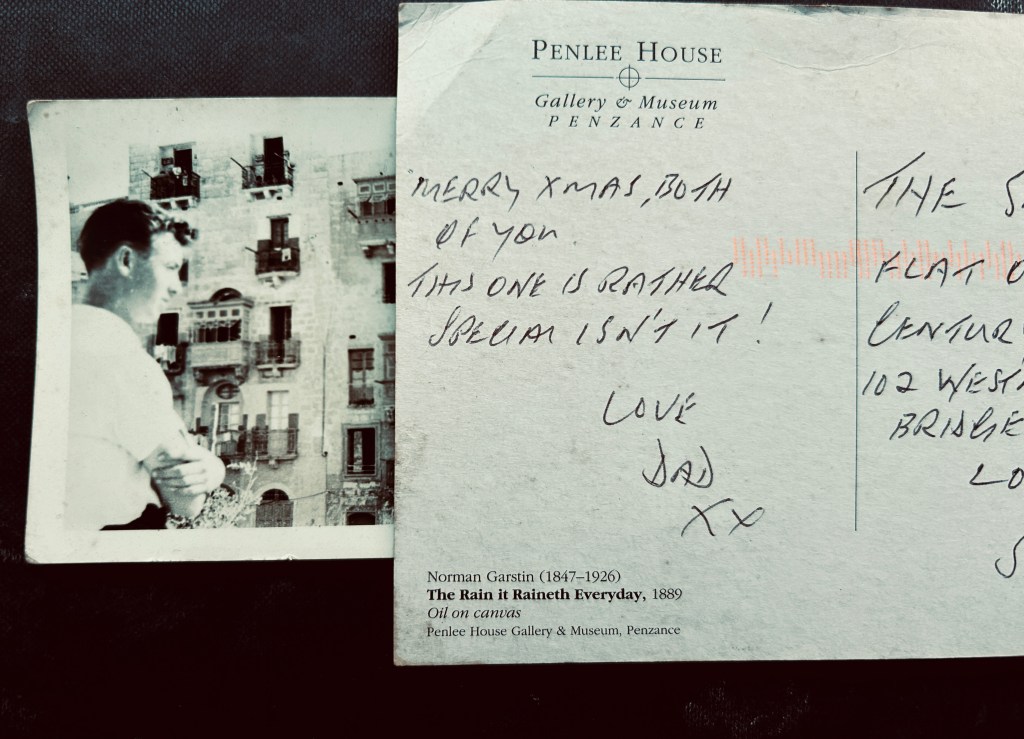
    We are asked who would you like to have a conversation with in relation to your work.  I work on an imagined dialogue with my late father. In his last months he told me about an opportunity he had by chance (coincidence comes up several times today) which saw him and a bunch of other South London kids who’d had a tough life, as part of a progressive education project, transported to the countryside and a classical education.  Something I have tried to research but never got very far with.  Partly maybe I resist that research because he kept this story from me for most of his life for his own reasons.  To me it is a moment of glorious post-war optimism which he chanced upon (how chance could have taken him another way) and that changed who he was and who I am in turn.  

    So I wrote about this and mostly I think I am actually writing about the hopelessness of ever getting a full answer from him now that he’s left us.  He was an unreliable narrator at the best of times.  

    *******

    Talking to my Dad about making art.

    But what did you make Dad?

    It was a golden time.  One of the tutors there was a contemporary of Henry Moore you know, very respected.  

    You said

    And then it was all over and Nan came to fetch me and we went back to Camberwell.  She was with Stan then.  Grandad Stan.  I didn’t like him.  

    But what did you make Dad?

    Well, that was it, it was all over.  It was the same when I got into Grammar School.  When I passed the eleven plus.  She got the hump about that.

    I know

    She had to fork out for a uniform and she was livid.  

    And that was Wilson’s Grammar School.

    What is Camberwell Art School yes.  Terrible place, Wilson’s.

    And Johnny said you had an exhibition in the little library on Camberwell Green?

    Yes

    What was it of Dad?

    Paintings.

    What kind?

    Near Kennedy’s Butchers.  Best sausages.

    In the whole of London.  But what were the paintings of Dad?

    It was a golden time at that school, the one I went to.  We listened to opera and read Shakespeare.

    And you learnt sculpture.

    Yes, she was a contemporary of the great Henry Moore.

    What sort of work did you make Dad?  

    I was pissed off when Elsie turned up with Stan. Nasty piece of work Stan.  

    And you went to Cambridge?

    I enrolled in the poly and I was a milkman.

    Did you still make art Dad?

    Lovely city Cambridge.  Full of people and ideas.

    Maybe you could have made some art later on.

    No Al, no.

    Why not Dad?

    Never time.

    Would you make some art now Dad, if you were still here?

    Maybe.

    What would we do today Dad?

    We would take a trip into town and see Rose Wylie if it’s still on.  A feast of colour. 
  • The Opposite is Also True

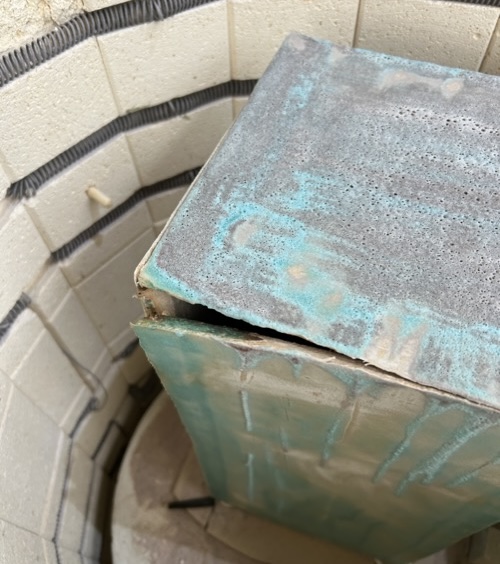
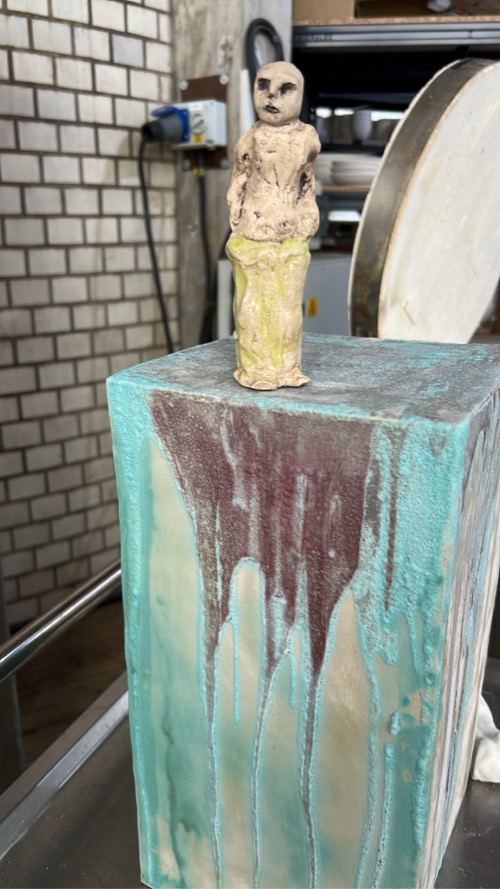
    So finally after all the challenges of firing schedules and making I opened Baby Diana the smaller kiln (being D or ABC – Agnes, Barbara and Collette – names which sound like cool and distant goddesses to me) which I’d tenaciously had to negotiate in this less than ideal process.  

    First of all – the glaze on the large slab built box is the most beautiful effect.  Swamp lichen – a reactive glaze with Crater over it. It looks like water and foam and swimming pools which is a thing colour wise that has been emerging for me for this project.  (I’ve become interested in an extraordinary film called Ten Meter Tower a 17 minute short film training the camera on Swedish people considering jumping off a very high tower in a local pool – which I think is another whole post…)

    It also has a giant crack across the corner side seam.  Where the box fell and was reassembled during making.  When this sort of thing happens (scaling up slab building, the box was tricky) it’s kind of inevitable that even though you fix the seam beautifully, inside and out, and then you even add a little vinegar slip when it’s drying…the clay remembers like a damaged child.  It all comes out when it’s all grown up. 

    So part of a breakthrough was that I was going to explore fragility.  That breaking things may be part of it. It’s almost poetic justice in a way.  But also the perfectionist that haunts and hampers me says – remember that girl on your course last year who used to present all thrown and failed pots as intentional…well…her…

    All sorts of narratives appear such as – ‘hey all the ceramicists know about this kind of crack’.  It’s not a beautiful accident – it’s poor making.  

    I feel at once full of hatred and joy.  Shame and excitement.  Disappointment and triumph.   Is this what making visual art is?  All art?  I remember the knot in my shoulders after listening to my first play read-through at RSC – it felt like the worst two hours of my life.  Even though everyone loved it and thought it went really well and my agent was crying.  (In a good way haha…)

    So.  

    I have things to play with, which is what I’m interested in anyway right?  Currently I have four different elements in my work which I could use – they don’t hang together in ay concievable coherent way.  In my opinion.  Right now. 

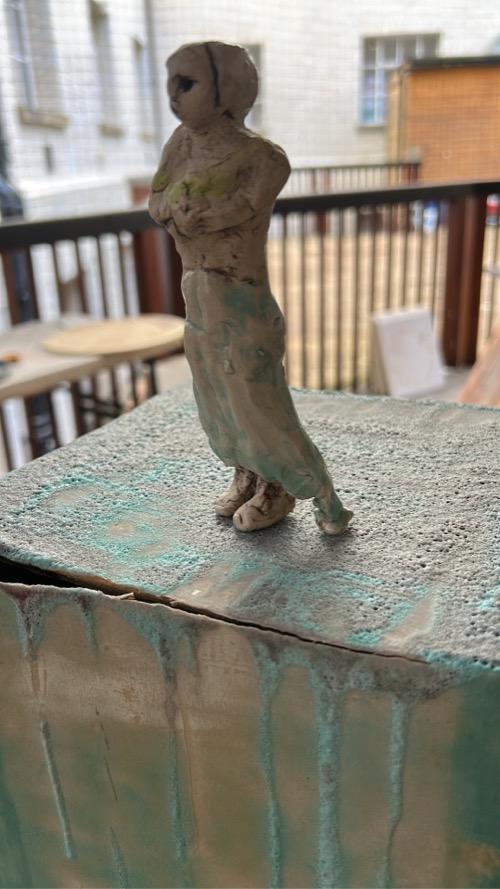
    The figures – some of them have an interesting quality.  Some are just ‘cute’.

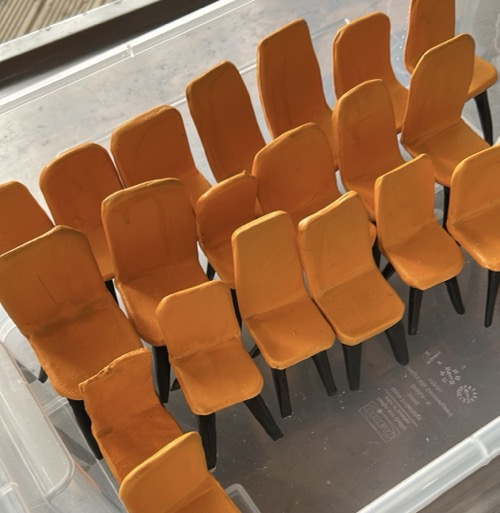
    I have made lots of tiny orange chairs.  They have no visual or stylistic connection to the other bits.  Apart from municipal swimming pools.  They might be good to play with.  

    The parian figures that I had to try so hard to get fired – they need a slow ramp to temperature – but can be fired in one glaze fire no bisque.  They’re…just.  I don’t like them.  They feel like tests that I should have finished ages ago.  I think they’re not going to be any part of whatever happens next.

    Another thing I could do is take a hammer to the whole thing.  

    Gaby – who I wrote of earlier – is teaching throwing on Tuesday in the Ceramics Gallery / Studio I work in – I will ask her what she would do.  Gaby reassembles the detritus of kiln firings.  I notice a small part of this is me wanting Ceramicsworld to give me an acceptable answer.

    Anyway.  Off to work…

    …and in the afternoon my friend Trui Malten walks into the Gallery.  Trui is an extraordinarily smart and funny theatre lighting designer.  I showed her my pictures of the beautiful glaze and the big crack.  And my Fine Art insecurities.  And she says – 


    “What would theatre say?  Put it in the space.  See what it means”

    She says it’s right that the crack is like it is.  Accidents and change have always been part of my practice.  That’s actually what I’m writing about according to my Study Statement.    

    ‘My friend is a theatre designer who got so sick of the transient nature of theatre he had to become an architect’. Trui is really funny and really smart as I say. 

    Chance.  Is there if you are open to it.  It’s always there.  

    Today as working am only able to join Jonathan’s session during my lunch break and it’s about ‘Dérive’.  The Situationist’s idea of wandering, drifting, following one’s nose.  And it’s not just a creative whim – it’s anti-capitalist.  It’s as if not more urgent now as the world is imploding into mediocrity, fake news and identikit shopping centres.  Alongside the rise of structural disenfranchisement, extremist right-wing politics, extremist misogny etc etc etc etc etc.

    Suddenly talking to Trui a whole multi-disciplinary chain of connections opens up.

    Maybe if I was riffing on my thoughts today, the class that I was half in and out of, the surprise inspiration from Trui it might look something like this 

    • my work, acceptable or not to the ceramicist world, to the art world, what does Gaby think, what does Collect 2026 think, that will be positive inspiration at least, but also overwhelming, my class is exploring ‘dérive’ and following their noses, it’s different to not be in the class I miss it, oh Trui arrives, she’s not in Italy, she’s bringing cakes and I forgot to pack snacks, theatre sets get thrown in a skip what a waste, what’s sustainable, damaged creative ceramic children, ah once again theatre has the answers for me, break everything and start again, it will be ok, why am I making this work that looks like theatre sets, that’s not ceramic art, then a guy walks in to the Gallery, he really enjoyed Collect will I be going (yes), look out for his work, he’s from Nova Scotia, Trui and I google him, Neil Forrest, oh look his work looks like theatre sets, little figures, I love ceramics, I hate ceramics.

    My friend Niall Ashdown is maybe one of the best improvisors in the world.  We teach together sometimes.  He often says when people question the ‘rules of improv’ that he wants to get a t-shirt made that says – 


    The Opposite is Also True