Had a long chat with Jonathan about the feedback on the Assessment and what is most helpful for me right now. Unpacking what I mean by something more critical, and tangible to build on. Especially in regards to research. Quite rightly he asked what would I tell myself in regards to feedback and this opened up a bigger thought about why I’m doing the MA. I see my imposter syndrome – in fact I bore myself with the amount of space that takes up in my blog. And I do feel I’m in the right place in terms of my approach to the journey – and take the encouragement to ‘do more of the same’. But I guess although the aim is independence in one’s practice I’m here for the critical engagement, and ultimately of course if I’m making art it’s not just for me. Like a hobby or an indulgence or something that exists just for myself. It is a public thing.
I want to find out how my work operates in relationship to the world. To outside myself. In dialogue with others. I want to affect people.
So unpacking that really helps clarify things for me. I am engaging with my own conversation with myself. But I’m here for the rigorousness of criticality and the outside world. And that doesn’t have to be in the art school tradition of aggressive critiques (we have enough artists who have been trained to talk impressively about their work in written explanation and I’m not convinced there’s much beyond defensiveness sometimes). I’m glad that this MA puts kindness at the forefront of the journey. But I’m here to go on a journey of discovery, and that means not just circling around myself, but to make use of the expertise and knowledge of Central Saint Martins.
So we unpacked my aims on the Study Statement – which starts with ‘break open my practice’. Which sounds dramatic to Jonathan, what do I mean? Actually that is exactly what I mean, I kind of feel that something is too contained, to subject to the demands of the medium and what I expect I have to do with it, the constraints of the firing schedule (always one step forward two steps back – now the firings are apparently fixed dates – but…every 6 weeks as opposed to the monthly on the contract), I feel like I want to put a bomb under my practice in order to see what remains.
I want to own it. Jonathan – own what exactly?
Well the transition from ideas to making is really clunky. Sketches to making feels really literal.
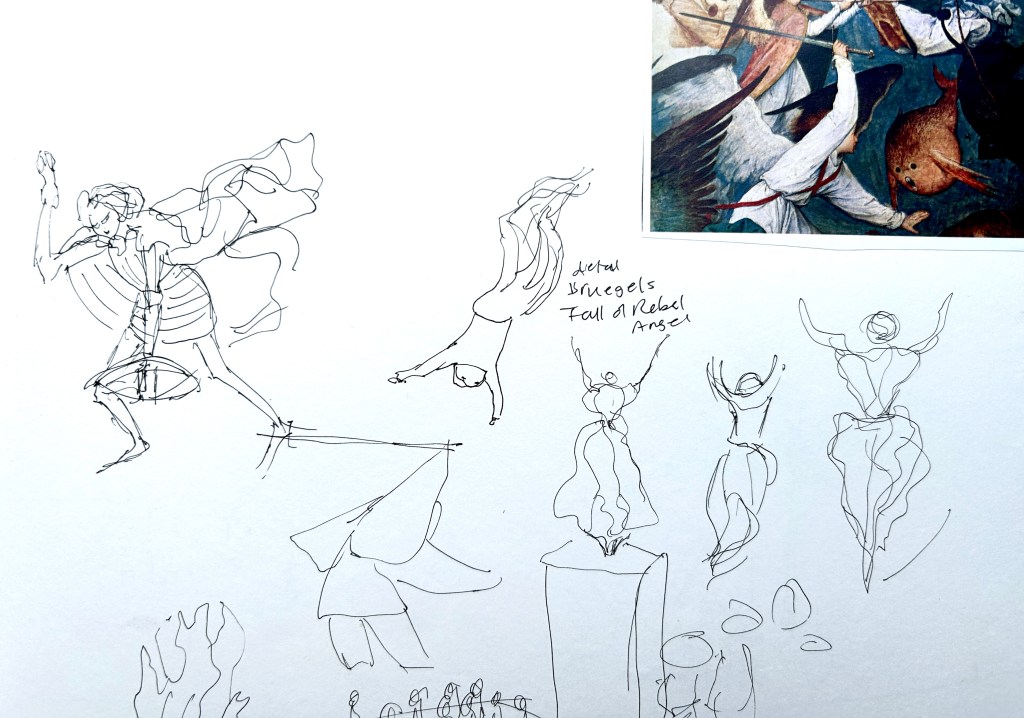
I talk about the journey from making this thing from ideas to what I presented. Now as I write this I’m looking in my sketchbook at drawings of Bruegel’s Mad Meg and the Fall of the Rebel Angels. None of which made it beyond the cutting room floor. Although actually…the idea of falling did. So maybe exploring any visual hunch is good. Blind alleys are maybe more interesting than just sticking to the path.
We talked about the qualities of other people’s work that inspires me most – I keep returning to Yuki Nakamura’s ‘Fragile like life’ porcelain footballs. More than anything I loved with that the concept of play and joy and of breath and life (deflated football) in this sad hospital garden. And the something so generous about the ‘here and gone’ nature of the installation that speaks to me of the weirdness of time spent in the bubble of caring and hospital visits.
I also speak about my friend Tim Crouch’s play An Oak Tree. I’m going to talk about that in the next blog post (which I was halfway through writing when this Jonathan conversation came in)
Tim is an interesting example for me. An actor turned playwright doesn’t quite sum it up. Aside from Caryl Churchill he’s probable the most ground-breaking playwright in the UK. He’s kind of moved playwrighting towards conceptual art. But what I want to say at this point is – there is this care and attention, simply to Nakamura’s piece, of how the work really works for an audience. Beyond basic curatorial choices, drilling deeper into how and why the audience meets the work in the way that it does.
It’s that specificity I am after.
That maybe what ‘owning it’ would look like. I understand audience (Gaulier taught me that, improv taught me that, making site specific theatre on beaches and in village halls and working mens clubs, my indie theatre company was all about how to mess with the live experience). Staging the chairs and the figures and the plinth and being very deliberate about how they were presented in the space was a positive thing.
So the space between my experience and what I want to do with my work is at the pull between intention and spontaneity.
When it’s out the in the world I can’t control the experience in the way I can with live performance. Although our long form improv shows were in the the chaos of the unknown we did work in great detail on how we controlled that one sentence set-up at the start for the audience – the only scripted line – in order to allow the audience to put aside their expectations, nervousness and cynicism about whether it’s even improvised at all – so that they could get on with experiencing the thing we wanted them to experience.
I think I’m often most creative when I’m creating perverse conditions for my work.
And perhaps that’s what I want to break open.
Feeling. Relationship. What relates. What is affective?
This is not about controlling meaning. This is not about starting with the end in mind. This is definitely not about a textual explanation on a card on the wall. This is about interrogating the conditions in which the audience meets the work whilst – and this is the paradoxical bit perhaps – whilst giving them space to do whatever they want with it.
So to go back to improv – we are letting go of all control over the structure and meaning and in fact also the quality perhaps of the story we tell – in favour of allowing the wild ride of spontaneity. And we’re allowing them to believe in something that we’re told is impossible – because conventional practice would have us believe it takes one genius man in a room to write a play. Jonathan reminded me of this quote from Keith Johnstone’s seminal ‘Impro’
“People try to use what they know. They want to be ‘right.’ But I prefer to see people who don’t know what they’re doing and take strange paths.”
I worked though some big things in this generous conversation with Jonathan in how my audience meet the work. Or maybe the question is what is it about the work that allows my practice to meet the audience.
That’s maybe why I asked the question ‘what’s the most exciting thing that is growing’. Because that’s what I need to know, and that’s not ‘what’s most exciting’ to me. That’s an outward seeking question, in relation with my work and the world.

