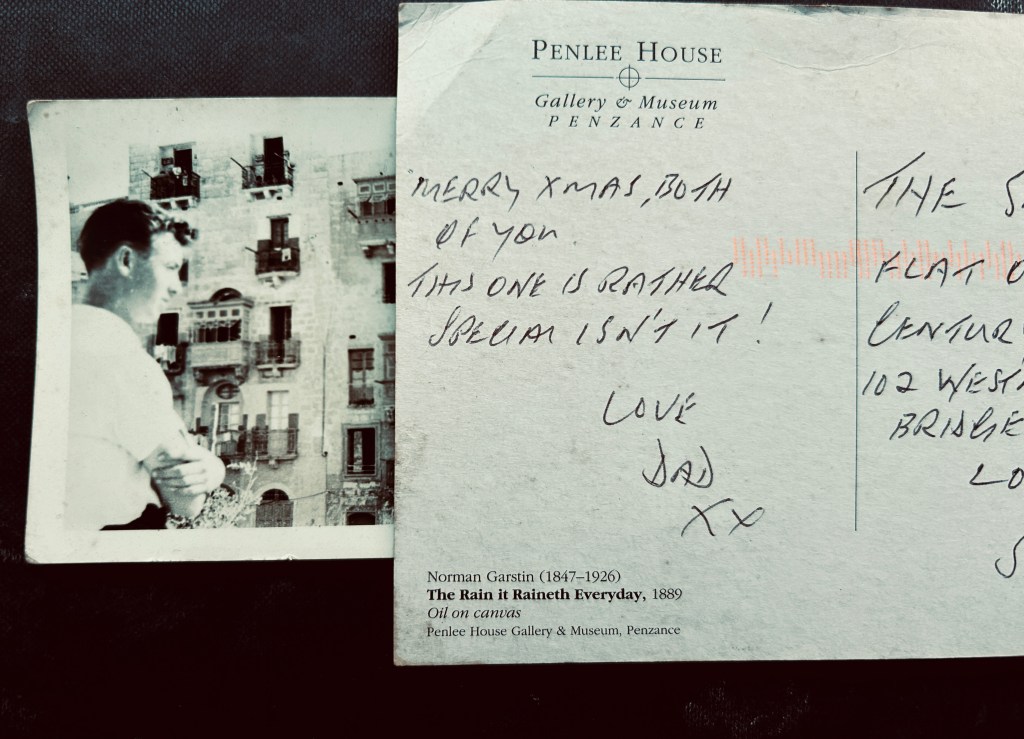
Session with Rebecca Fortnum, artist and researcher, about ‘correspondence’. Rethinking how we do research as artists. Collecting data and other traditional methods may not work – and she raised the question who is the best judge of the work. Is the audience? Not always. The critics? The artist themself – and at what point? Retrospectively or immediately after making a thing?
Fortnum has made work in ‘correspondence’ with other artists, often marginalised female practitioners, giving voices to say the Practiciennes supported by Rodin. She explores their voices through letters, through investigating images from a different angle, her viewfinder closing in on large figurative sculpture and honing in on say, a detail in an expression. She gives us another way of looking at a 3D piece by flattening it into a painting. I write down the word ‘prosopopoeia’ – making the inanimate have a voice. Are we doing that in what we chose to hone in on? Giving a moment or a feeling or an idea a form. I feel that I’ve done that in the past with writing and today is a writing exercise day.
When we work in homage to another artist, or in response to or have correspondence with, we are still making our own voices heard. As Tim brilliantly says ‘you are writing to the significance they have for you’.
We are asked who would you like to have a conversation with in relation to your work. I work on an imagined dialogue with my late father. In his last months he told me about an opportunity he had by chance (coincidence comes up several times today) which saw him and a bunch of other South London kids who’d had a tough life, as part of a progressive education project, transported to the countryside and a classical education. Something I have tried to research but never got very far with. Partly maybe I resist that research because he kept this story from me for most of his life for his own reasons. To me it is a moment of glorious post-war optimism which he chanced upon (how chance could have taken him another way) and that changed who he was and who I am in turn.
So I wrote about this and mostly I think I am actually writing about the hopelessness of ever getting a full answer from him now that he’s left us. He was an unreliable narrator at the best of times.
*******
Talking to my Dad about making art.
But what did you make Dad?
It was a golden time. One of the tutors there was a contemporary of Henry Moore you know, very respected.
You said
And then it was all over and Nan came to fetch me and we went back to Camberwell. She was with Stan then. Grandad Stan. I didn’t like him.
But what did you make Dad?
Well, that was it, it was all over. It was the same when I got into Grammar School. When I passed the eleven plus. She got the hump about that.
I know
She had to fork out for a uniform and she was livid.
And that was Wilson’s Grammar School.
What is Camberwell Art School yes. Terrible place, Wilson’s.
And Johnny said you had an exhibition in the little library on Camberwell Green?
Yes
What was it of Dad?
Paintings.
What kind?
Near Kennedy’s Butchers. Best sausages.
In the whole of London. But what were the paintings of Dad?
It was a golden time at that school, the one I went to. We listened to opera and read Shakespeare.
And you learnt sculpture.
Yes, she was a contemporary of the great Henry Moore.
What sort of work did you make Dad?
I was pissed off when Elsie turned up with Stan. Nasty piece of work Stan.
And you went to Cambridge?
I enrolled in the poly and I was a milkman.
Did you still make art Dad?
Lovely city Cambridge. Full of people and ideas.
Maybe you could have made some art later on.
No Al, no.
Why not Dad?
Never time.
Would you make some art now Dad, if you were still here?
Maybe.
What would we do today Dad?
We would take a trip into town and see Rose Wylie if it’s still on. A feast of colour.

