Tag: kindness

  • Why should we care?

    Things are sort of joining up with my theatre practice.  This is my third tutorial with Jonathan.

    I’ve been compartmentalising the two things which makes no sense.  I talk to Jonathan about the themes in my recent blogs – looking more closely at my theatre making influences. 

    I also enjoyed writing in the Rebecca Fortnum class.  I hadn’t done it in a while because of a block, and a situation with someone which put me off.  But mostly I didn’t write because I felt I didn’t want to make my plays work in the conventional dramatic arc way.  People who commissioned my plays would say they want form-breaking plays but then by the second draft they wanted a dramatic arc.  And actually as a theatre maker I’d always been taking risks with the form.

    I’m pushing about the research question, it’s shifting a bit.  

    It’s becoming more about how the audience has agency.  And the Jennifer Doyle book, the thing about feeling.  And how that is in contemporary art – it’s really slippery – how artists deal with feelings and audience.

    Jonathan – how do you define the difference between audience agency and audience interaction?

    I think in so-called immersive work audience interaction is so ‘pat’ – we did this and that made the audience do that.  It manipulates the audience – it’s like there’s not respect.  It sort of feels as exclusive as how people describe regular theatre.  The people who attend live art or immersive art – it’s like an in-joke.  A club.  It’s inaccessible.

    We talk a bit about how Tim’s play Toto Kerblammo uses binaural sound – and Jonathan has played a lot with that.  The difference being spatial for the sound.  So Tim and his sound designer have imagined how the sound of human feelings are for a dog.  ‘This is what you sound like when you feel abandoned’.  Beautiful. 

    Jonathan – I asked about agency and interaction.  You took audience interaction as an actor interacting.  I was thinking about the work in say an exhibition.

    Interactive art can be quite shallow e.g. digital computing ‘I move and something changes’.  Audience as paint brush.  So is the difference respect – in the word agency?

    I say yes – respect for their intelligence and imagination.  You could say when you control the entire experience – which theatre tries to do, tries to shape – there’s less space for the audience.  But perhaps a piece of abstract art may leave tonnes of space for the audience to do what they want with it.  But also there’s a sort of coolness – ‘make of it what you will’ – that the intentions of the artist is so distant to the response that you could say the artist doesn’t seem to care?

    Jonathan – is time to do with that?  It starts at 7.30pm – is there a fundamental difference there?

    And if you’re not controlling what time the audience spend there, say maybe something happens at 4 but otherwise you can go in and out.   Then what? 

    Jonathan loved the Rachel Maclean show in Liverpool which does loop round and round, but had a clock counting down and if you see it on that particular time there is an experience like theatre.  She uses curtains opening automatically at certain times.  

    I wish I could see it.  

    We talk about actor Ralph Little playing being tortured in a production of The Spy Who Came In From The Cold – which Jonathan saw recently and felt really uncomfortable at.  There is an experience of coming outside of the show/story and being live in a room when Little has his head held underwater.   Are you watching anymore or worrying about being the audience member who witnessed the accidental death of a beloved TV actor?

    Of course it will have been done really safely – a tube, a safe word etc – although it was pretty well done.  Still viscerally different from watching it on film.

    I say that very few film-makers have ever got away with doing ‘meta’ film.  We buy into the game that it is real.  

    We talk about the sense that the audience have more agency in the object animation theatre piece I saw ‘Matter Era’ – because they know more about what’s going on than the puppeteers with magnets under the metal stage.  It was time and time again about jeopardy and failure – and like improv – the audience understood that in the moment.

    I found the design breathtakingly simple.  And it was a really long time before anything happened. Too long in theatre terms.  Playwright / Director David Lan (formerly at the Young Vic) – used to say when a show starts there is a finite amount of time for the audience before they lose interest.  But we didn’t really even notice Matter Era start…just these oily blueberries started to just…be there.  You couldn’t quite say what those things were representing, the furry things that were breathing, the sticks, silly bits of string.  You projected what you saw in it.  

    It pushed the limits of what time should do in theatre.  

    The sound designer was improvising off the action in the room.  

    It was just wild.  

    The way the final image arrived out of the various objects, was kind of an accident, an improvised story sort of, of failure and effort.  

    It felt like the objects had an inner life.

    In collusion with the audience.

    I describe Animo an improvised studio show I used to do with Improbable Theatre, where sometimes we would bring pieces of newspaper to life.

    Matter Era was. Right on the edge of visual art.  And theatre.

    People kind of respected the space, but didn’t interfere – respecting the rules of the game – which was to discover it.  It wasn’t like some performance art piece where it was more ‘I left this here do something with it’

    We talk a bit about the problems of badly done performance art – the lack of consideration of the space, where the audience are to be, how the elements are going to play out and whether that has even been tested. Surely there’s a way of making good quality decisions about how performance art is going to work – even if you then want to break all the conventions and ‘rules’?

    With Matter Era you had that sense of being in safe hands even though they were improvising, and even though they were pushing their control of the work to the limits.

    And yet like improv – if it’s really genuine and you put aside comedy sketches – you have to embrace the possibility of it really failing.  If it’s to be really improvised.  

    There are ways of controlling improv so it doesn’t fail – putting in tricks and landing places, rehearsing stock moves, casting big star improvisors who always make a ‘good night of it’.  All of the mid-scale improv does this.  But real improvised work is different.

    The audience embracing the possibility of failure.  That’s the sweet spot.

    Jonathan makes a note of this – as he feels from his perspective that this line of enquiry could make a research paper that’s really worth reading.  Bringing that theatre maker perspective – how the audience have agency (rather than just interaction), teasing that and understanding that.  That could be really valuable for Fine Art practice. That has implications of what we make. And how we curate and set up exhibitions.  

    A PHD colleague of Jonathan’s – writing about Curation – was thinking about ‘palette cleansers’ – how in a world where we’re bombarded with millions of images – can we visually cleanse the pallets and experience the flavours.  A bit like the theatre – the rituals of the stairs and the tickets and the seats.  Jonathan singing You’ll Never Walk Alone at the football in Liverpool with the years of history collectively – we’re doing something together in the moment.  A lot to tease out and maybe beneficial.

    Coming full circle – I’ve been thinking about this all my life.

    But what are the lessons that can be learned across those boundaries for art practice?

    Because as Doyle says – there’s a sort of coolness – it often feels it doesn’t sort of matter to the artist what happens with the audience experience.  

    It’s about to do with caring about what the audience get.  Without contriving it.  

    I talk about my Improbable Theatre friend Lee Simpson’s idea of finding a perfect moment in theatre.  He tells this story.  It’s like a shy deer has wandered on – and we all hold our breath because a wrong feeling or noise and it will run off.  The key point is liveness.  It’s just wandered in.  Now we could shoot the deer, stuff it, wheel it in on a trolley at the same moment every night.  But it won’t be the same because it won’t be spontaneous.

    There’s a fragility. Allowing the audience’s care to be part of the experience.

    Jonathan – what are the lessons of that for an exhibition that may be open for a month or more?

    There can be some kind of liveness on the opening night, but the rest of the time?

    Could you have the quality of the deer in a piece that stays for a long time with no-one present.

    Is it about time-based work?  Or can you have a sense of spontaneity in the way the work looks or is set up so it has a sense of liveness?

    Gosh I need another year.

    Quote Jonathan found recently – ‘All art is the creation of forms symbolic of human feeling’ – Susan Langer?

    The objects in Matter Era had feeling.  I remember a theatre making peer of mine Paul Hunter (of Told By An Idiot) saying that if a character is angry instead of writing dialogue literally, like you would say in Eastenders, we might just see them burst into flames.

    What’s really speaking to me in Doyle’s work is there’s this coolness in some contemporary art that leaves me cold.  Is it coolness towards the audience?

    There is space and agency for what the audience does with it – do what you like with it… but where does that tip over into ‘I don’t even care what your response is or even if I did anything for you at all – you’re so far away from me’.

    A colleague of Jonathan’s wrote a course called Public Art.  It would sit within socially engaged practice (he notes an essay worth reading that’s very against socially engaged practice).  Joseph Beuys talks of Social Sculpture – the idea of audience and artist are together forming things.  It’s let see what happens – put things in place and see what happens.  Anyway one of his definitions of whether art is public or not (Duchamp said it becomes art when audience sees it) – he said a work of art is not a work of art unless two strangers talk about it together.  

    He was thinking about work in a Gallery.  Can be love, anger or whatever it is that provokes you but you spoke to someone you don’t know and a whole different experience appears.  A thought experiment – it needs that level of engagement before it becomes something real.  

    And I think there’s that thing about access – and how I think a lot of ‘immersive theatre’ is an exclusive club.  Who’s going to turn to the person next to them? A middle class person could do that like a shot. 

    But also non-‘arts attendees’ might say ‘what’s that? My five year old son could do that’

    Who owns it?

    Jonathan talks of a 13th Century painting bought by the city of Hull when it was City of Culture.  It cost 3 million pounds.  He remembers a guy with his kid, didn’t look like he went to shows like this.  He walked straight up to it.  He said to his son ‘That’s ours that is’, then to Jonathan ‘It’s good isn’t it?’  That sense of civic pride.  700 years after the thing was made.

    Jonathan thinks there’s a lot in this line of enquiry.  “It’s a really interesting paper but it plays into your practice, there’s value in it.  

    Accept your expertise and bring that across to this – that is real value – whatever it looks like.

    It’s a big area sure, so you’ll have to narrow it down, but embrace your decades of expertise and all of us will benefit.”  
  • Perverse conditions

    Had a long chat with Jonathan about the feedback on the Assessment and what is most helpful for me right now.  Unpacking what I mean by something more critical, and tangible to build on.  Especially in regards to research.  Quite rightly he asked what would I tell myself in regards to feedback and this opened up a bigger thought about why I’m doing the MA.  I see my imposter syndrome – in fact I bore myself with the amount of space that takes up in my blog.   And I do feel I’m in the right place in terms of my approach to the journey – and take the encouragement to ‘do more of the same’.  But I guess although the aim is independence in one’s practice I’m here for the critical engagement, and ultimately of course if I’m making art it’s not just for me.  Like a hobby or an indulgence or something that exists just for myself.  It is a public thing.

    I want to find out how my work operates in relationship to the world.  To outside myself.  In dialogue with others.  I want to affect people.  

    So unpacking that really helps clarify things for me.  I am engaging with my own conversation with myself.  But I’m here for the rigorousness of criticality and the outside world.  And that doesn’t have to be in the art school tradition of aggressive critiques (we have enough artists who have been trained to talk impressively about their work in written explanation and I’m not convinced there’s much beyond defensiveness sometimes).  I’m glad that this MA puts kindness at the forefront of the journey.  But I’m here to go on a journey of discovery, and that means not just circling around myself, but to make use of the expertise and knowledge of Central Saint Martins. 

    So we unpacked my aims on the Study Statement – which starts with ‘break open my practice’.  Which sounds dramatic to Jonathan, what do I mean?  Actually that is exactly what I mean, I kind of feel that something is too contained, to subject to the demands of the medium and what I expect I have to do with it, the constraints of the firing schedule (always one step forward two steps back – now the firings are apparently fixed dates – but…every 6 weeks as opposed to the monthly on the contract), I feel like I want to put a bomb under my practice in order to see what remains.  

    I want to own it.  Jonathan – own what exactly?

    Well the transition from ideas to making is really clunky.  Sketches to making feels really literal. 

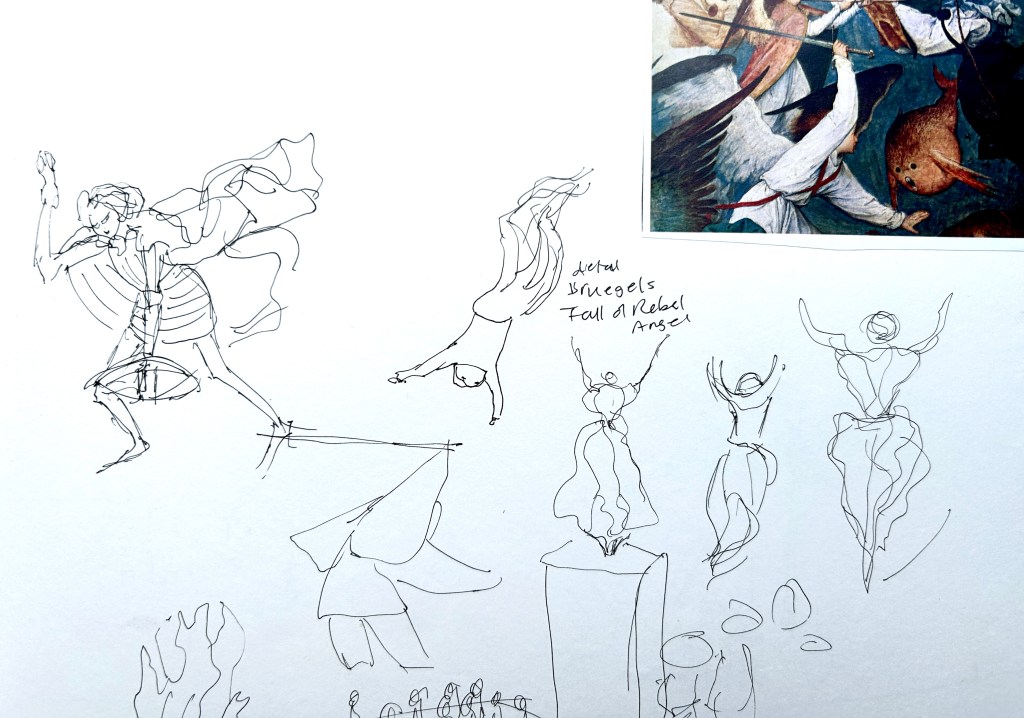
    I talk about the journey from making this thing from ideas to what I presented.  Now as I write this I’m looking in my sketchbook at drawings of Bruegel’s Mad Meg and the Fall of the Rebel Angels.  None of which made it beyond the cutting room floor.  Although actually…the idea of falling did.  So maybe exploring any visual hunch is good.  Blind alleys are maybe more interesting than just sticking to the path.  

    We talked about the qualities of other people’s work that inspires me most – I keep returning to Yuki Nakamura’s ‘Fragile like life’ porcelain footballs.  More than anything I loved with that the concept of play and joy and of breath and life (deflated football) in this sad hospital garden.  And the something so generous about the ‘here and gone’ nature of the installation that speaks to me of the weirdness of time spent in the bubble of caring and hospital visits.  

    I also speak about my friend Tim Crouch’s play An Oak Tree.  I’m going to talk about that in the next blog post (which I was halfway through writing when this Jonathan conversation came in) 

    Tim is an interesting example for me.  An actor turned playwright doesn’t quite sum it up.  Aside from Caryl Churchill he’s probable the most ground-breaking playwright in the UK.   He’s kind of moved playwrighting towards conceptual art.  But what I want to say at this point is – there is this care and attention, simply to Nakamura’s piece, of how the work really works for an audience. Beyond basic curatorial choices, drilling deeper into how and why the audience meets the work in the way that it does.  

    It’s that specificity I am after.  

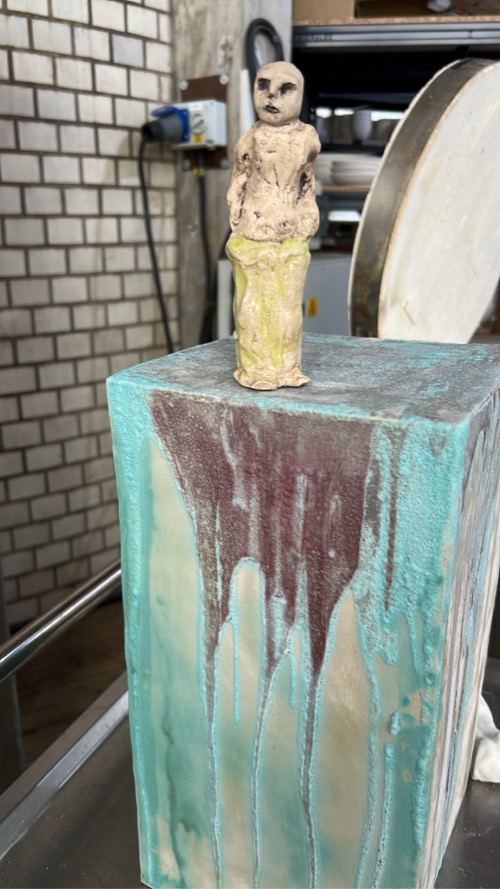
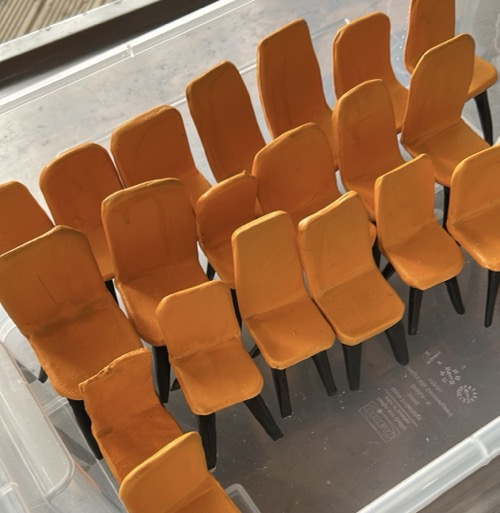
    That maybe what ‘owning it’ would look like.  I understand audience (Gaulier taught me that, improv taught me that, making site specific theatre on beaches and in village halls and working mens clubs, my indie theatre company was all about how to mess with the live experience).  Staging the chairs and the figures and the plinth and being very deliberate about how they were presented in the space was a positive thing.  

    So the space between my experience and what I want to do with my work is at the pull between intention and spontaneity.  

    When it’s out the in the world I can’t control the experience in the way I can with live performance.  Although our long form improv shows were in the the chaos of the unknown we did work in great detail on how we controlled that one sentence set-up at the start for the audience – the only scripted line – in order to allow the audience to put aside their expectations, nervousness and cynicism about whether it’s even improvised at all – so that they could get on with experiencing the thing we wanted them to experience. 

    I think I’m often most creative when I’m creating perverse conditions for my work.  

    And perhaps that’s what I want to break open.  

    Feeling.  Relationship. What relates.  What is affective?

    This is not about controlling meaning.  This is not about starting with the end in mind.  This is definitely not about a textual explanation on a card on the wall.  This is about interrogating the conditions in which the audience meets the work whilst – and this is the paradoxical bit perhaps – whilst giving them space to do whatever they want with it.  

    So to go back to improv – we are letting go of all control over the structure and meaning and in fact also the quality perhaps of the story we tell – in favour of allowing the wild ride of spontaneity.  And we’re allowing them to believe in something that we’re told is impossible – because conventional practice would have us believe it takes one genius man in a room to write a play.   Jonathan reminded me of this quote from Keith Johnstone’s seminal ‘Impro’


    “People try to use what they know. They want to be ‘right.’ But I prefer to see people who don’t know what they’re doing and take strange paths.”

    I worked though some big things in this generous conversation with Jonathan in how my audience meet the work.  Or maybe the question is what is it about the work that allows my practice to meet the audience.

    That’s maybe why I asked the question ‘what’s the most exciting thing that is growing’.  Because that’s what I need to know, and that’s not ‘what’s most exciting’ to me.  That’s an outward seeking question, in relation with my work and the world. 

  • The Opposite is Also True

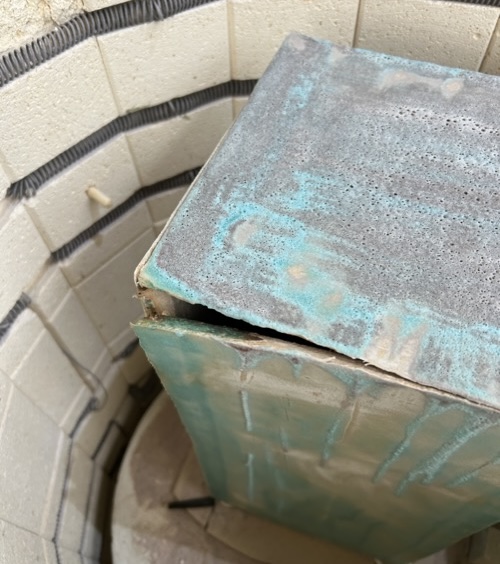
    So finally after all the challenges of firing schedules and making I opened Baby Diana the smaller kiln (being D or ABC – Agnes, Barbara and Collette – names which sound like cool and distant goddesses to me) which I’d tenaciously had to negotiate in this less than ideal process.  

    First of all – the glaze on the large slab built box is the most beautiful effect.  Swamp lichen – a reactive glaze with Crater over it. It looks like water and foam and swimming pools which is a thing colour wise that has been emerging for me for this project.  (I’ve become interested in an extraordinary film called Ten Meter Tower a 17 minute short film training the camera on Swedish people considering jumping off a very high tower in a local pool – which I think is another whole post…)

    It also has a giant crack across the corner side seam.  Where the box fell and was reassembled during making.  When this sort of thing happens (scaling up slab building, the box was tricky) it’s kind of inevitable that even though you fix the seam beautifully, inside and out, and then you even add a little vinegar slip when it’s drying…the clay remembers like a damaged child.  It all comes out when it’s all grown up. 

    So part of a breakthrough was that I was going to explore fragility.  That breaking things may be part of it. It’s almost poetic justice in a way.  But also the perfectionist that haunts and hampers me says – remember that girl on your course last year who used to present all thrown and failed pots as intentional…well…her…

    All sorts of narratives appear such as – ‘hey all the ceramicists know about this kind of crack’.  It’s not a beautiful accident – it’s poor making.  

    I feel at once full of hatred and joy.  Shame and excitement.  Disappointment and triumph.   Is this what making visual art is?  All art?  I remember the knot in my shoulders after listening to my first play read-through at RSC – it felt like the worst two hours of my life.  Even though everyone loved it and thought it went really well and my agent was crying.  (In a good way haha…)

    So.  

    I have things to play with, which is what I’m interested in anyway right?  Currently I have four different elements in my work which I could use – they don’t hang together in ay concievable coherent way.  In my opinion.  Right now. 

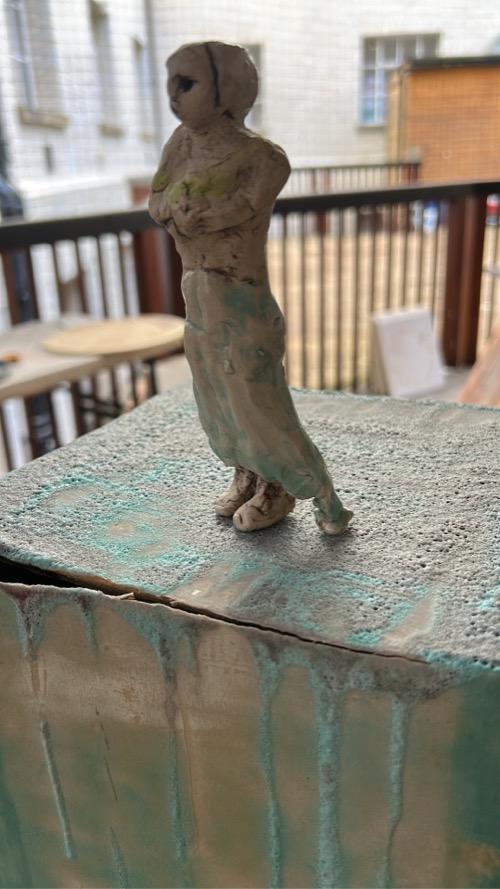
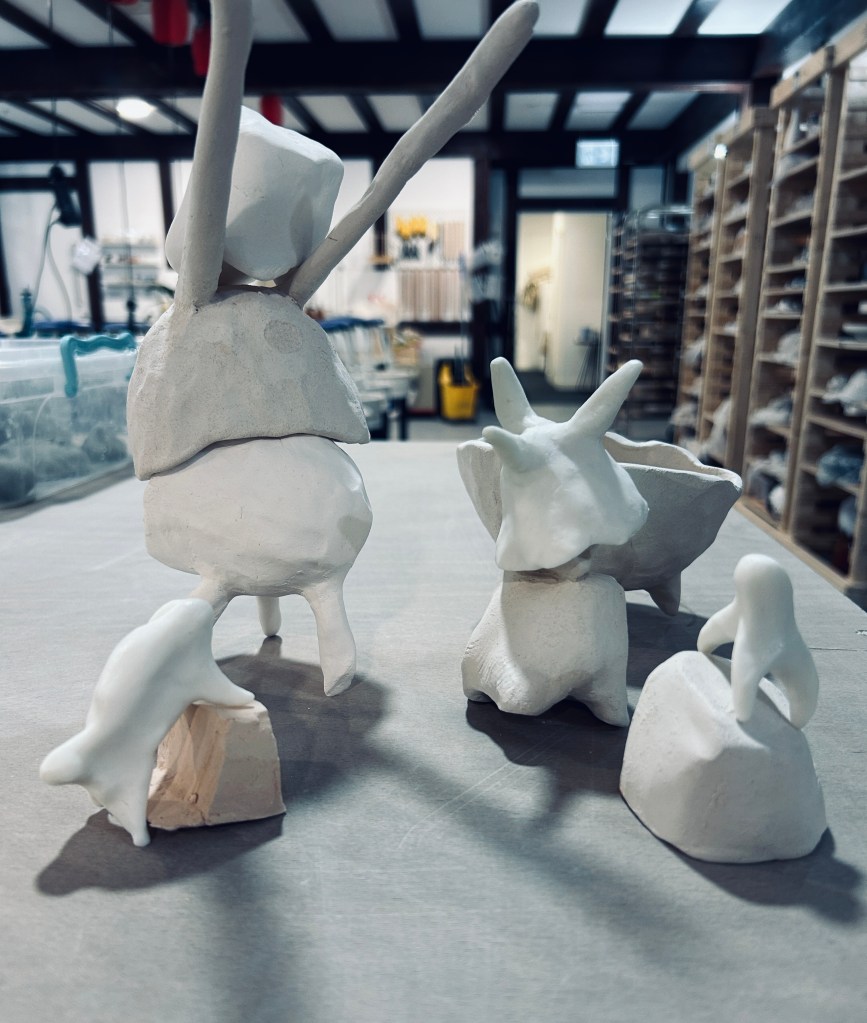
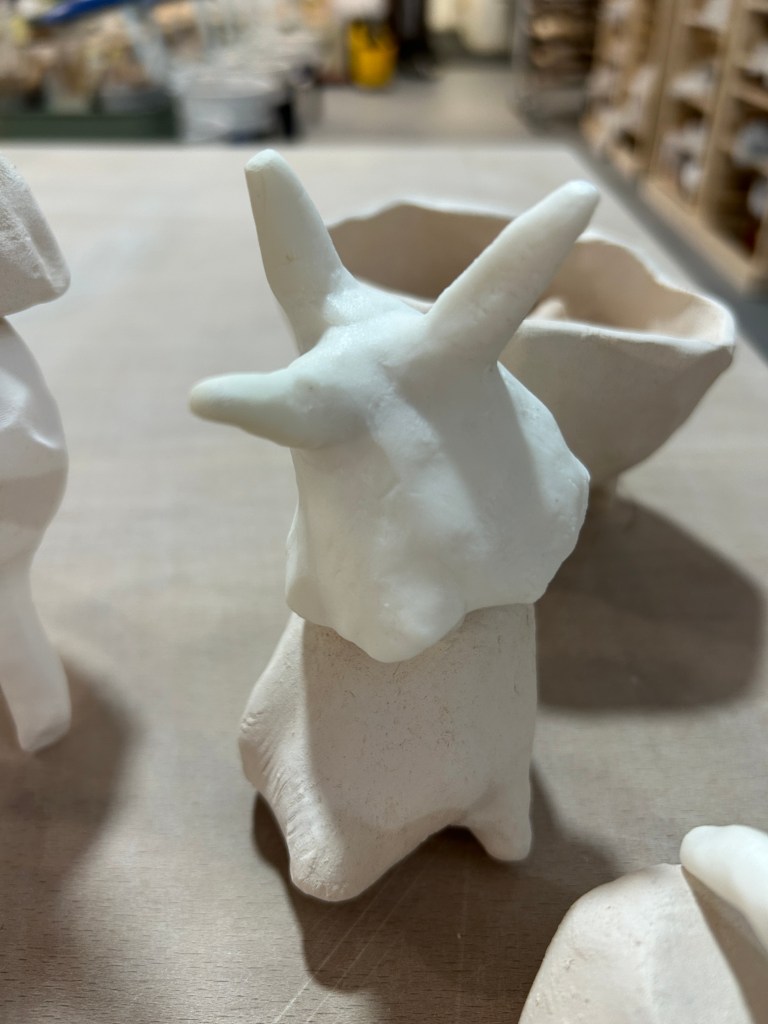
    The figures – some of them have an interesting quality.  Some are just ‘cute’.

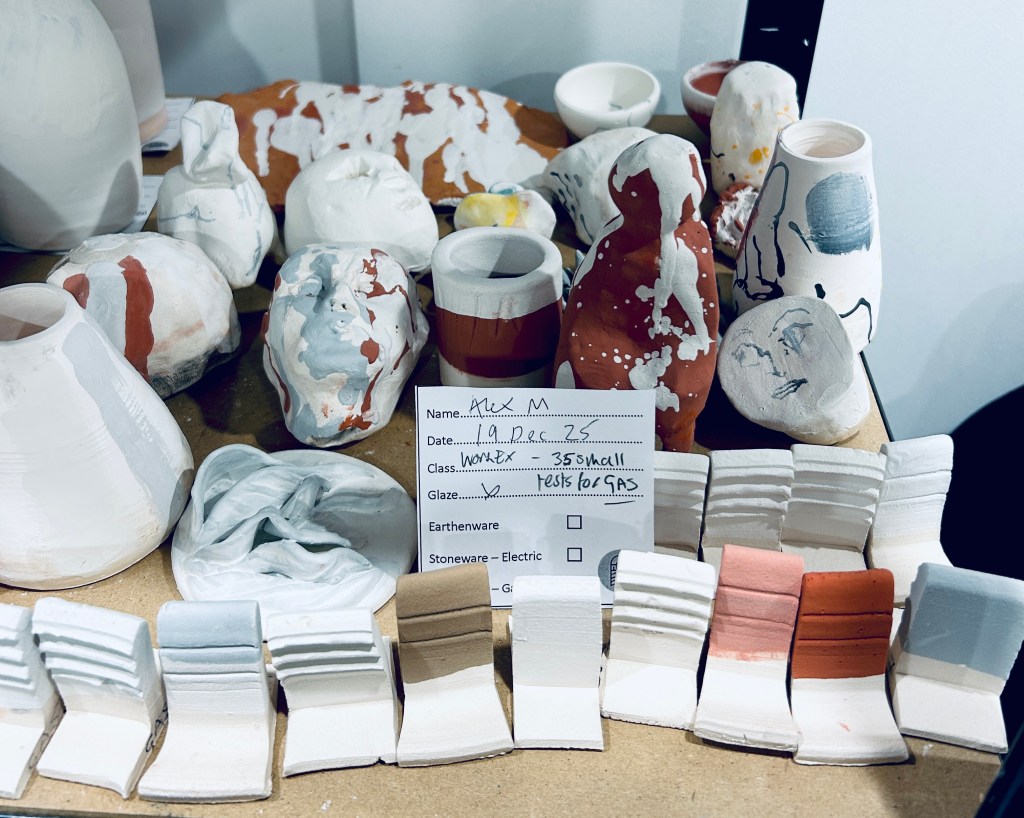
    I have made lots of tiny orange chairs.  They have no visual or stylistic connection to the other bits.  Apart from municipal swimming pools.  They might be good to play with.  

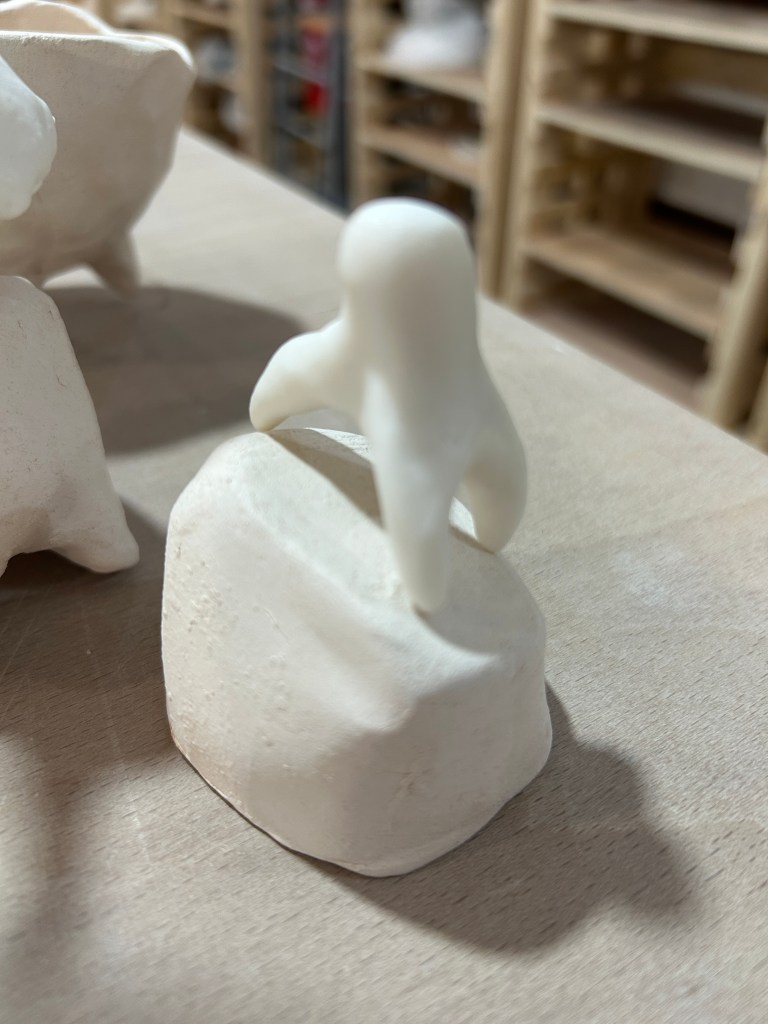
    The parian figures that I had to try so hard to get fired – they need a slow ramp to temperature – but can be fired in one glaze fire no bisque.  They’re…just.  I don’t like them.  They feel like tests that I should have finished ages ago.  I think they’re not going to be any part of whatever happens next.

    Another thing I could do is take a hammer to the whole thing.  

    Gaby – who I wrote of earlier – is teaching throwing on Tuesday in the Ceramics Gallery / Studio I work in – I will ask her what she would do.  Gaby reassembles the detritus of kiln firings.  I notice a small part of this is me wanting Ceramicsworld to give me an acceptable answer.

    Anyway.  Off to work…

    …and in the afternoon my friend Trui Malten walks into the Gallery.  Trui is an extraordinarily smart and funny theatre lighting designer.  I showed her my pictures of the beautiful glaze and the big crack.  And my Fine Art insecurities.  And she says – 


    “What would theatre say?  Put it in the space.  See what it means”

    She says it’s right that the crack is like it is.  Accidents and change have always been part of my practice.  That’s actually what I’m writing about according to my Study Statement.    

    ‘My friend is a theatre designer who got so sick of the transient nature of theatre he had to become an architect’. Trui is really funny and really smart as I say. 

    Chance.  Is there if you are open to it.  It’s always there.  

    Today as working am only able to join Jonathan’s session during my lunch break and it’s about ‘Dérive’.  The Situationist’s idea of wandering, drifting, following one’s nose.  And it’s not just a creative whim – it’s anti-capitalist.  It’s as if not more urgent now as the world is imploding into mediocrity, fake news and identikit shopping centres.  Alongside the rise of structural disenfranchisement, extremist right-wing politics, extremist misogny etc etc etc etc etc.

    Suddenly talking to Trui a whole multi-disciplinary chain of connections opens up.

    Maybe if I was riffing on my thoughts today, the class that I was half in and out of, the surprise inspiration from Trui it might look something like this 

    • my work, acceptable or not to the ceramicist world, to the art world, what does Gaby think, what does Collect 2026 think, that will be positive inspiration at least, but also overwhelming, my class is exploring ‘dérive’ and following their noses, it’s different to not be in the class I miss it, oh Trui arrives, she’s not in Italy, she’s bringing cakes and I forgot to pack snacks, theatre sets get thrown in a skip what a waste, what’s sustainable, damaged creative ceramic children, ah once again theatre has the answers for me, break everything and start again, it will be ok, why am I making this work that looks like theatre sets, that’s not ceramic art, then a guy walks in to the Gallery, he really enjoyed Collect will I be going (yes), look out for his work, he’s from Nova Scotia, Trui and I google him, Neil Forrest, oh look his work looks like theatre sets, little figures, I love ceramics, I hate ceramics.

    My friend Niall Ashdown is maybe one of the best improvisors in the world.  We teach together sometimes.  He often says when people question the ‘rules of improv’ that he wants to get a t-shirt made that says – 


    The Opposite is Also True

  • Je ne regrette rien 

    Remembering Philippe Gauler 1943-2026

    Yesterday I went to Paris to attend the extraordinary funeral of the teacher who changed the course of my life Philippe Gaulier.  In the sometimes murky world of artist training Gaulier is perhaps the most widely and wildly misunderstood pedagogue of all.  Perhaps we all assembled from around the world yesterday – how many? maybe 600 of us – because we wanted to hold onto that magical thread of his teaching specifically by being together…because we were there…because we know it.  Perhaps we all feel tired by having to listen – every time his name comes up – to the broken record of criticism spewing from the mouths of people who never even went to his school regarding his somewhat unorthodox teaching style. As Simon McBurney put it he was –

    ‘provocative, demanding, deliberately inappropriate and utterly hilarious’ 

    The elusive cornerstone of his school was to find that ‘complicité’ on which McBurney, Arden and Magni founded the namesake company – the inferred danger and delight in being connected (with each other, with the audience) when we play.  Do we have pleasure to be on the stage?  If not why bore us? ’Adios, sit down immediately, my little friend’.  Gaulier actors read audience in a way that no other actors do and that is what I am proud to know. It will be in my bones.  It was in the bones of us, connected together when we – a giant congregation – burst into ‘Non, Je ne regrette rien’ along with Piaf as we saw the old fella off on his way.  And we might be messy and we may not do things ‘correctly’ but we will do it with heart and a kind of passion that is very rarely really seen on stage.  Spontaneous, huge applause, whooping, cheering, Bravo, Bravo went off as he was carried up the long theatrical staircase to disappear into the glittery backdrop of blue-sky mosaics of La Coupole in Pere Lechaise cemetery.    

    I began at Gaulier’s school aged 25, just two months after losing my mother.  Philippe taught me to feel again and how to be free.

    Why am I writing about this here?  Because what I am looking for is not and should not be definitive or even precisely known.  This is the same for fine art, for performance, for poetry, for playwriting, for art installation, for ceramics, for concept art, for music – definitely not for music – for opera, for dance, for education…for making anything at all really, I think.  

  • Univited Guests

    This week was treated to a visit from imposter syndrome.  All of his friends came too – perfectionism, procrastination, paralysis – the whole gang.

    I have lurched between the identities of six different kinds of artists.  Been haunted by distorted imaginary voices of perfectly supportive ceramicist friends, who think I’ve made bad choices and generally am making a fool of myself.  

    The nature of these thoughts are worth writing down because they are so ridiculous in black and white.  We are not our thoughts.  An idea that seems impossible to grapple with, I believe rooted in mindfulness and therapeutic practices – though at odds with Freud. 

    What am I doing making art?  And in the middle of the night – ‘What IS art? See, you can’t even answer that’.  Well I’m doing a Fine Art Masters, so let’s just see.   I find in these moments of self doubt I scroll on instagram more – it’s a great idea.  My feed shows pristine lifestyle ceramicists throwing pots next to white sofas, desperate influencers showing 3 steps for making abstract art that sells…and even the legit art scene posts seem all about what’s fashionable and what’s correct and accepted right now.  

    And part of the problem also is that everything is acceptable.  I sit down at my life-drawing class (organised by the students union, and excellent) next to a gloomy woman who says that no-one seems to care what art is anymore.  

    Under a cloud I head to the studio at County Hall Pottery, where I work as a technician in exchange for studio space. 

    At the studio Charley Blackburn, the new ceramicist-in-residence, is preparing for an update with the managers.  Her sketchbooks and glaze tests are set out for the meeting and it’s breathtaking work, but also chatting to her, I notice there are more questions than answers.  There’s certainly no end goal.  I show her a box of bisque shapes I’ve been playing with.  And a stop-frame animation I made to document the process.  I might make more stop-frames.  Charley gives me some feedback about what would making a film of them moving add to the work, which she feels already has movement and energy.  I have no idea how she has seen that. 

    While her meeting goes on I listen in to a fantastic conversation from my lovely brilliant colleagues about Charleys work – and I go into hyper focus.  Or flow. Just playing with the shapes.

    One of the challenges of ceramics is the technicality of putting something together, which really requires prototyping, sketching out, planning.  Factoring in the 7-10 different stages of drying time.  But how do I improvise if I have to plan first?  Where is the creativity that comes from spontaneity.  Each ceramicist approaches this chicken and egg in a different way.

    But most importantly something is unblocked by showing up at the studio and my wonderful community and friends at County Hall.  By Charley’s serious generosity and belief.  

    I felt so galvanised by that.  I also want to mention Daniella who has (along with Olga and Hicham) pretty much remotely organised a group show for us in the Good Rice Gallery with a couple of days notice.  She is one of the extraordinary people that just believes, is unfailingly optimistic and generous.   Instead of overthinking this, I go with the flow.

    I think my my thought this week is about community.  If I can’t be kind to myself then to take myself to the people who lift me up.  The studio becomes then not an aspirational space I can’t afford, but an environment I create by people I choose to connect with.

  • Shaped or found?

    First tutorial with Jonathan, a totally brilliant and surprising and far-reaching conversation.  Trying here to get it all down but actually it’s going to be more like a list I think, of chapters to dip into as I go along.  

    I guess the main headline is what has my path been before, is it going to beautifully joined up (as I’ve been thinking) or is it going to be healthily separated.  What do I want out of this practice?  What can I take with me and what can I leave behind.  

    Why have I chosen clay now, or rather as I see it sometimes clay has chosen me?  I know there is something about my theatre practice being about liveness, physicality, spontaneity and movement – and there being something about clay being the opposite of that – a material that when fired transforms into ceramic material that is fixed in time for thousands of years.  

    Something about holding onto something?  About anchors?  About trying to bring something to stillness?

    All of my practice so far has been collaborative.  It has been ‘we’.  That the ideas of the collective can – or must? – be more rich than the individual.  But is that true?  Is that still true for me?  Where am I in that?

    It has just popped into my head that a text-driven theatre director associated with Battersea Arts Centre many years ago called devised practice ‘fuzzy compromised theatre born out of antagonism’.

    This still makes me laugh.

    We laugh when we recognise something painful and true.

    Anyway.

    Clay.  Clay is also a tricksy collaborator – it’s needy, unpredictable, it actually remembers wrong decisions you’ve made and changed and it throws those bad decisions back at you when you open the kiln door.  And it is also compelling, essential, honest, solid, real.

    We talk about being comfortable with process.  I notice when thinking about what I want to make I am looking for a finished idea.  I visualise a kind of finished thing.  But there is something here to borrow from theatre practice – a phrase we use ‘don’t jump through the steps’ – when actors don’t see all the steps or beats in the story or moment.  

    How can I bring that sense of movement to my practice, rather than go straight to end product.  Of course improv has lessons for me here.  This translates to what processes I am using in the studio – the mesmerising pull of the wheel versus the time it takes to master the wheel.  Perhaps hand building might offer me more freedom right now?  Collaborating and ‘yes and…’ing with the clay itself.

    Also we discussed the kind of things I feel blocked by – work I like and don’t like – what does it feel like when my practice is going well.  

    There is something about essence.  About kind of finding the seam, moving between different ideas and thoughts towards something particular and tiny that feels true.  You know true when you see it.  I remember bursting into tears when I saw an Edward Hopper painting in the Smithsonian Washington DC, from some distance away.  Tracey Emin’s scratchy nudes.  You feel something at a guttural level.  Maybe I just need to dial back and notice what does speak to my gut, and what doesn’t.

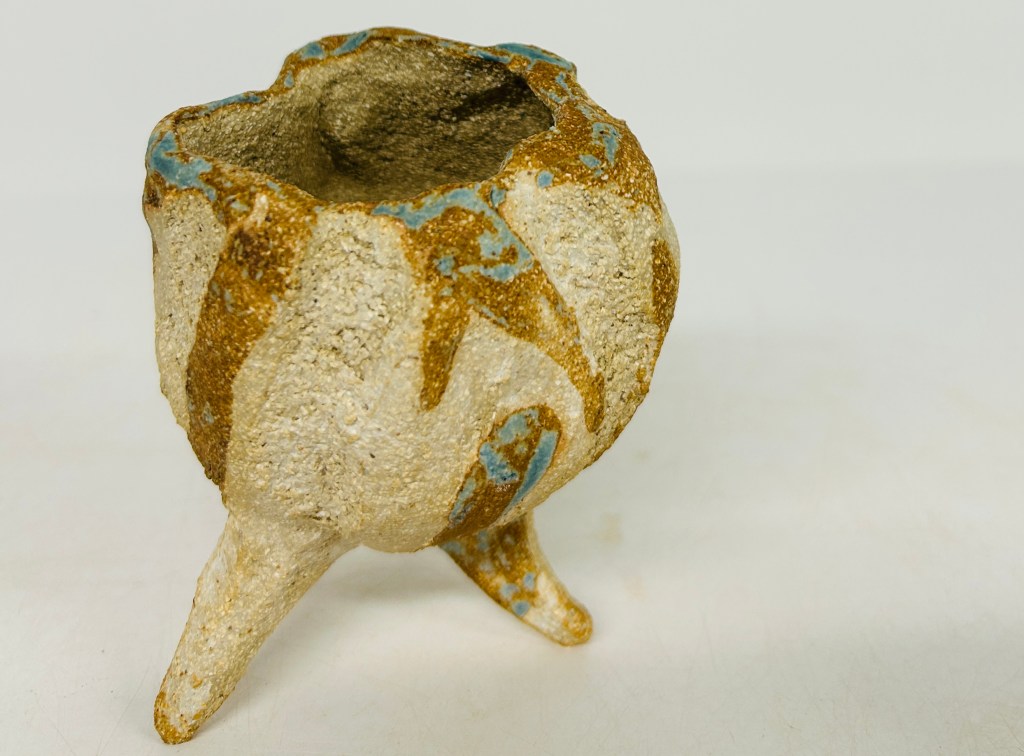
    Essence.  I don’t love all the work I make but I do love the placement of a leg on one of my three legged triped pots.  

    We decide it might be useful just to focus on that. 

  • How to begin

    Beginning of my MA Fine Art : Digital at Central Saint Martins. First session.

    Kindness, compassion as ‘psychological safety’ – exploring the idea that these might be the foundations of an art practice as opposed to the idea of progression only coming through the pushy dynamic of ‘challenge’ in a more hard, aggressive way.  I’m really excited by this.  I’ll sign up right away please for psychological safety.  I come from a freelance theatre background, and whilst lip service might be played to ‘safety’ by salaried policy-makers, for the most part one is dealing with rejection and criticism on an almost daily basis – it’s part of the deal.  You have literally signed up as an actor to put your self out there and have your self pulled apart, judged and given the ‘yes’ or ‘no’.  Maybe the visual art world is no different but I’m excited by Jonathan’s choice to put upfront values of compassion and kindness.

    I’m also an improvisor, where saying ‘yes’ opens the portal to creativity.  I have two copies of Keith Johnstone’s 1981 book ‘Impro’.  Underlined in each is the line – 

    ‘There are people who prefer to say ‘Yes’, and there are people who prefer to say ‘No’.  Those who say ‘Yes’ are rewarded by the adventures they have, and those who say ‘No’ are rewarded by the safety they attain’.

    Through my improvisation practice I’ve experienced, hundreds of times, the adventure.  Also the ‘no’ sayers, and the safety dulling and literally blocking the work.  Saying ‘yes’ – to everything – became a foundational idea.  But it is not 1981 and this beautiful, complicated quote contains a lot to be unpacked now – questions about consent, ideas of safety having a value. 

    What does now feel like for me?  The geopolitical world feels like a bin fire.  Closer to home my theatre making practice feels vulnerable-making – and sometimes not in a good way.

    I don’t have any answers here.  This is just the beginning.  This is just asking some questions.  Getting down some notes.

    I don’t know yet what I’m going to put out in the world.  What I’m going to bring with me on the journey.  I do know that I’m going to take (from my theatre practice, from improv) the notion of play.

    Just playing.

    Seriously.  Just playing seriously and just playing for plays sake.

    In the session Olga said a lovely thing about the loss of innocence and play which I roughly remember as ‘when we are adults something is always for something’.

    Art-making is possibly the most vulnerable-making thing.   A community of practice with guiding principles of kindness and compassion held lightly around the edges seems like a fine idea – not to close off challenge but to enable it.  

    As Jonathan said instead of a scarcity mindset we’ll be ‘mindful, hungry, generous…the more we put in, the more there IS’

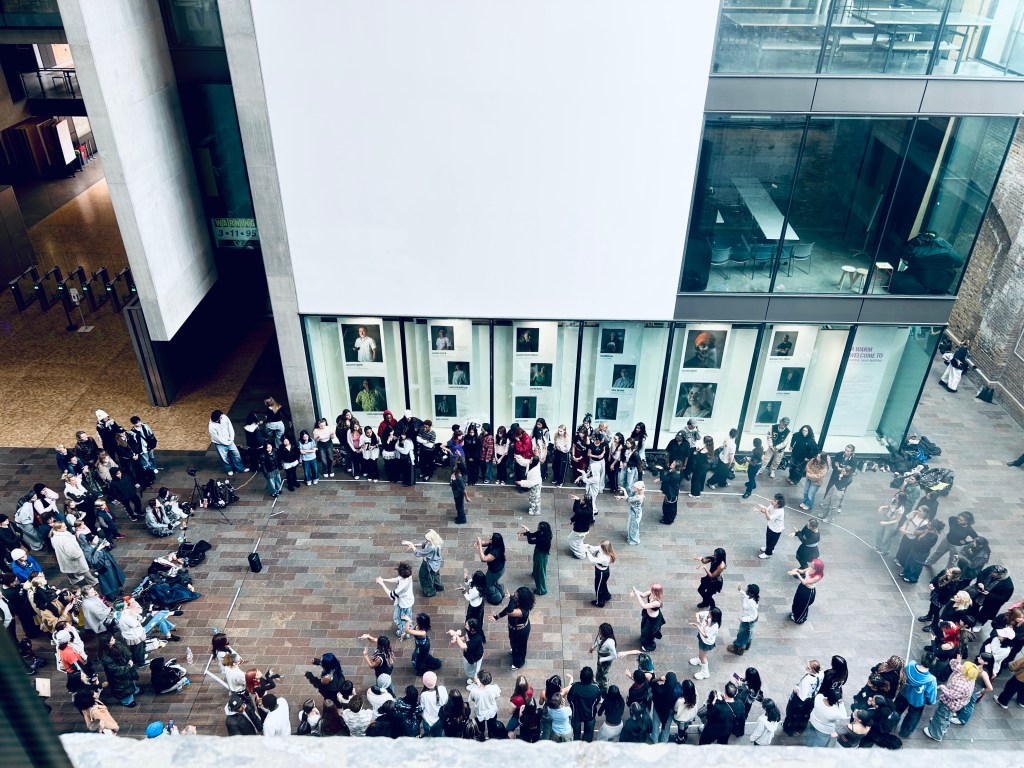
    (image : photograph taken from the library of Central Saint Martin’s students dancing in the Street, 06/10/2025)