Tag: messy

  • The Opposite is Also True

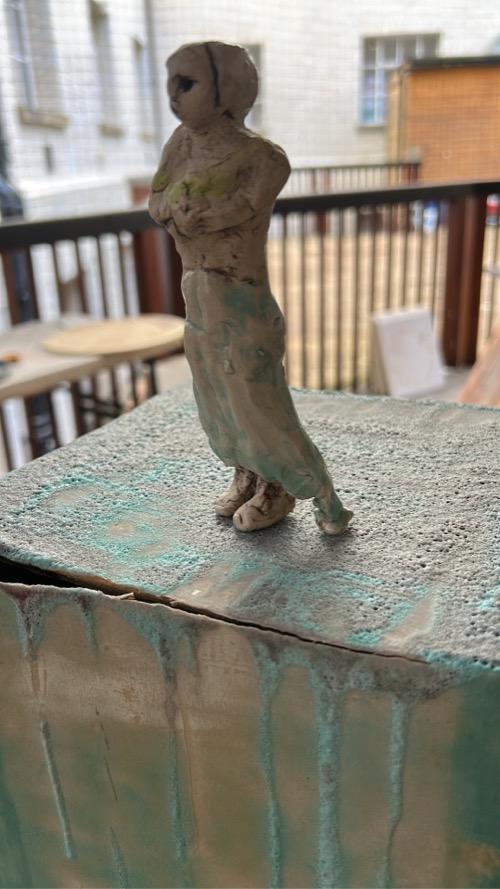
    So finally after all the challenges of firing schedules and making I opened Baby Diana the smaller kiln (being D or ABC – Agnes, Barbara and Collette – names which sound like cool and distant goddesses to me) which I’d tenaciously had to negotiate in this less than ideal process.  

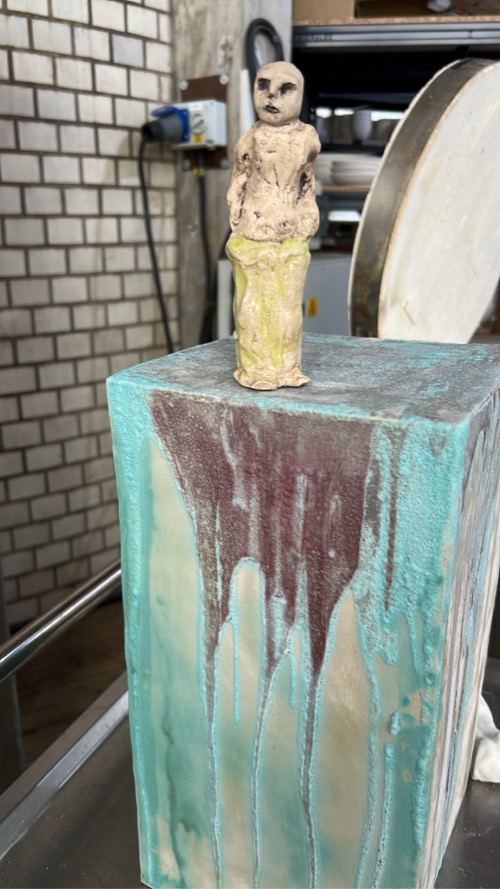
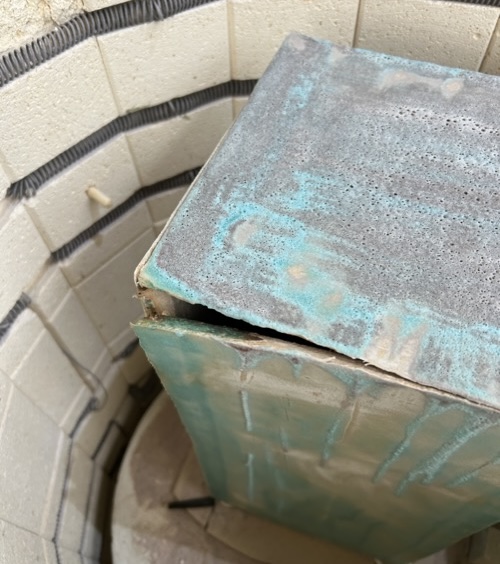
    First of all – the glaze on the large slab built box is the most beautiful effect.  Swamp lichen – a reactive glaze with Crater over it. It looks like water and foam and swimming pools which is a thing colour wise that has been emerging for me for this project.  (I’ve become interested in an extraordinary film called Ten Meter Tower a 17 minute short film training the camera on Swedish people considering jumping off a very high tower in a local pool – which I think is another whole post…)

    It also has a giant crack across the corner side seam.  Where the box fell and was reassembled during making.  When this sort of thing happens (scaling up slab building, the box was tricky) it’s kind of inevitable that even though you fix the seam beautifully, inside and out, and then you even add a little vinegar slip when it’s drying…the clay remembers like a damaged child.  It all comes out when it’s all grown up. 

    So part of a breakthrough was that I was going to explore fragility.  That breaking things may be part of it. It’s almost poetic justice in a way.  But also the perfectionist that haunts and hampers me says – remember that girl on your course last year who used to present all thrown and failed pots as intentional…well…her…

    All sorts of narratives appear such as – ‘hey all the ceramicists know about this kind of crack’.  It’s not a beautiful accident – it’s poor making.  

    I feel at once full of hatred and joy.  Shame and excitement.  Disappointment and triumph.   Is this what making visual art is?  All art?  I remember the knot in my shoulders after listening to my first play read-through at RSC – it felt like the worst two hours of my life.  Even though everyone loved it and thought it went really well and my agent was crying.  (In a good way haha…)

    So.  

    I have things to play with, which is what I’m interested in anyway right?  Currently I have four different elements in my work which I could use – they don’t hang together in ay concievable coherent way.  In my opinion.  Right now. 

    The figures – some of them have an interesting quality.  Some are just ‘cute’.

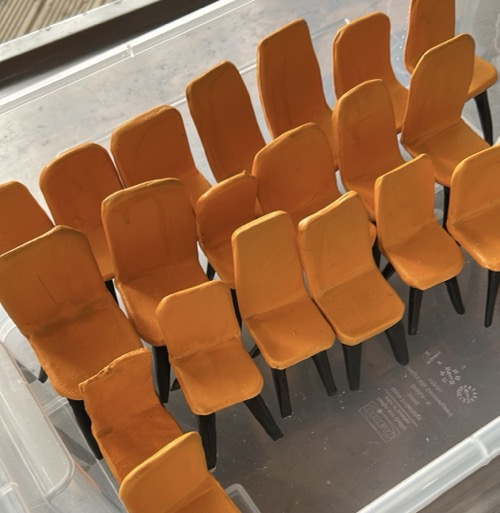
    I have made lots of tiny orange chairs.  They have no visual or stylistic connection to the other bits.  Apart from municipal swimming pools.  They might be good to play with.  

    The parian figures that I had to try so hard to get fired – they need a slow ramp to temperature – but can be fired in one glaze fire no bisque.  They’re…just.  I don’t like them.  They feel like tests that I should have finished ages ago.  I think they’re not going to be any part of whatever happens next.

    Another thing I could do is take a hammer to the whole thing.  

    Gaby – who I wrote of earlier – is teaching throwing on Tuesday in the Ceramics Gallery / Studio I work in – I will ask her what she would do.  Gaby reassembles the detritus of kiln firings.  I notice a small part of this is me wanting Ceramicsworld to give me an acceptable answer.

    Anyway.  Off to work…

    …and in the afternoon my friend Trui Malten walks into the Gallery.  Trui is an extraordinarily smart and funny theatre lighting designer.  I showed her my pictures of the beautiful glaze and the big crack.  And my Fine Art insecurities.  And she says – 


    “What would theatre say?  Put it in the space.  See what it means”

    She says it’s right that the crack is like it is.  Accidents and change have always been part of my practice.  That’s actually what I’m writing about according to my Study Statement.    

    ‘My friend is a theatre designer who got so sick of the transient nature of theatre he had to become an architect’. Trui is really funny and really smart as I say. 

    Chance.  Is there if you are open to it.  It’s always there.  

    Today as working am only able to join Jonathan’s session during my lunch break and it’s about ‘Dérive’.  The Situationist’s idea of wandering, drifting, following one’s nose.  And it’s not just a creative whim – it’s anti-capitalist.  It’s as if not more urgent now as the world is imploding into mediocrity, fake news and identikit shopping centres.  Alongside the rise of structural disenfranchisement, extremist right-wing politics, extremist misogny etc etc etc etc etc.

    Suddenly talking to Trui a whole multi-disciplinary chain of connections opens up.

    Maybe if I was riffing on my thoughts today, the class that I was half in and out of, the surprise inspiration from Trui it might look something like this 

    • my work, acceptable or not to the ceramicist world, to the art world, what does Gaby think, what does Collect 2026 think, that will be positive inspiration at least, but also overwhelming, my class is exploring ‘dérive’ and following their noses, it’s different to not be in the class I miss it, oh Trui arrives, she’s not in Italy, she’s bringing cakes and I forgot to pack snacks, theatre sets get thrown in a skip what a waste, what’s sustainable, damaged creative ceramic children, ah once again theatre has the answers for me, break everything and start again, it will be ok, why am I making this work that looks like theatre sets, that’s not ceramic art, then a guy walks in to the Gallery, he really enjoyed Collect will I be going (yes), look out for his work, he’s from Nova Scotia, Trui and I google him, Neil Forrest, oh look his work looks like theatre sets, little figures, I love ceramics, I hate ceramics.

    My friend Niall Ashdown is maybe one of the best improvisors in the world.  We teach together sometimes.  He often says when people question the ‘rules of improv’ that he wants to get a t-shirt made that says – 


    The Opposite is Also True
  • Je ne regrette rien 

    Remembering Philippe Gauler 1943-2026

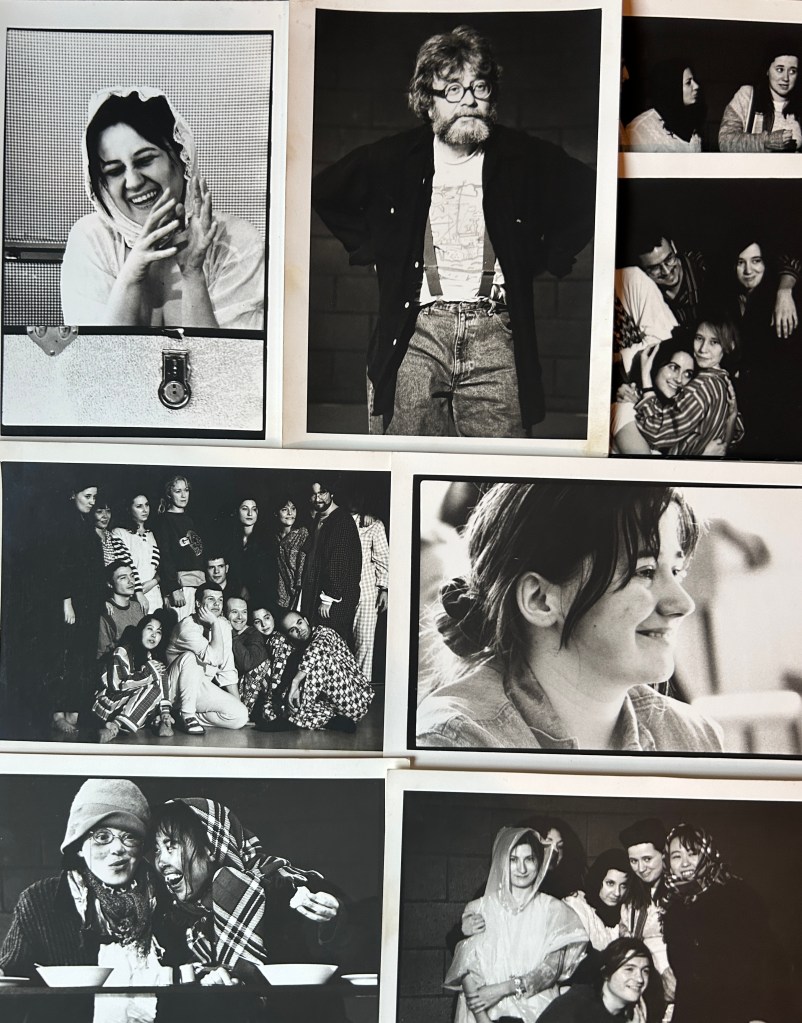
    Yesterday I went to Paris to attend the extraordinary funeral of the teacher who changed the course of my life Philippe Gaulier.  In the sometimes murky world of artist training Gaulier is perhaps the most widely and wildly misunderstood pedagogue of all.  Perhaps we all assembled from around the world yesterday – how many? maybe 600 of us – because we wanted to hold onto that magical thread of his teaching specifically by being together…because we were there…because we know it.  Perhaps we all feel tired by having to listen – every time his name comes up – to the broken record of criticism spewing from the mouths of people who never even went to his school regarding his somewhat unorthodox teaching style. As Simon McBurney put it he was –

    ‘provocative, demanding, deliberately inappropriate and utterly hilarious’ 

    The elusive cornerstone of his school was to find that ‘complicité’ on which McBurney, Arden and Magni founded the namesake company – the inferred danger and delight in being connected (with each other, with the audience) when we play.  Do we have pleasure to be on the stage?  If not why bore us? ’Adios, sit down immediately, my little friend’.  Gaulier actors read audience in a way that no other actors do and that is what I am proud to know. It will be in my bones.  It was in the bones of us, connected together when we – a giant congregation – burst into ‘Non, Je ne regrette rien’ along with Piaf as we saw the old fella off on his way.  And we might be messy and we may not do things ‘correctly’ but we will do it with heart and a kind of passion that is very rarely really seen on stage.  Spontaneous, huge applause, whooping, cheering, Bravo, Bravo went off as he was carried up the long theatrical staircase to disappear into the glittery backdrop of blue-sky mosaics of La Coupole in Pere Lechaise cemetery.    

    I began at Gaulier’s school aged 25, just two months after losing my mother.  Philippe taught me to feel again and how to be free.

    Why am I writing about this here?  Because what I am looking for is not and should not be definitive or even precisely known.  This is the same for fine art, for performance, for poetry, for playwriting, for art installation, for ceramics, for concept art, for music – definitely not for music – for opera, for dance, for education…for making anything at all really, I think.  

  • Nebulous

    Transience and permanence, the constant

    Monuments + sculpture – marking in time making valid – heaviness

    Transience – ephemeral, nebulous – lightness

    And audience 

    Experience of art – the transient nature of the encounter = becomes validated by memory and the quality of experience

    How it makes you feel

    What you feel is how you remember.  (Often attributed to Maya Angelou – ‘…people will forget what you said, they will forget what you did, but they will never forget how they made you feel’)

    Transience is moving, through time, moving on from, beginnings and endings, here and gone

    Permanence is stillness – rocks, monuments, weightiness, significance

    But in theatre / improv audiences experience of something fleeting – the encounter feels special, unique, personal

    It is a two way relationship.  Not standing in front of.  But dancing with.

    Theatre and improvisation know about the value of transience to audience.  And specifically the shared experience of the moment.  The audience completes the work.

    Museums, archives, monuments, the canon of gold framed paintings, arguably most 2D visual art and all sculpture – deal with fixing in time, history, longevity, statements.  (There is hierarchy at work here – power – who choses what is permanent?)

    Ceramics in particular is elemental – earth and fire.  Survival of Mesopotamian pots – trace of man’s first technological advancement – but also evidence artistic expression.  They tell stories.

    Which is where theatre meets because it tells stories. 

    Time tells stories – beginning middle and end.  

    Without end – no story…?

    Or without end – audience completes story?

    Where is the audiences agency in the work – this is crucial to me. 

    Gilchrist – where we put our attention…attending as a moral act which changes the world…who does the attending?

    Artist role to draw attention.  To focus – to say look, here?  At what I see?

    How do you leave space?

    Notion that when we accept that there is no permanence that everything is changing, we are freed from fear of death and endings – Buddhism.

    Gruf Rhys –

    “Rocks are slow life”

    Even rocks are moving, changing.

    Climate disaster, landscapes shifting, mud moving…clay and earth subject to the elements.

    Toute Bouge (Everything moves / is moving) – Jacques Lecoq text

    Lecoq students study elements – physically.

    Presence in the theatre feels and looks like stillness but isn’t stillness, it’s kind of a vibration.  It’s an energy.  

    You can teach it to actors by making them play Grandmother’s Footsteps – when the child is forced to stand ‘like a statue’ – they are in fact holding themselves in preparation for immediate movement when Grandmother’s back is turned.

    Watch a cat pretend to not be about to catch a bird in the garden. 

    What personally does this mean for me?

    Theatre, improv

    Writing

    Making

    Clay

    Artmaking

  • Gifts from the Kiln Gods 

    (Clay in Conversation, Ceramic Research Centre, 16th January)

    I went to a really useful talk at the Ceramics Research Centre called ‘Clay in Conversation – Play’. 

    Gaby Mlynarczyk a ceramicist who teaches throwing at my studio makes beautiful work constructed from detritus and accidents from the firing process. ‘Gifted to me by the Kiln Gods’ she says.  She explores environmental concerns, is obsessed by the Great Pacific Garbage Patch – and she’ll cast food waste she’s salvaged in porcelain slip. It’s interesting to me in term of my improvisation practice – she embraces accident in her work, pieces that have fused together in the kiln or disintegrated.  She says it’s a game of trial and error.  ‘I take stuff that has died and try to create a narrative’.

    Gaby talks about the agency of clay – ‘clay is an active partner’.  She also cites Jane Bennett’s Vibrant Matter which by chance comes up several times in this week – in the Art in Context Lecture, in our Thursday session, during my tutorial and then I find the book on Charly Blackburn’s shelf – the aforementioned artist in residence at my studio.

    An idea I’m definitely going to look at is that she starts building one way, then turns the thing over and starts building in another direction.  She calls it Rhizomatic play.  How does she decide it’s finished? ‘I ask myself – has it got energy, is the negative space interesting?’. I’m reminded about bringing my experience of space and audience viewpoint into my work.

    The second talk is Yuki Nakamura.  For ‘Fragile Like Life’ Nakamura used her peculiar collection of deflated footballs.  Cast them in slip and glazes them.  The work was commissioned for a hospital garden, the sort of place where people come to smoke a cigarette having had bad news.  A charged space.  Instead of displaying the artwork on a plinth she rolls the footballs under a hedge, or places them on a bench, or stuck in the branches of a tree.  The work stayed there temporarily – an idea that she was keen on because of the nature of the experience of a number of viewers who stumbled on them for a short moment in time. That might have lifted their spirits.  She observed a doctor trying to kick one and discovering no bounce back, he discovered the piece like a child or an animal, with curiosity and play.

    By chance I get talking to the woman sat next to me Vidya Thirunarayan and she’s writing her PhD  on the relationship of theatre and clay.  We plan to meet and talk more.  

    So again, community.  Serendipity.  Being there and being open.  Noticing threads coming together even if I don’t know how I’ll use them yet. 

  • Permission, presence, purpose

    Trying at the moment to work from my gut, and trying not think to many steps ahead.  Trying, trying, trying to not try so hard.  We have a discussion about what blocks the imagination, taking as a starting point the word resentment.  Which interestingly turns out to mean re-feeling (French: sentir, Latin: sentio).  This makes me think about presence.  If we are re-feeling, we are cycling past emotions.  And I can see that this can happen with re-feeling in the direction of the future also – being in that stuck place of ‘this will happen, that will happen’ – which will always be cyclical because it doesn’t exist.  There is only now.  And now.  And now. Etc.

    My internal narrative when unhelpful, when not-present, is often littered with questions about validity – what’s good, what’s good enough, what’s excellent, what’s not, what’s ok, what’s correct.  When you write it down it’s pretty ugly.  Again in improv ideas are generated on the foundational premise that there are no bad ideas.  Keith Johnstone (aforementioned improv forefather) would coach actors with ‘be boring’ or ‘too original!’.  I trained as an actor at École Philippe Gaulier, an eccentric but unrivalled master of engendering the essential quality of presence in the actor.  Famous for ordering actors to ‘leave the stage immediately’ seconds after their entrances, because he could ‘see a little idea coming’, it was a school of hard knocks.  We once asked him about talent.  He said ‘There is no such thing as talent.  Only what you authorise in yourself to do’.  I think about this nearly every day. 

    We discuss results of an automatic writing exercise on what blocks the imagination.  The discussion is framed as ‘Where do we need new creativity, new imagination?’.  We think about the ‘we’.   Tim – ‘the lofty idea of the artist as solo genius, artist as hero, that model, Rothko – is really unhelpful’.  We think about the ‘new’ – are there new ideas – probably not.  We think about the ‘need’ – is the work doing the job it is meant to be doing?

    What is that job exactly?

    Jonathan reads a provocation from Ben Okri in the Guardian about the artist’s responsibility towards only working on the subject of the climate emergency.  What does existential creativity look like in our art practice? How do we translate that or interpret it?  Also read out – an extract from Douglas Hine’s ‘At Work in the Ruins’ – about the problem of seeing art only as a tool for getting across a message.

    Art is not a cheap alternative to an advertising agency or a sophisticated extension of the communications department, and the urgency of the message doesn’t change this.

    I really enjoyed Luisa’s response to this ‘our art practice is to protect thinking’.  I take from this that we need to give our audience space.  To not be conclusive.  To leave space for a dialogue – even if the artist has left the room, or the planet – we are in conversation with them through the work.  We remember how shut down we were at school when preached at. 

    Hine quotes in turn playwright Anders Duus – 

    Our job is to complicate matters

    I think this has really helped me think about how I approach meaning.  I’ve worked in a discipline where storytelling is at the centre of things – and clarity is essential in script/playwrighting.  I suppose I am still telling stories but maybe in my art practice in a different way, giving space for the audience yes, and also space for the intangible, as Hine puts it, for the ‘messiness and strangeness of life’.

  • You did it wrong.

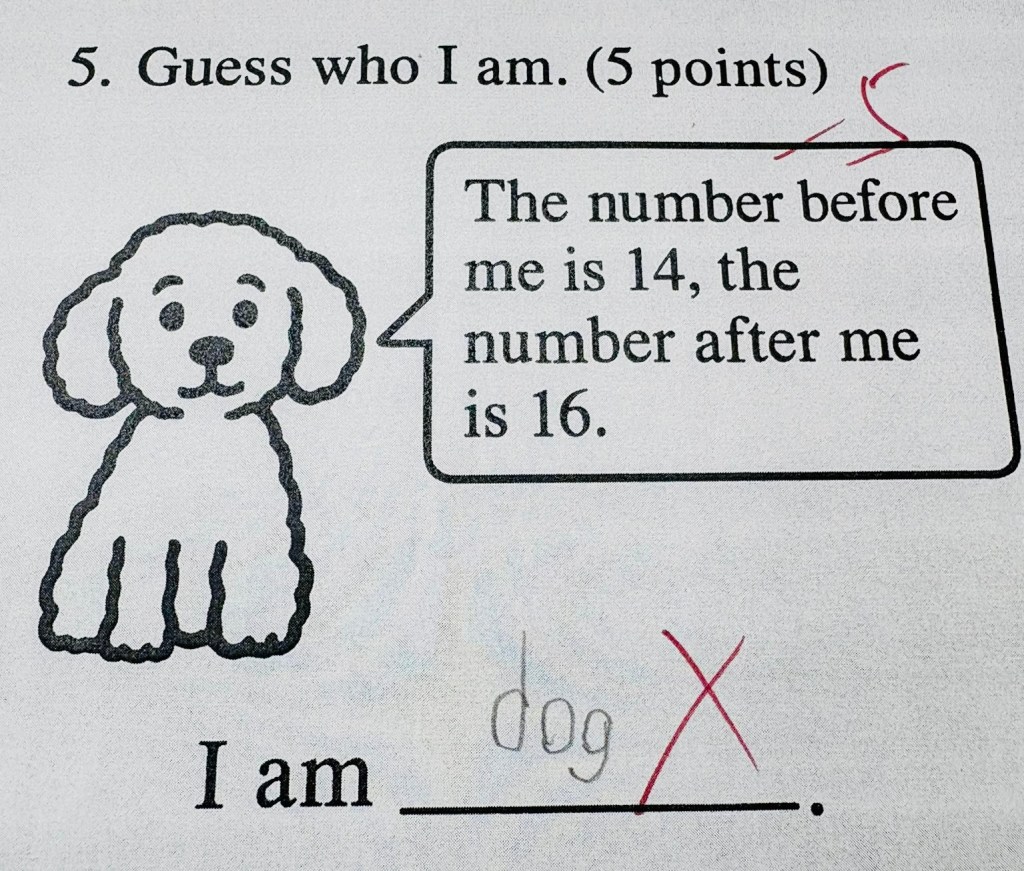
    I love everything about this picture that I found on stupid social media.  Is the kid wrong?  I think the answer ‘I am dog’ is somehow more right than ‘I am Fifteen’.  Pedagogically the test has created so many crappy misleading clues for the kid – grammatically (’Guess who I am’), visually (a talking dog is actually a number, stoopid) before we even get started on the dated assumption that all kids learn through words alone and that some will be neurodivergent thinkers etc.  But most importantly the teacher is really firm in their opinion that this kid’s answer is a big red-cross WRONG.

    We talked in the last session about failure.  I’ve come to expect my assumptions to be up-ended in this class which is why I’m loving it.  Jonathan presented the idea – ‘do we really learn from failure?’ – and that what happens in the case of being told we’ve failed is more like fight (‘stupid test) or flight (I’m never going there again).  The educational system is designed to have us want to get things ‘right’.

    I notice to myself that all my life I’ve been trying to do things right, to not be as weird as I imagine people think I am, to achieve in other’s people’s eyes.  In the case of my career – to be picked.

    I have more to say on this.  I have a fleeting idea of making a piece of work about it called ‘Well done Alex’ based on an patronising interaction with a ‘more successful’ peer of mine.  I’ll come back to this…

    But actually there are lessons from my theatre training on the subject of working with failure.  We discussed Keith Johnstone (quoted in my first post), improvisation’s UK forefather and saying yes to the unknown.  One of the tenets of improv is to fail gracefully – mistakes are actually a gift.  (My company used to improvise whole stories in one night and on one occasion I had forgotten the name of my character’s husband – a perennial improv problem.  I dropped John in for good measure, accidentally naming Brian’s character’s husband.  Bri said ‘do you mean my John?’ – and thus we had a story of a revealed love affair.).  As Jonathan pointed out – we over-accept the offer from failure and run with it.

    In clowning training the moment of the failure or ‘flop’ is the moment where we discover real fragility and truthfulness.  More another time.

    Jonathan tried an experiment where we reframe failure by distancing ourselves in writing about it in the third person.  I won’t write it all out here but to sum up. In reframing her failure to manage her time in the ceramic studio, Alex discovers that she could be kinder to herself about her excitement to try too many new things, and actually that time is in fact a huge part of the narrative of clay as a medium.  As is slowness, stillness and most definitely unpredictable results and letting go.

    Quoting Jonathan (or somebody else) – 

    the information in failure is a public good, when it is shared society benefits

    Provocation this week – do something in your art practice that might not work.

    Take a risk.  Record it.

    Disrupt something, break it open.

  • Where am I now?

    Really interesting lecture from the Art in Context series run by Dean Kenning.  About diagrams as a methodology.  Diagrams being ‘synoptic’ – you see everything at once.  How we think in terms of a diagram creating order but there is not necessarily an order. 

    A timeline is the most basic diagram.  It spatialises time.

    Diagrams like timelines use metaphors to do with directions of travel – we say ‘go forward’ ‘go back’ – arrows towards some kind of end point.

    This joined up with Jonathan’s lecture for me about the reflective process as a cyclical plan – reflect, plan, achieve, observe > new question now, reflect, plan, achieve, observe etc.  Rinse and repeat.  And how that is problematic with art because ‘continual progress’ and a ‘final end point’ is deceiving.  It looks more like messy, tangential, zig-zagging.  Rito’s ‘radical incompleteness’.

    Dean Kenning showed us some examples of timelines that demonstrate that they are always …that word ‘partial’ again…always selecting, never neutral.

    Joseph Priestley’s New Chart of History – (1769?) – a view of the history of the world from the point of view of the Empire.  Alfred Barr’s graphic of the relationships that make up – in his view – the story of Modern Art.  As the founder of MOMA NY he should know – but like all custodians of artwork he is partial, selective.  

    (Note to self here – to check out ‘System’s Theory’. And the Zeno Paradox – where you are only ever halfway to a point, always halfway to another point etc to infinity.)

    So anyway.  No arrow.  Just the rewriting of a story in particular and personal terms.

    What to take from this?

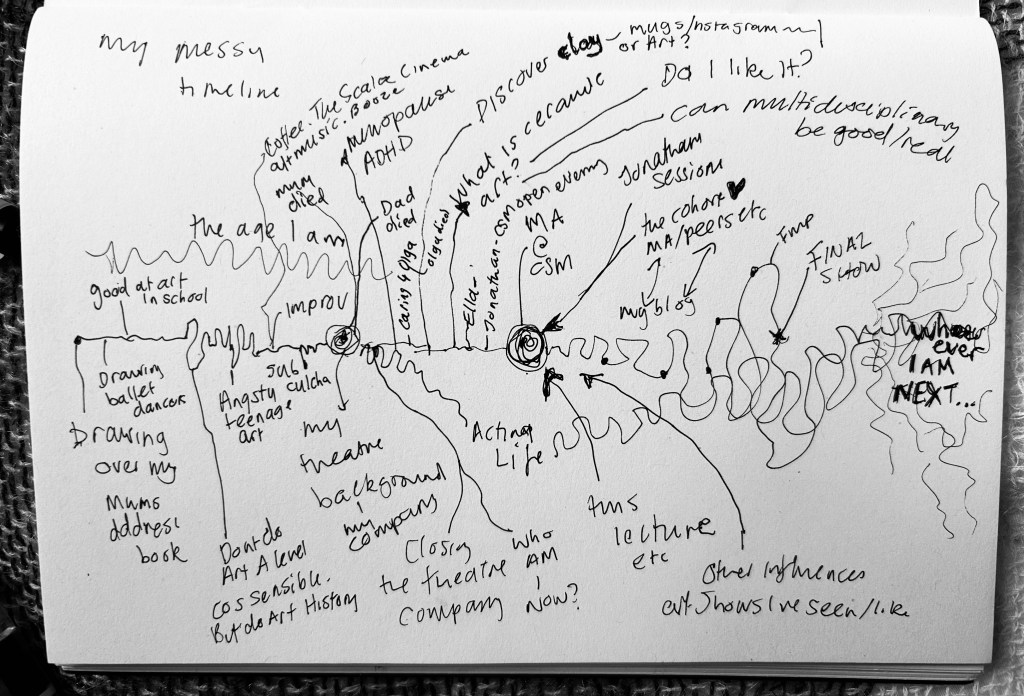
    The above messy timeline of my own.  I notice I didn’t place my now in art history terms, just in terms of my journey and what got me here now.   All the influences that make up me.  Looking at it again I see that I have blown some things up and minimised other events and I guess this would look completely different say 5 or 10 years ago. I feel excited about what things will become important and prominent in the next 5 or 10 years time. I have no idea.

  • Partial and Errant

    I took the bus to Camberwell to go to Jonathan’s lecture IRL.  I was flooded by really specific memories of starting university, some kind of wave of nostalgia for the start of an adventure.  The building was full of awkward, cool, lost-looking young people.  Not for the first time in recent weeks (but that’s another story) I felt like I had accidentally time-travelled and was experiencing my life being played back over again.  I notice I am not that different in many ways – certainly awkward, maybe not cool, lost definitely.  I lost my favourite jacket on the bus.  Same person I ever was.

    The lecture was called ‘A Messy Introduction to Practice-based Research’.  I want to know what that means – having once gone through a lengthy process to apply for Practice-led Research with the Arts and Humanities Research Council only to be rejected with the infuriating ‘feedback’ – It reads like an artist wanting to have money  (or something like that. That’s what I took from it).  Tangent.

    Tangents are messy so not a tangent.

    We had to collaborate in pairs to discuss what how one might research the impact of eating fruit on 100 economically disadvantaged children.  I braved it and spoke to a 20 year old girl who said it didn’t apply to her because she’s a painter so she wouldn’t be doing that.  I suggested it was maybe a hypothetical situation.  I tried to apply a healthy attitude to collaboration at this point but my enthusiasm was a bit dulled.

    I guess though incidentally (or not) this had revealed a point that Jonathan was making about being both an artist and a researcher.  Which we technically are by dint of enrolling in an art school masters.

    What is the difference between research if it’s carried out by a scientist or an artist?  Jonathan pointed us to the work of Kurt Lewin who was a founder on the subject of Action Research, the task being not to interpret the world but to change it. Although Lewin’s work isn’t directed at artists as such, he’s asking us to raise questions rather than just solve problems.  Changing the world could be said to be the job of art – it’s certainly a validating job if art needs validating which is does now and again.   The example was given of the film of Kesey’s One Flew Over the Cuckoo’s Nest – and the shocking experience of witnessing electroconvulsive therapy leading to it’s eventually falling out of favour as a practice.  

    I remember, when I first made my theatre work, spending time being conflicted because the work that got most easily funded (there I was trying to make a living again, how dare I?) was issue based and ‘worthy’.  Someone pointed out that where I was putting my work at the time (village halls, site specific, non-theatre based) was political with a small ‘p’.  

    Sometimes change in the world might be change in your world’. I think this was a quote from Jonathan, maybe Lewin…  

    …that there is a ripple effect caused by finding your unique voice, and if you can put it into your art, you are changing the world because no-one else can do this – in this way – as you do.

    I put off writing plays for decades because I was insecure about the validation of my voice.  

    I also wrote down – Jonathan I think you were paraphrasing who here? – 

    There is a moment for each artist in which a particular truth can be found and if it is not found then, it will never be found

    I also underlined these words from Carolina Rito. 

    Practice research is…partial and errant…tentative and opaque…it moves through the radical incompleteness of the subject.

    There was a lot more to return to in the lecture but for now I just want to underline here

    …the words about time in this…

    there is a moment

    if it is not found then….

    So I am noting to myself – can I please get out of my own way and seize this moment? Messy though it is and massively insecure-making and unknown.