Tag: movement

  • Really in the Sauerkraut

    Had the most amazing and generous tutorial with Jonathan.  I’ve been feeling really stuck, whilst at the same time because of the complexities of the firing schedule at my studio (as detailed in my earlier blog) I’m having to press on and make regardless of stuckness, in order to have something for the interim show.  Not a great way to nurture my developing practice.

    During the tutorial, where we talked a lot about my multi-disciplinary practice and what that brings, I talked about the situation in devised theatre processes where it’s agreed that we’re stuck and we’ll have to wait.  In my company I used to refer to it as ‘waiting outside the cave until the dragon wants to come out’.  Mike Shepherd from Kneehigh frequently used the phrase ‘hold your nerve’.  And Kasia Zaremba-Byrne, a brilliant polish movement director, will often pause during choreo sessions and say ‘we’re really in the sauerkraut’.

    Am trying to refine what I want to explore here.  Pull the threads together.   There’s something that’s very clearly pertinent to my positionally as a ceramicist – given that ceramics once fired are fixed in time – and that I’ve come from a theatre background.  A theatre background specifically rooted in liveness and improvisation.  So it feels like time is going to be important.  Theatre is ephemeral, transient, here and now and then gone.  Ceramic is fixed in time, it survives thousands of years.  Being one of man’s first discoveries it sits deep in our consciousness that ceramic endures.

    But at the same time – the opposite is also true – ceramics break.

    Liveness, ethereal, transient…here and gone…fragility.

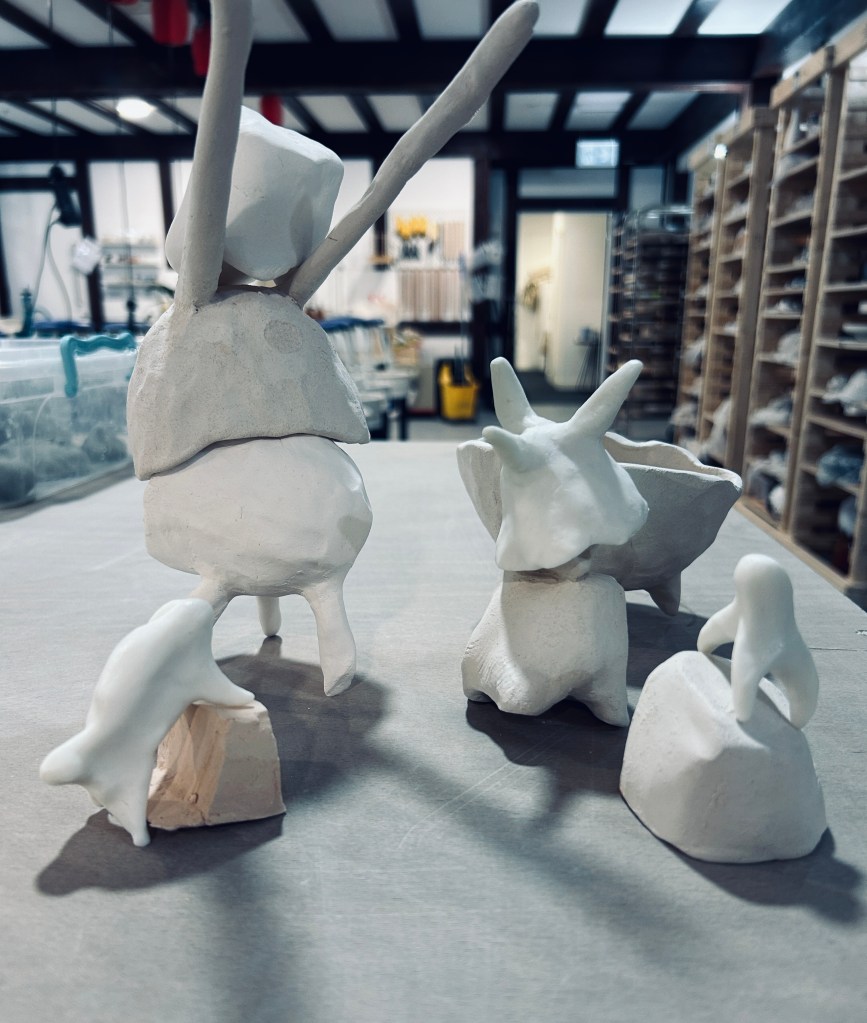
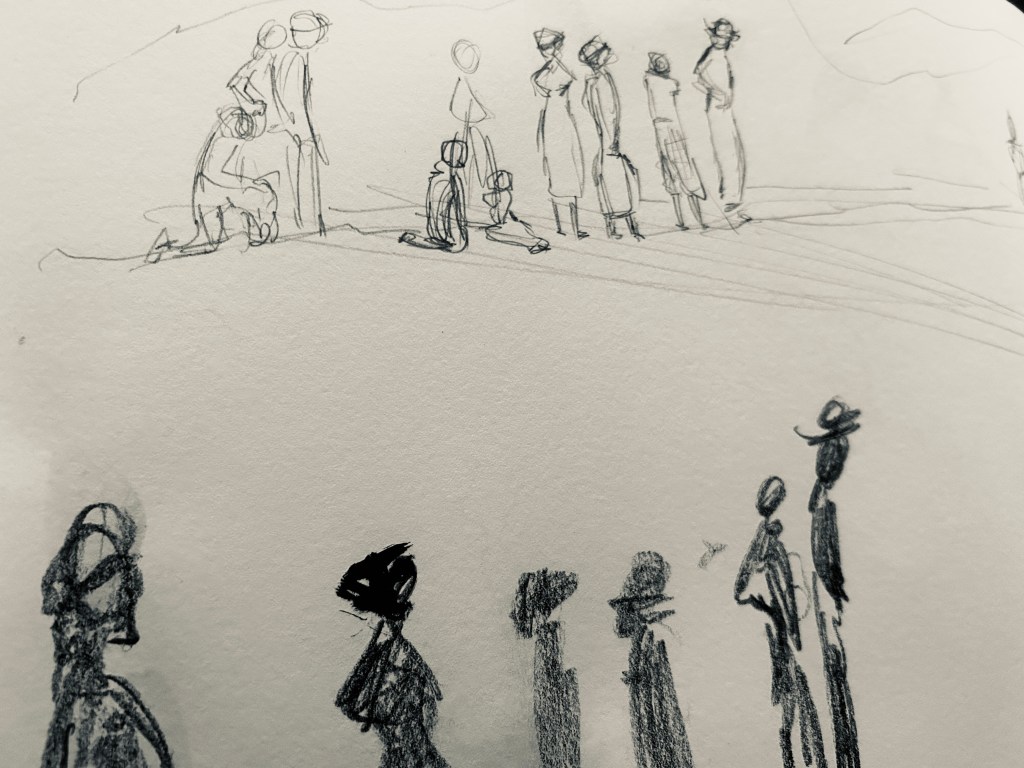
    The other – not unrelated – interest is movement.  My theatre background is largely physical, and so far I have choreographed my ceramic figures in dynamic spatial relationships.  Which does in turn create story.

    I’m aware of ceramicists who have a performative element to their work.  My pal Shane Keeling climbs on ladders to drop his pots to the ground.  And the artist Vidya Thirunarayan I met at the talk recently incorporates raw clay into her dance performances.  There is more to explore there, but I notice I am not drawn to performing in my fine art practice.  The challenge for me is finding the place where my performance experience intersects with my ceramic practice, without ceramics becoming consumed into my performance practice. 

    Jonathan asks – is it about the concepts, the shape or the material itself that you’re interested in?

    We talk about am I looking at movement in a phenomenological sense, or putting in mechanics so things move? Maybe movement isn’t the right word – maybe it’s more about space and distance and relationship.   The capture of the quality of movement (as per The Futurists explorations) seems too literal.

    Previously I thought about Puppeteers keeping puppets ‘live’ by breath-work. 

    Maybe the word is breath.

    Breathing space.

    Breath = life force.

    I keep returning to an assumption that I’m somehow obliged to abstract the figure because that’s what ceramicists do… (This is where trends and fashion are unhelpful).  A counter to that assumption is Claire Partington, a powerful ceramic artist that I love who…makes extraordinary ceramic figures.  Satirical, feminist, referencing flouncy 18th Century porcelain figurines – and with a theatricality and sense of space that I can relate to.  

    And that leads us to porcelain, how I have become captivated by this self-glazing kind called Parian.  And how I felt when I opened the kiln door, how perfect my Parian pots were (to me).  Want to note here this was quite an emotional session, my recent ADHD diagnosis came to the fore again because I’m seeing that my hampering perfectionism is infact me compensating for something / everything. When you’ve just discovered an entirely different truth about who you’ve been your whole life, trying to find what’s authentic is hard.  

    But also I am still me.

    I want to capture here somehow how meandering this tutorial / conversation is, because writing it down from my notes, it’s useful to notice that process of circling past the idea and back again.  

    Jonathan says that this kind of grappling does come before a breakthrough.

    Then I have this thought that if the ceramics are fixed maybe something else moves them, the floor perhaps.  A designer Jon Bausor that I worked with when directing a Ionesco play ‘The New Tenant’ at the Young Vic created a mechanism to vibrate the floor so that furniture could move by itself.  (This cuts a very long story short – the Tech was an all-nighter!)

    Jonathan finds me an instructable site about making a Chladni Plate, which uses low-frequency sound to create vibrations.  And tells me about an experimentation where bass sound caused an artwork he made, involving toy cows in a fish tank of milk, to move into formation. (I am nearly dismantling my bass amp at the end of this tutorial but then remember…it’s my bass amp).

    And then things come full circle for me because the missing piece is about the audience.  If I don’t want to perform but want to leave my work in a place for the audience to experience something, how do I create that sense of liveness, that sense of spontaneity, that transient quality that gives the audience space to dream, experience and feel? To be agents of their own interpretation.  I tell Jonathan about Yuki Nakamura’s ‘Fragile Like Life’ – the temporality of the deflated porcelain-cast footballs in a place where people are considering life and death.  The reference to life – and actually to breath – and to play and joy. 

    Maybe that’s why I’m currently drawn to porcelain.  It’s ethereal, nebulous and it feels fragile and precious.  People have a visceral reaction to the idea of porcelain breaking.

    Perhaps my figures move on this vibrating surface.  And they might fall off and break.  I might orchestrate that, or leave it entirely to chance.  I could even fire something once – they’d be fragile but that’s ok.

    Finding the something that allows the audience some breathing space. Jonathan reminds me that I’d spoken about placing objects in the space, the space between, the sharing of space and the dialogue between. 

    Gaby Mlynarczyk at the talk spoke about the negative space.  Painters understand negative space.  But I’m not sure it’s something we often think about with ceramics because the focus is on the thing, the material, the object itself.

    I began this tutorial full of panic at my dwindling options due the the firing schedule shenanigans and the time ceramics take.  I leave full of inspiration, with ideas to spare, having waded out of the sauerkraut.

    Jonathan – ‘You know on a foggy morning you know the sun is there.  That lingering in the fog can be really beneficial’.
  • Risk and Taste

    Some weeks ago we were challenged to take a risk.  I didn’t do it because at the time I couldn’t think about what sort of risk I wanted to take.  My first thoughts about artists taking risks involves them making themselves extremely vulnerable, or exploring things that are really confrontational to people with conservative values (Yoko Ono, Marina Abramovic, Tracey Emin).  Thinking about my own blocks and resistance I noticed that risk, for me, is bound up with taste.  I’ve made a judgement call somewhere along the way where X is ok and Y is not.  

    Somehow particularly in ceramics.  Perhaps I’ve picked this up from other makers I look up to.  

    And partly it’s something about the fact that ceramics is tough badge to earn – it’s very technical, there are no shortcuts to experience, it’s slow and resource-hungry.  You had better get it right.  

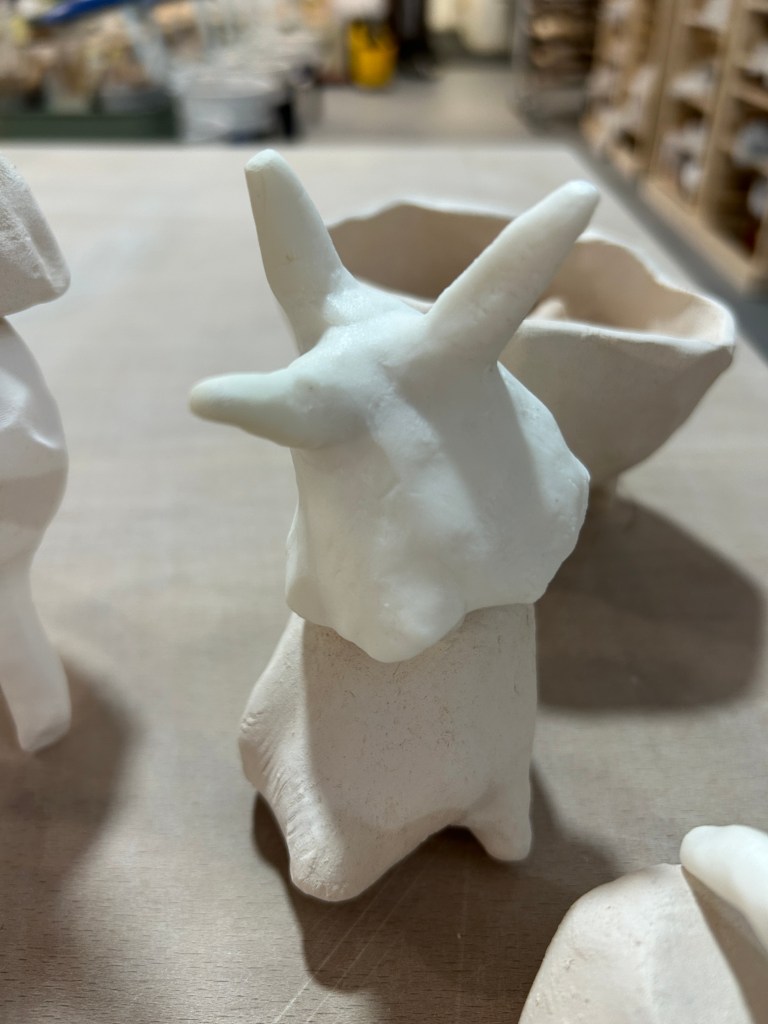
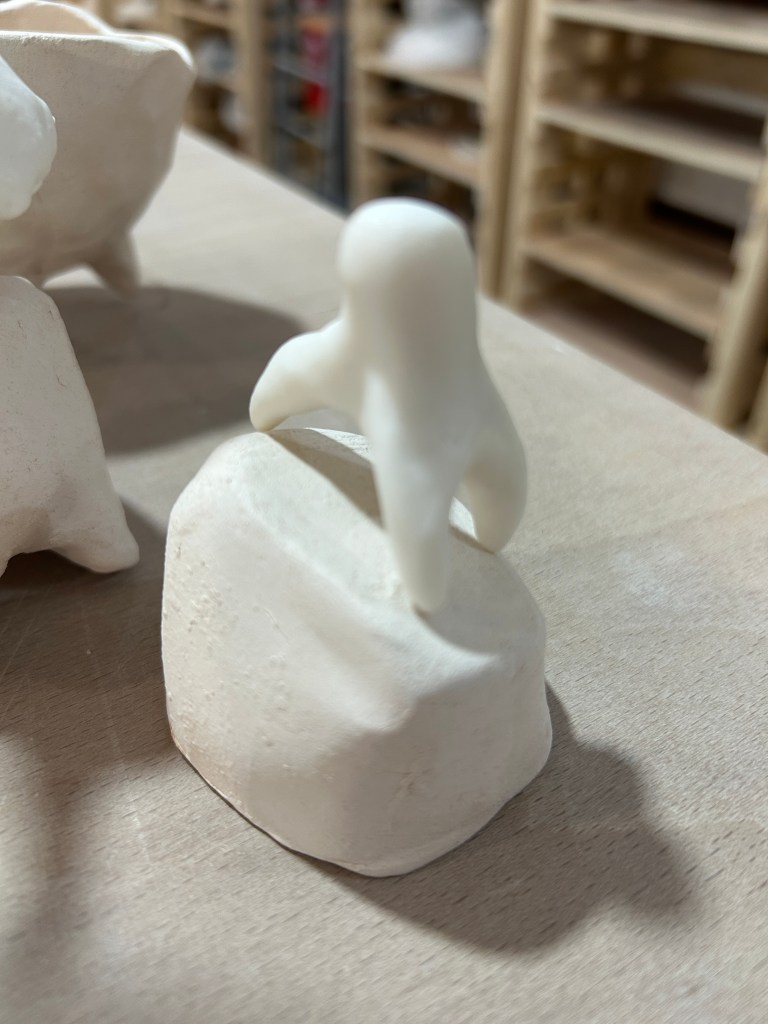
    In my case I am drawn to the human experience – being from a physical theatre and story-telling background.  And yet I think I have an aversion to the figure in figurative ceramics – to capturing a human form.  So thus far I have kind of abstracted that by creating three-legged or pot-like figures.  Which look kind of alien – and that also doesn’t satisfy me.  I also often get the feedback that they’re ‘cute’ which makes me feel sad. 

    So maybe the biggest risk for me is to explore the human form.

    I decide to spend some time with the the human figure.  I get three books out of the library about the human figure in ceramics.  My husband says ‘why are they all so creepy?’

    I guess the human frozen in time is creepy. You can paint a face on a still thing but it remains a still thing. 2D imposed on 3D.  I guess there’s something of the puppet or doll – staple figures in any horror movie.  I wonder if the idea of the clay pot surviving the centuries is inevitably somewhere in our minds when looking at a ceramic object?

    In my theatre practice I have often worked with puppetry and one of the key things about a puppet is to ‘keep it breathing’.  Even when it’s still, we feel the breath.  Puppeteers think about the breath all the time – they breathe with the puppet.  If you stop the puppet’s body from having it’s life breath – say you just sit it down and move away – we say it ceases to ‘live’.

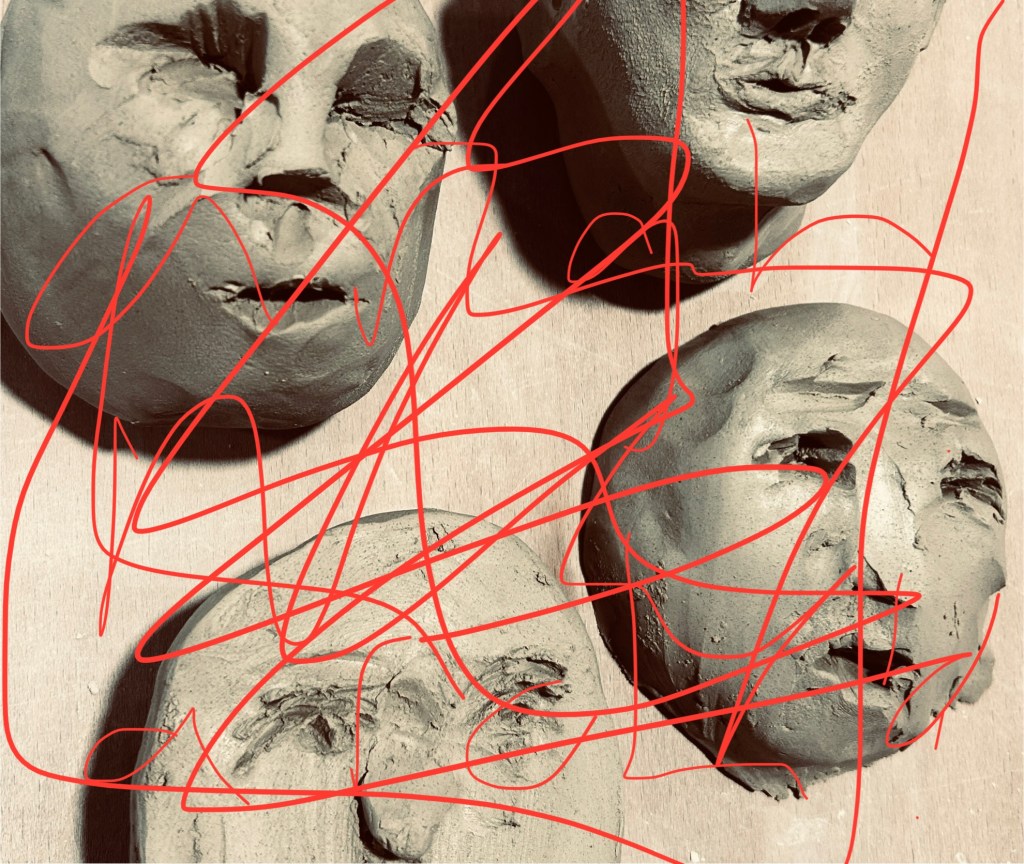
    You might think going into the studio and making a real human face isn’t going to kill me.  (I go to life drawing classes, I enjoy figurative paintings…).  But when I walk into my studio and try to make a figurative head I feel kind of sick.  If I’m honest – I feel kind of cheesy.  I tinker away with the human head and I hate it and hide it in a box.  I explore other less realistic, more abstracted faces.  I dislike them all.

    I enjoy the making.  There are technical considerations that are interesting to me – finishing a head or even a whole body one has to then slice it in half and hollow it out.  If the thing is going to stand on two feet – there has to be consideration of how it balances.  How will it sit in the kiln. It’s arms need to be propped up or they might warp.  I can imagine that making a truly realistic full size bust might be enjoyably challenging. 

    I don’t have a satisfying conclusion to this experiment.  I stop short of firing the things because I hate them so much.

    But I push on and decide to commit to making an angry menopausal wolf-woman, with high heels and a long bushy tail.  I think it might be the ugliest thing I’ve ever seen in my life.  Someone comes a long and says ‘oh, cute!’

    Onwards.

  • Univited Guests

    This week was treated to a visit from imposter syndrome.  All of his friends came too – perfectionism, procrastination, paralysis – the whole gang.

    I have lurched between the identities of six different kinds of artists.  Been haunted by distorted imaginary voices of perfectly supportive ceramicist friends, who think I’ve made bad choices and generally am making a fool of myself.  

    The nature of these thoughts are worth writing down because they are so ridiculous in black and white.  We are not our thoughts.  An idea that seems impossible to grapple with, I believe rooted in mindfulness and therapeutic practices – though at odds with Freud. 

    What am I doing making art?  And in the middle of the night – ‘What IS art? See, you can’t even answer that’.  Well I’m doing a Fine Art Masters, so let’s just see.   I find in these moments of self doubt I scroll on instagram more – it’s a great idea.  My feed shows pristine lifestyle ceramicists throwing pots next to white sofas, desperate influencers showing 3 steps for making abstract art that sells…and even the legit art scene posts seem all about what’s fashionable and what’s correct and accepted right now.  

    And part of the problem also is that everything is acceptable.  I sit down at my life-drawing class (organised by the students union, and excellent) next to a gloomy woman who says that no-one seems to care what art is anymore.  

    Under a cloud I head to the studio at County Hall Pottery, where I work as a technician in exchange for studio space. 

    At the studio Charley Blackburn, the new ceramicist-in-residence, is preparing for an update with the managers.  Her sketchbooks and glaze tests are set out for the meeting and it’s breathtaking work, but also chatting to her, I notice there are more questions than answers.  There’s certainly no end goal.  I show her a box of bisque shapes I’ve been playing with.  And a stop-frame animation I made to document the process.  I might make more stop-frames.  Charley gives me some feedback about what would making a film of them moving add to the work, which she feels already has movement and energy.  I have no idea how she has seen that. 

    While her meeting goes on I listen in to a fantastic conversation from my lovely brilliant colleagues about Charleys work – and I go into hyper focus.  Or flow. Just playing with the shapes.

    One of the challenges of ceramics is the technicality of putting something together, which really requires prototyping, sketching out, planning.  Factoring in the 7-10 different stages of drying time.  But how do I improvise if I have to plan first?  Where is the creativity that comes from spontaneity.  Each ceramicist approaches this chicken and egg in a different way.

    But most importantly something is unblocked by showing up at the studio and my wonderful community and friends at County Hall.  By Charley’s serious generosity and belief.  

    I felt so galvanised by that.  I also want to mention Daniella who has (along with Olga and Hicham) pretty much remotely organised a group show for us in the Good Rice Gallery with a couple of days notice.  She is one of the extraordinary people that just believes, is unfailingly optimistic and generous.   Instead of overthinking this, I go with the flow.

    I think my my thought this week is about community.  If I can’t be kind to myself then to take myself to the people who lift me up.  The studio becomes then not an aspirational space I can’t afford, but an environment I create by people I choose to connect with.

  • Shaped or found?

    First tutorial with Jonathan, a totally brilliant and surprising and far-reaching conversation.  Trying here to get it all down but actually it’s going to be more like a list I think, of chapters to dip into as I go along.  

    I guess the main headline is what has my path been before, is it going to beautifully joined up (as I’ve been thinking) or is it going to be healthily separated.  What do I want out of this practice?  What can I take with me and what can I leave behind.  

    Why have I chosen clay now, or rather as I see it sometimes clay has chosen me?  I know there is something about my theatre practice being about liveness, physicality, spontaneity and movement – and there being something about clay being the opposite of that – a material that when fired transforms into ceramic material that is fixed in time for thousands of years.  

    Something about holding onto something?  About anchors?  About trying to bring something to stillness?

    All of my practice so far has been collaborative.  It has been ‘we’.  That the ideas of the collective can – or must? – be more rich than the individual.  But is that true?  Is that still true for me?  Where am I in that?

    It has just popped into my head that a text-driven theatre director associated with Battersea Arts Centre many years ago called devised practice ‘fuzzy compromised theatre born out of antagonism’.

    This still makes me laugh.

    We laugh when we recognise something painful and true.

    Anyway.

    Clay.  Clay is also a tricksy collaborator – it’s needy, unpredictable, it actually remembers wrong decisions you’ve made and changed and it throws those bad decisions back at you when you open the kiln door.  And it is also compelling, essential, honest, solid, real.

    We talk about being comfortable with process.  I notice when thinking about what I want to make I am looking for a finished idea.  I visualise a kind of finished thing.  But there is something here to borrow from theatre practice – a phrase we use ‘don’t jump through the steps’ – when actors don’t see all the steps or beats in the story or moment.  

    How can I bring that sense of movement to my practice, rather than go straight to end product.  Of course improv has lessons for me here.  This translates to what processes I am using in the studio – the mesmerising pull of the wheel versus the time it takes to master the wheel.  Perhaps hand building might offer me more freedom right now?  Collaborating and ‘yes and…’ing with the clay itself.

    Also we discussed the kind of things I feel blocked by – work I like and don’t like – what does it feel like when my practice is going well.  

    There is something about essence.  About kind of finding the seam, moving between different ideas and thoughts towards something particular and tiny that feels true.  You know true when you see it.  I remember bursting into tears when I saw an Edward Hopper painting in the Smithsonian Washington DC, from some distance away.  Tracey Emin’s scratchy nudes.  You feel something at a guttural level.  Maybe I just need to dial back and notice what does speak to my gut, and what doesn’t.

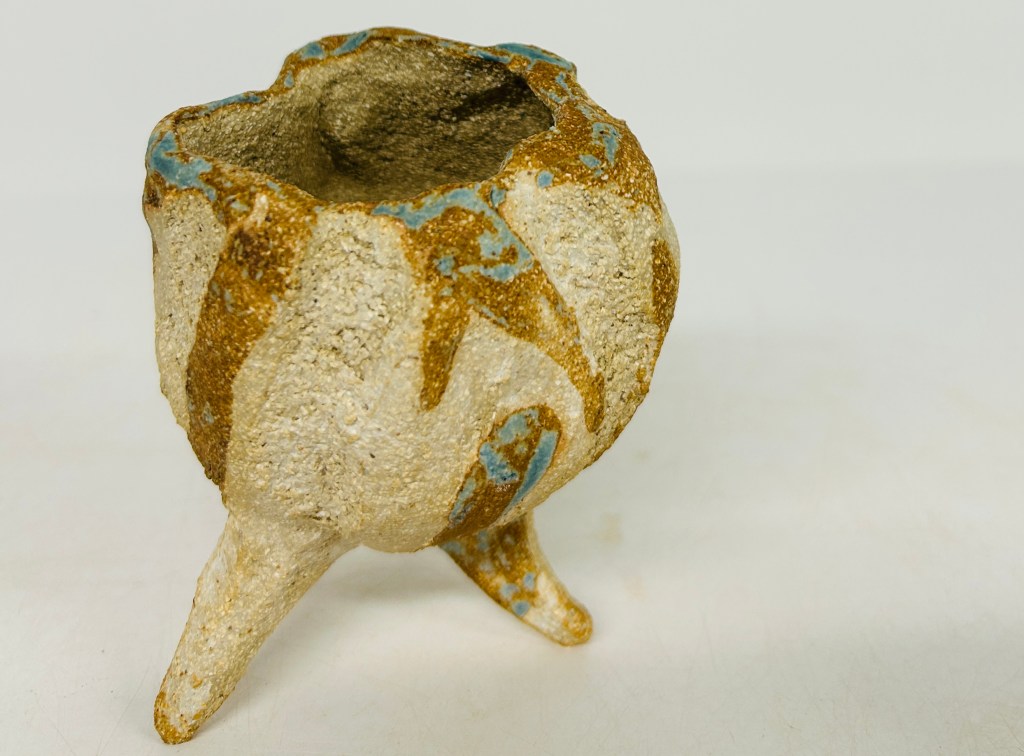
    Essence.  I don’t love all the work I make but I do love the placement of a leg on one of my three legged triped pots.  

    We decide it might be useful just to focus on that.