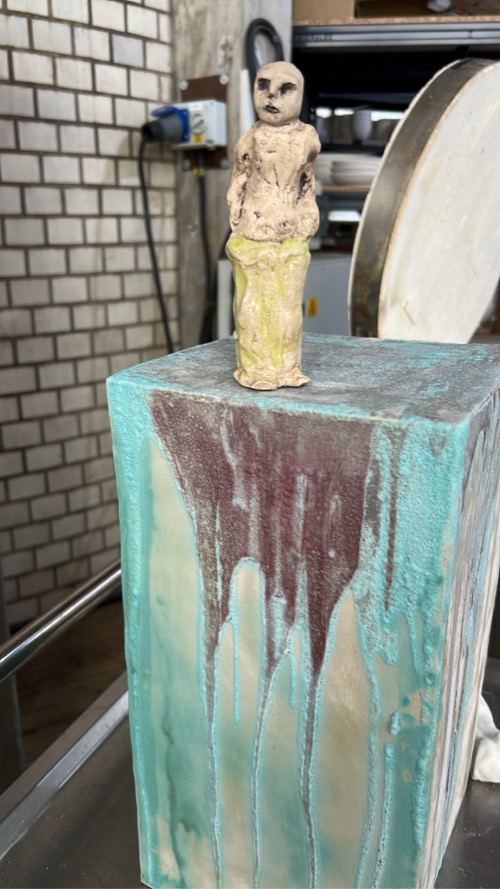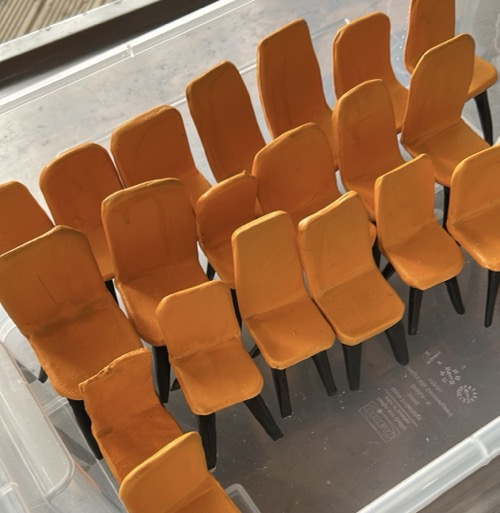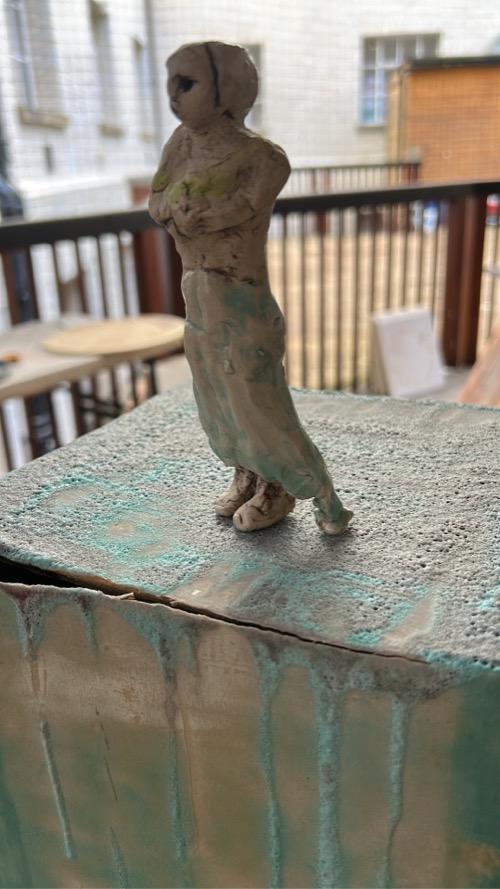
Things are sort of joining up with my theatre practice. This is my third tutorial with Jonathan.
I’ve been compartmentalising the two things which makes no sense. I talk to Jonathan about the themes in my recent blogs – looking more closely at my theatre making influences.
I also enjoyed writing in the Rebecca Fortnum class. I hadn’t done it in a while because of a block, and a situation with someone which put me off. But mostly I didn’t write because I felt I didn’t want to make my plays work in the conventional dramatic arc way. People who commissioned my plays would say they want form-breaking plays but then by the second draft they wanted a dramatic arc. And actually as a theatre maker I’d always been taking risks with the form.
I’m pushing about the research question, it’s shifting a bit.
It’s becoming more about how the audience has agency. And the Jennifer Doyle book, the thing about feeling. And how that is in contemporary art – it’s really slippery – how artists deal with feelings and audience.
Jonathan – how do you define the difference between audience agency and audience interaction?
I think in so-called immersive work audience interaction is so ‘pat’ – we did this and that made the audience do that. It manipulates the audience – it’s like there’s not respect. It sort of feels as exclusive as how people describe regular theatre. The people who attend live art or immersive art – it’s like an in-joke. A club. It’s inaccessible.
We talk a bit about how Tim’s play Toto Kerblammo uses binaural sound – and Jonathan has played a lot with that. The difference being spatial for the sound. So Tim and his sound designer have imagined how the sound of human feelings are for a dog. ‘This is what you sound like when you feel abandoned’. Beautiful.
Jonathan – I asked about agency and interaction. You took audience interaction as an actor interacting. I was thinking about the work in say an exhibition.
Interactive art can be quite shallow e.g. digital computing ‘I move and something changes’. Audience as paint brush. So is the difference respect – in the word agency?
I say yes – respect for their intelligence and imagination. You could say when you control the entire experience – which theatre tries to do, tries to shape – there’s less space for the audience. But perhaps a piece of abstract art may leave tonnes of space for the audience to do what they want with it. But also there’s a sort of coolness – ‘make of it what you will’ – that the intentions of the artist is so distant to the response that you could say the artist doesn’t seem to care?
Jonathan – is time to do with that? It starts at 7.30pm – is there a fundamental difference there?
And if you’re not controlling what time the audience spend there, say maybe something happens at 4 but otherwise you can go in and out. Then what?
Jonathan loved the Rachel Maclean show in Liverpool which does loop round and round, but had a clock counting down and if you see it on that particular time there is an experience like theatre. She uses curtains opening automatically at certain times.
I wish I could see it.
We talk about actor Ralph Little playing being tortured in a production of The Spy Who Came In From The Cold – which Jonathan saw recently and felt really uncomfortable at. There is an experience of coming outside of the show/story and being live in a room when Little has his head held underwater. Are you watching anymore or worrying about being the audience member who witnessed the accidental death of a beloved TV actor?
Of course it will have been done really safely – a tube, a safe word etc – although it was pretty well done. Still viscerally different from watching it on film.
I say that very few film-makers have ever got away with doing ‘meta’ film. We buy into the game that it is real.
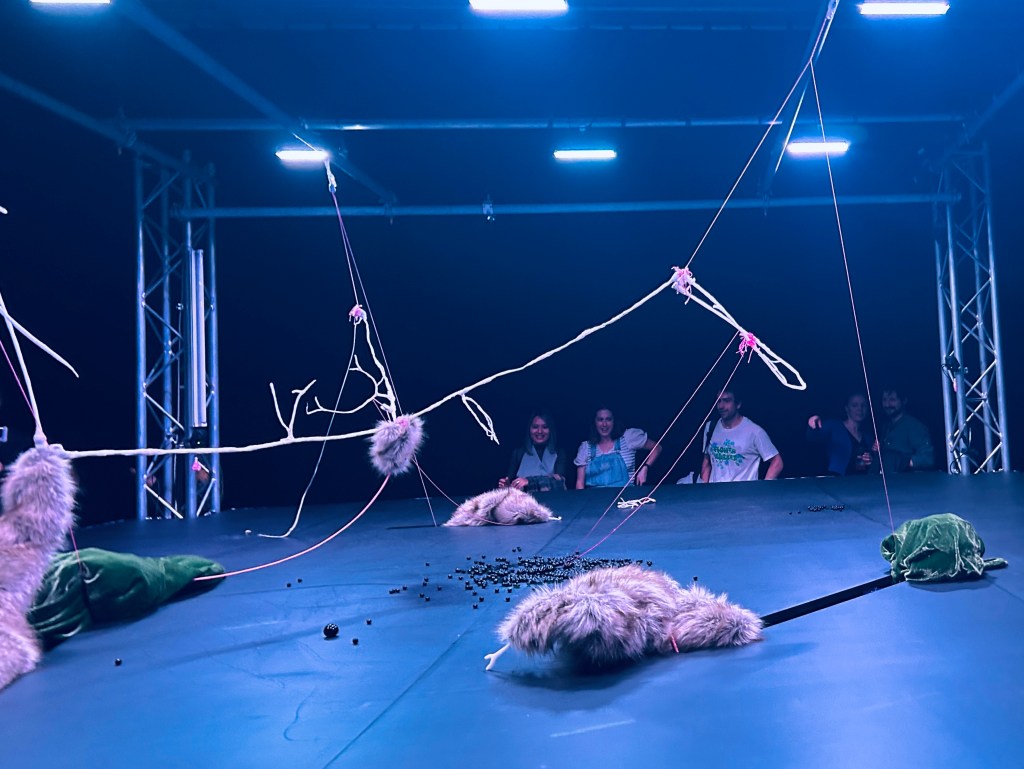
We talk about the sense that the audience have more agency in the object animation theatre piece I saw ‘Matter Era’ – because they know more about what’s going on than the puppeteers with magnets under the metal stage. It was time and time again about jeopardy and failure – and like improv – the audience understood that in the moment.
I found the design breathtakingly simple. And it was a really long time before anything happened. Too long in theatre terms. Playwright / Director David Lan (formerly at the Young Vic) – used to say when a show starts there is a finite amount of time for the audience before they lose interest. But we didn’t really even notice Matter Era start…just these oily blueberries started to just…be there. You couldn’t quite say what those things were representing, the furry things that were breathing, the sticks, silly bits of string. You projected what you saw in it.
It pushed the limits of what time should do in theatre.
The sound designer was improvising off the action in the room.
It was just wild.
The way the final image arrived out of the various objects, was kind of an accident, an improvised story sort of, of failure and effort.
It felt like the objects had an inner life.
In collusion with the audience.
I describe Animo an improvised studio show I used to do with Improbable Theatre, where sometimes we would bring pieces of newspaper to life.
Matter Era was. Right on the edge of visual art. And theatre.
People kind of respected the space, but didn’t interfere – respecting the rules of the game – which was to discover it. It wasn’t like some performance art piece where it was more ‘I left this here do something with it’
We talk a bit about the problems of badly done performance art – the lack of consideration of the space, where the audience are to be, how the elements are going to play out and whether that has even been tested. Surely there’s a way of making good quality decisions about how performance art is going to work – even if you then want to break all the conventions and ‘rules’?
With Matter Era you had that sense of being in safe hands even though they were improvising, and even though they were pushing their control of the work to the limits.
And yet like improv – if it’s really genuine and you put aside comedy sketches – you have to embrace the possibility of it really failing. If it’s to be really improvised.
There are ways of controlling improv so it doesn’t fail – putting in tricks and landing places, rehearsing stock moves, casting big star improvisors who always make a ‘good night of it’. All of the mid-scale improv does this. But real improvised work is different.
The audience embracing the possibility of failure. That’s the sweet spot.
Jonathan makes a note of this – as he feels from his perspective that this line of enquiry could make a research paper that’s really worth reading. Bringing that theatre maker perspective – how the audience have agency (rather than just interaction), teasing that and understanding that. That could be really valuable for Fine Art practice. That has implications of what we make. And how we curate and set up exhibitions.
A PHD colleague of Jonathan’s – writing about Curation – was thinking about ‘palette cleansers’ – how in a world where we’re bombarded with millions of images – can we visually cleanse the pallets and experience the flavours. A bit like the theatre – the rituals of the stairs and the tickets and the seats. Jonathan singing You’ll Never Walk Alone at the football in Liverpool with the years of history collectively – we’re doing something together in the moment. A lot to tease out and maybe beneficial.
Coming full circle – I’ve been thinking about this all my life.
But what are the lessons that can be learned across those boundaries for art practice?
Because as Doyle says – there’s a sort of coolness – it often feels it doesn’t sort of matter to the artist what happens with the audience experience.
It’s about to do with caring about what the audience get. Without contriving it.
I talk about my Improbable Theatre friend Lee Simpson’s idea of finding a perfect moment in theatre. He tells this story. It’s like a shy deer has wandered on – and we all hold our breath because a wrong feeling or noise and it will run off. The key point is liveness. It’s just wandered in. Now we could shoot the deer, stuff it, wheel it in on a trolley at the same moment every night. But it won’t be the same because it won’t be spontaneous.
There’s a fragility. Allowing the audience’s care to be part of the experience.
Jonathan – what are the lessons of that for an exhibition that may be open for a month or more?
There can be some kind of liveness on the opening night, but the rest of the time?
Could you have the quality of the deer in a piece that stays for a long time with no-one present.
Is it about time-based work? Or can you have a sense of spontaneity in the way the work looks or is set up so it has a sense of liveness?
Gosh I need another year.
Quote Jonathan found recently – ‘All art is the creation of forms symbolic of human feeling’ – Susan Langer?
The objects in Matter Era had feeling. I remember a theatre making peer of mine Paul Hunter (of Told By An Idiot) saying that if a character is angry instead of writing dialogue literally, like you would say in Eastenders, we might just see them burst into flames.
What’s really speaking to me in Doyle’s work is there’s this coolness in some contemporary art that leaves me cold. Is it coolness towards the audience?
There is space and agency for what the audience does with it – do what you like with it… but where does that tip over into ‘I don’t even care what your response is or even if I did anything for you at all – you’re so far away from me’.
A colleague of Jonathan’s wrote a course called Public Art. It would sit within socially engaged practice (he notes an essay worth reading that’s very against socially engaged practice). Joseph Beuys talks of Social Sculpture – the idea of audience and artist are together forming things. It’s let see what happens – put things in place and see what happens. Anyway one of his definitions of whether art is public or not (Duchamp said it becomes art when audience sees it) – he said a work of art is not a work of art unless two strangers talk about it together.
He was thinking about work in a Gallery. Can be love, anger or whatever it is that provokes you but you spoke to someone you don’t know and a whole different experience appears. A thought experiment – it needs that level of engagement before it becomes something real.
And I think there’s that thing about access – and how I think a lot of ‘immersive theatre’ is an exclusive club. Who’s going to turn to the person next to them? A middle class person could do that like a shot.
But also non-‘arts attendees’ might say ‘what’s that? My five year old son could do that’
Who owns it?
Jonathan talks of a 13th Century painting bought by the city of Hull when it was City of Culture. It cost 3 million pounds. He remembers a guy with his kid, didn’t look like he went to shows like this. He walked straight up to it. He said to his son ‘That’s ours that is’, then to Jonathan ‘It’s good isn’t it?’ That sense of civic pride. 700 years after the thing was made.
Jonathan thinks there’s a lot in this line of enquiry. “It’s a really interesting paper but it plays into your practice, there’s value in it.
Accept your expertise and bring that across to this – that is real value – whatever it looks like.
It’s a big area sure, so you’ll have to narrow it down, but embrace your decades of expertise and all of us will benefit.”