Had the most amazing and generous tutorial with Jonathan. I’ve been feeling really stuck, whilst at the same time because of the complexities of the firing schedule at my studio (as detailed in my earlier blog) I’m having to press on and make regardless of stuckness, in order to have something for the interim show. Not a great way to nurture my developing practice.
During the tutorial, where we talked a lot about my multi-disciplinary practice and what that brings, I talked about the situation in devised theatre processes where it’s agreed that we’re stuck and we’ll have to wait. In my company I used to refer to it as ‘waiting outside the cave until the dragon wants to come out’. Mike Shepherd from Kneehigh frequently used the phrase ‘hold your nerve’. And Kasia Zaremba-Byrne, a brilliant polish movement director, will often pause during choreo sessions and say ‘we’re really in the sauerkraut’.
Am trying to refine what I want to explore here. Pull the threads together. There’s something that’s very clearly pertinent to my positionally as a ceramicist – given that ceramics once fired are fixed in time – and that I’ve come from a theatre background. A theatre background specifically rooted in liveness and improvisation. So it feels like time is going to be important. Theatre is ephemeral, transient, here and now and then gone. Ceramic is fixed in time, it survives thousands of years. Being one of man’s first discoveries it sits deep in our consciousness that ceramic endures.
But at the same time – the opposite is also true – ceramics break.
Liveness, ethereal, transient…here and gone…fragility.
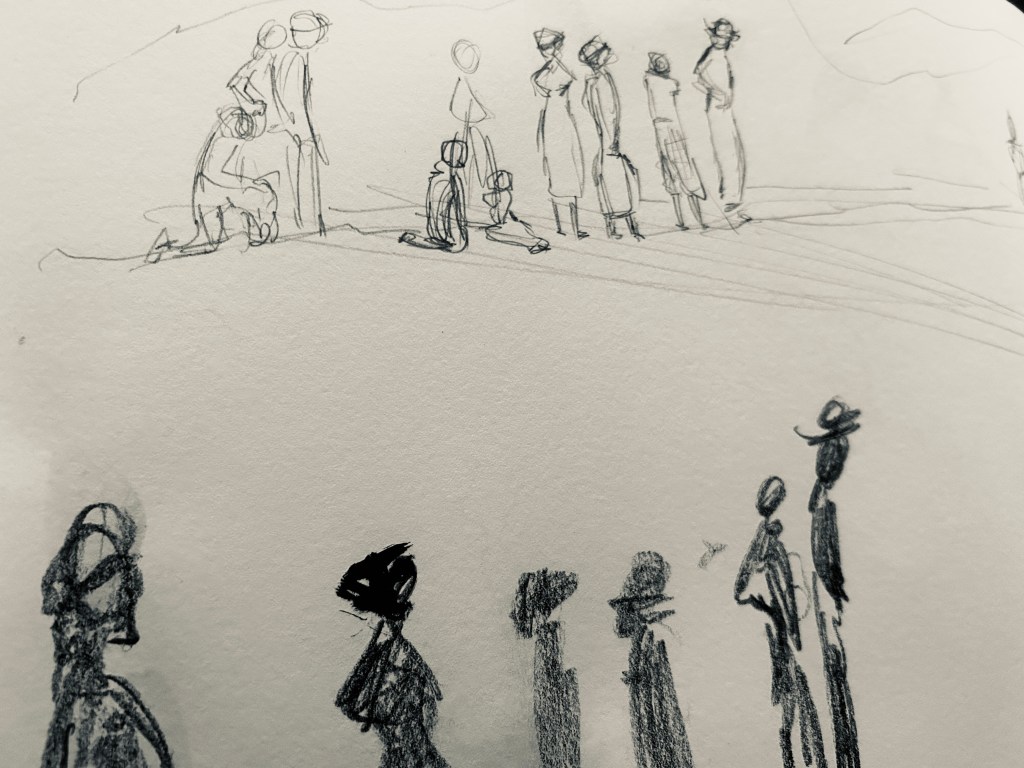
The other – not unrelated – interest is movement. My theatre background is largely physical, and so far I have choreographed my ceramic figures in dynamic spatial relationships. Which does in turn create story.
I’m aware of ceramicists who have a performative element to their work. My pal Shane Keeling climbs on ladders to drop his pots to the ground. And the artist Vidya Thirunarayan I met at the talk recently incorporates raw clay into her dance performances. There is more to explore there, but I notice I am not drawn to performing in my fine art practice. The challenge for me is finding the place where my performance experience intersects with my ceramic practice, without ceramics becoming consumed into my performance practice.
Jonathan asks – is it about the concepts, the shape or the material itself that you’re interested in?
We talk about am I looking at movement in a phenomenological sense, or putting in mechanics so things move? Maybe movement isn’t the right word – maybe it’s more about space and distance and relationship. The capture of the quality of movement (as per The Futurists explorations) seems too literal.
Previously I thought about Puppeteers keeping puppets ‘live’ by breath-work.
Maybe the word is breath.
Breathing space.
Breath = life force.
I keep returning to an assumption that I’m somehow obliged to abstract the figure because that’s what ceramicists do… (This is where trends and fashion are unhelpful). A counter to that assumption is Claire Partington, a powerful ceramic artist that I love who…makes extraordinary ceramic figures. Satirical, feminist, referencing flouncy 18th Century porcelain figurines – and with a theatricality and sense of space that I can relate to.
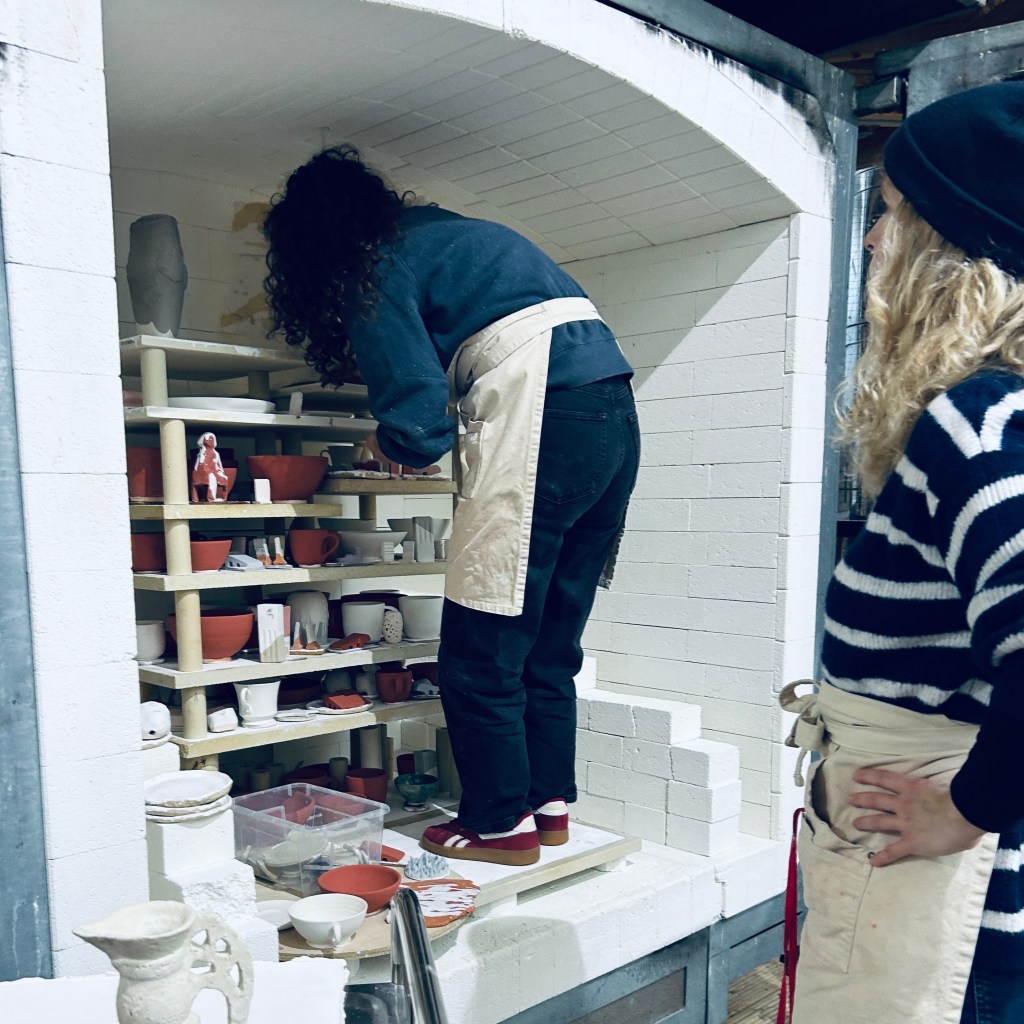
And that leads us to porcelain, how I have become captivated by this self-glazing kind called Parian. And how I felt when I opened the kiln door, how perfect my Parian pots were (to me). Want to note here this was quite an emotional session, my recent ADHD diagnosis came to the fore again because I’m seeing that my hampering perfectionism is infact me compensating for something / everything. When you’ve just discovered an entirely different truth about who you’ve been your whole life, trying to find what’s authentic is hard.
But also I am still me.
I want to capture here somehow how meandering this tutorial / conversation is, because writing it down from my notes, it’s useful to notice that process of circling past the idea and back again.
Jonathan says that this kind of grappling does come before a breakthrough.
Then I have this thought that if the ceramics are fixed maybe something else moves them, the floor perhaps. A designer Jon Bausor that I worked with when directing a Ionesco play ‘The New Tenant’ at the Young Vic created a mechanism to vibrate the floor so that furniture could move by itself. (This cuts a very long story short – the Tech was an all-nighter!)
Jonathan finds me an instructable site about making a Chladni Plate, which uses low-frequency sound to create vibrations. And tells me about an experimentation where bass sound caused an artwork he made, involving toy cows in a fish tank of milk, to move into formation. (I am nearly dismantling my bass amp at the end of this tutorial but then remember…it’s my bass amp).
And then things come full circle for me because the missing piece is about the audience. If I don’t want to perform but want to leave my work in a place for the audience to experience something, how do I create that sense of liveness, that sense of spontaneity, that transient quality that gives the audience space to dream, experience and feel? To be agents of their own interpretation. I tell Jonathan about Yuki Nakamura’s ‘Fragile Like Life’ – the temporality of the deflated porcelain-cast footballs in a place where people are considering life and death. The reference to life – and actually to breath – and to play and joy.
Maybe that’s why I’m currently drawn to porcelain. It’s ethereal, nebulous and it feels fragile and precious. People have a visceral reaction to the idea of porcelain breaking.
Perhaps my figures move on this vibrating surface. And they might fall off and break. I might orchestrate that, or leave it entirely to chance. I could even fire something once – they’d be fragile but that’s ok.
Finding the something that allows the audience some breathing space. Jonathan reminds me that I’d spoken about placing objects in the space, the space between, the sharing of space and the dialogue between.
Gaby Mlynarczyk at the talk spoke about the negative space. Painters understand negative space. But I’m not sure it’s something we often think about with ceramics because the focus is on the thing, the material, the object itself.
I began this tutorial full of panic at my dwindling options due the the firing schedule shenanigans and the time ceramics take. I leave full of inspiration, with ideas to spare, having waded out of the sauerkraut.
Jonathan – ‘You know on a foggy morning you know the sun is there. That lingering in the fog can be really beneficial’.
 Alex Murdoch, Artist