Tag: Process

  • Permission, presence, purpose

    Trying at the moment to work from my gut, and trying not think to many steps ahead.  Trying, trying, trying to not try so hard.  We have a discussion about what blocks the imagination, taking as a starting point the word resentment.  Which interestingly turns out to mean re-feeling (French: sentir, Latin: sentio).  This makes me think about presence.  If we are re-feeling, we are cycling past emotions.  And I can see that this can happen with re-feeling in the direction of the future also – being in that stuck place of ‘this will happen, that will happen’ – which will always be cyclical because it doesn’t exist.  There is only now.  And now.  And now. Etc.

    My internal narrative when unhelpful, when not-present, is often littered with questions about validity – what’s good, what’s good enough, what’s excellent, what’s not, what’s ok, what’s correct.  When you write it down it’s pretty ugly.  Again in improv ideas are generated on the foundational premise that there are no bad ideas.  Keith Johnstone (aforementioned improv forefather) would coach actors with ‘be boring’ or ‘too original!’.  I trained as an actor at École Philippe Gaulier, an eccentric but unrivalled master of engendering the essential quality of presence in the actor.  Famous for ordering actors to ‘leave the stage immediately’ seconds after their entrances, because he could ‘see a little idea coming’, it was a school of hard knocks.  We once asked him about talent.  He said ‘There is no such thing as talent.  Only what you authorise in yourself to do’.  I think about this nearly every day. 

    We discuss results of an automatic writing exercise on what blocks the imagination.  The discussion is framed as ‘Where do we need new creativity, new imagination?’.  We think about the ‘we’.   Tim – ‘the lofty idea of the artist as solo genius, artist as hero, that model, Rothko – is really unhelpful’.  We think about the ‘new’ – are there new ideas – probably not.  We think about the ‘need’ – is the work doing the job it is meant to be doing?

    What is that job exactly?

    Jonathan reads a provocation from Ben Okri in the Guardian about the artist’s responsibility towards only working on the subject of the climate emergency.  What does existential creativity look like in our art practice? How do we translate that or interpret it?  Also read out – an extract from Douglas Hine’s ‘At Work in the Ruins’ – about the problem of seeing art only as a tool for getting across a message.

    Art is not a cheap alternative to an advertising agency or a sophisticated extension of the communications department, and the urgency of the message doesn’t change this.

    I really enjoyed Luisa’s response to this ‘our art practice is to protect thinking’.  I take from this that we need to give our audience space.  To not be conclusive.  To leave space for a dialogue – even if the artist has left the room, or the planet – we are in conversation with them through the work.  We remember how shut down we were at school when preached at. 

    Hine quotes in turn playwright Anders Duus – 

    Our job is to complicate matters

    I think this has really helped me think about how I approach meaning.  I’ve worked in a discipline where storytelling is at the centre of things – and clarity is essential in script/playwrighting.  I suppose I am still telling stories but maybe in my art practice in a different way, giving space for the audience yes, and also space for the intangible, as Hine puts it, for the ‘messiness and strangeness of life’.
  • Thinking or Feeling?

    We talked last week about David Cross and Matthew Cornford’s The Lion and the Unicorn, working on a response to a white cube space, thinking site-specifically, filling the space with coal, creating an environmental statement – and the ethics and integrity of that.  This week we were shown around – via live feed – Bobby Dowler’s exhibition with found and rejected canvases belonging to other artists that Bobby has appropriated, doctored and left open to live curation by visitors who can move and place them as they wish.  Dowler is talking about who own’s art (can these pieces be sold etc) and the place of commerce in the art world.

    Two site-based responses.  This is a language I know – my theatre company made shows on allotments, in shopping centres, working men’s clubs etc.  At the time I thought deeply about audience – and how the cultural dynamic was changed by going to the spaces owned by the audience rather than having them come to our traditional theatre buildings with their red velvet, ornate architecture and weighty cultural baggage and behaviours.

    I also feel now that ‘immersive theatre’ practice has full-circle turned back on it’s original more community-focused and democratising intentions – where now the term ‘immersive’ theatre is guaranteed to bring a set of excluding behaviours, arguably equally elitist as the traditional theatre dynamic, where very knowing audiences are well used to ‘joining in’.  And I feel a little tired of that.

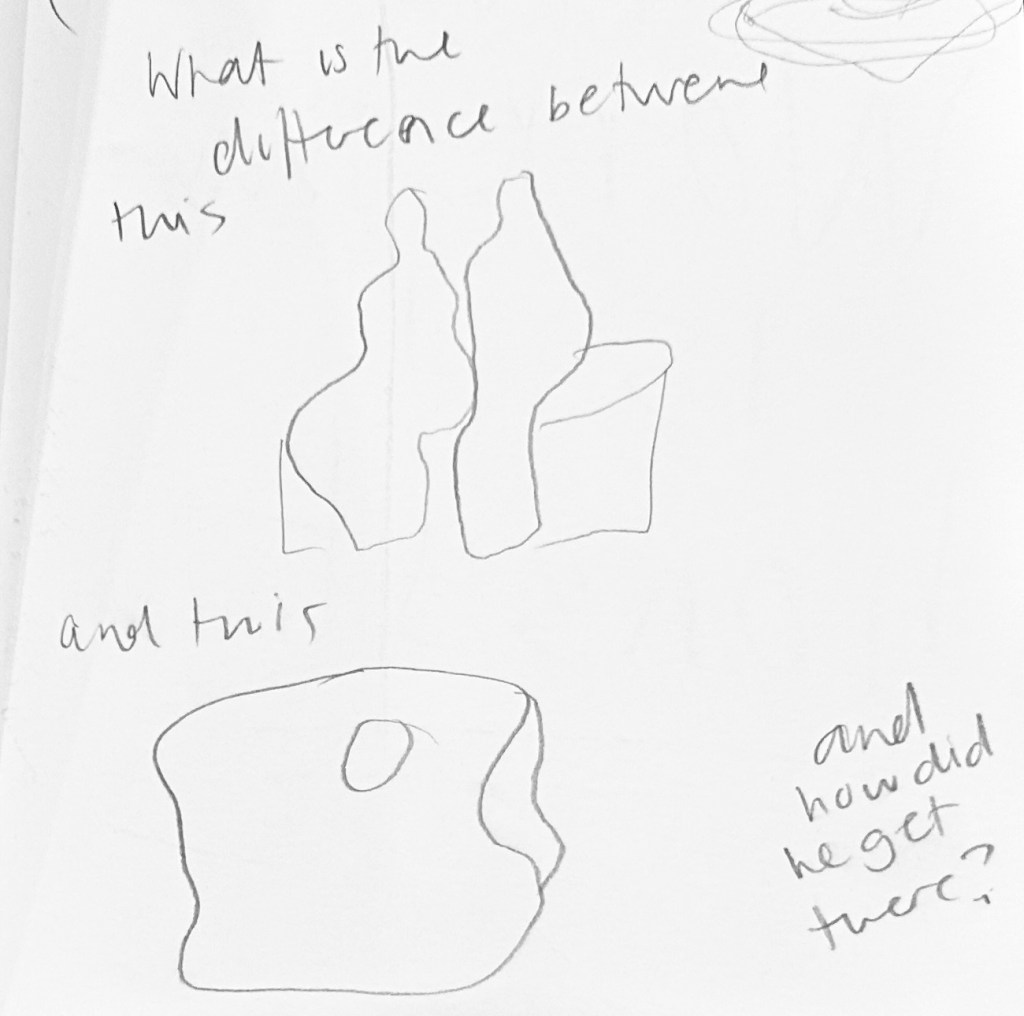
    This all made me think about intention and meaning.  How all-encompassing the idea of concept is in art now, can we even begin to move away from the analysing and deconstructing of ideas, can we ever experience pure feeling in an abstract sense?  I’m interesting in digging into this because while I enjoy pulling apart the artist’s intentions and the success of the realisation of those intentions, I also feel sometimes feels duped by art that is purely a talking thing, a tricksy and gimmicky thing.  

    And what does this all mean for process?  For the sketchbook, for the prototypes, for the technical stuff…especially pertinent in the demands of ceramics as a practice.  

    What do I want to say and how will I want to say it?

  • Shaped or found?

    First tutorial with Jonathan, a totally brilliant and surprising and far-reaching conversation.  Trying here to get it all down but actually it’s going to be more like a list I think, of chapters to dip into as I go along.  

    I guess the main headline is what has my path been before, is it going to beautifully joined up (as I’ve been thinking) or is it going to be healthily separated.  What do I want out of this practice?  What can I take with me and what can I leave behind.  

    Why have I chosen clay now, or rather as I see it sometimes clay has chosen me?  I know there is something about my theatre practice being about liveness, physicality, spontaneity and movement – and there being something about clay being the opposite of that – a material that when fired transforms into ceramic material that is fixed in time for thousands of years.  

    Something about holding onto something?  About anchors?  About trying to bring something to stillness?

    All of my practice so far has been collaborative.  It has been ‘we’.  That the ideas of the collective can – or must? – be more rich than the individual.  But is that true?  Is that still true for me?  Where am I in that?

    It has just popped into my head that a text-driven theatre director associated with Battersea Arts Centre many years ago called devised practice ‘fuzzy compromised theatre born out of antagonism’.

    This still makes me laugh.

    We laugh when we recognise something painful and true.

    Anyway.

    Clay.  Clay is also a tricksy collaborator – it’s needy, unpredictable, it actually remembers wrong decisions you’ve made and changed and it throws those bad decisions back at you when you open the kiln door.  And it is also compelling, essential, honest, solid, real.

    We talk about being comfortable with process.  I notice when thinking about what I want to make I am looking for a finished idea.  I visualise a kind of finished thing.  But there is something here to borrow from theatre practice – a phrase we use ‘don’t jump through the steps’ – when actors don’t see all the steps or beats in the story or moment.  

    How can I bring that sense of movement to my practice, rather than go straight to end product.  Of course improv has lessons for me here.  This translates to what processes I am using in the studio – the mesmerising pull of the wheel versus the time it takes to master the wheel.  Perhaps hand building might offer me more freedom right now?  Collaborating and ‘yes and…’ing with the clay itself.

    Also we discussed the kind of things I feel blocked by – work I like and don’t like – what does it feel like when my practice is going well.  

    There is something about essence.  About kind of finding the seam, moving between different ideas and thoughts towards something particular and tiny that feels true.  You know true when you see it.  I remember bursting into tears when I saw an Edward Hopper painting in the Smithsonian Washington DC, from some distance away.  Tracey Emin’s scratchy nudes.  You feel something at a guttural level.  Maybe I just need to dial back and notice what does speak to my gut, and what doesn’t.

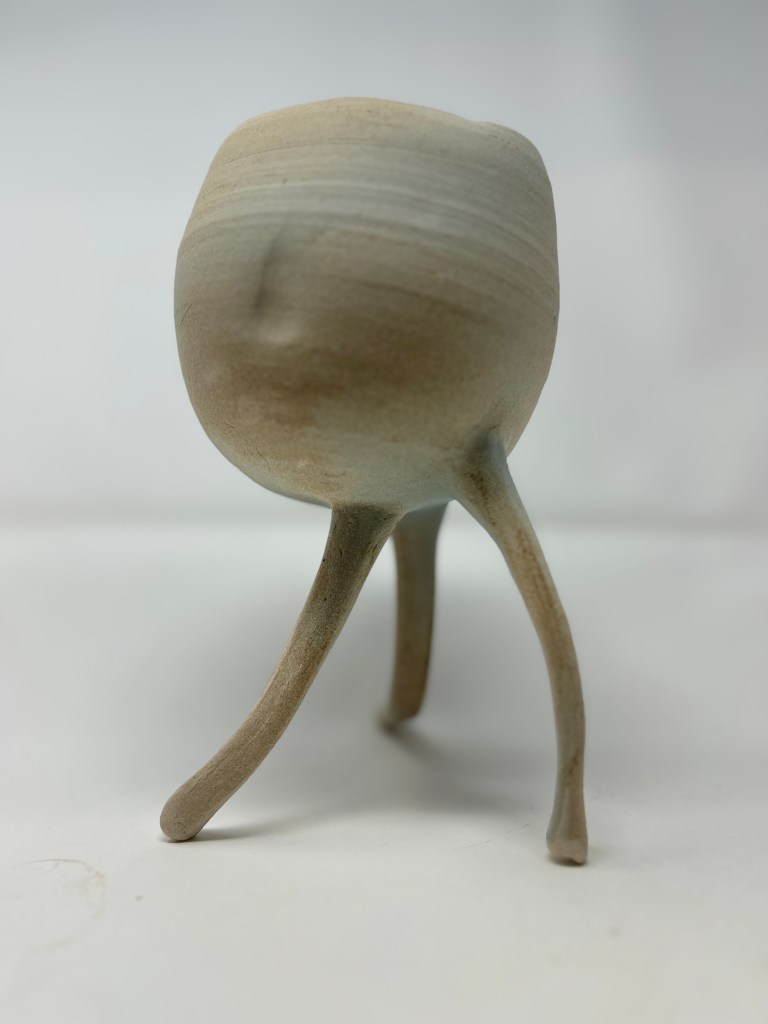
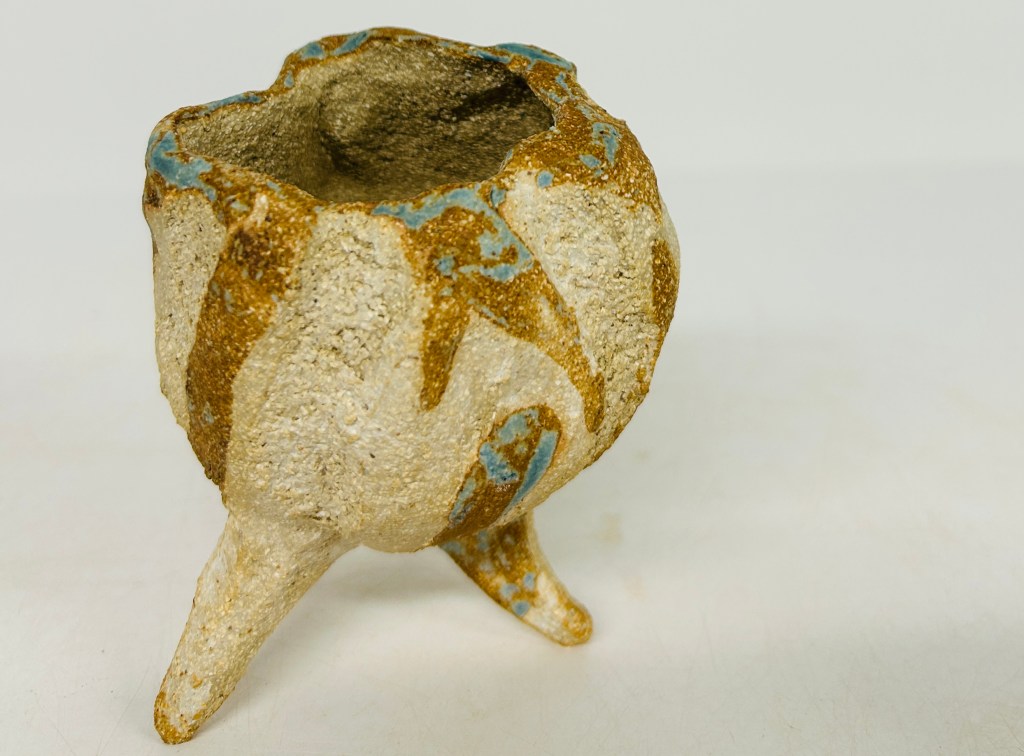
    Essence.  I don’t love all the work I make but I do love the placement of a leg on one of my three legged triped pots.  

    We decide it might be useful just to focus on that.