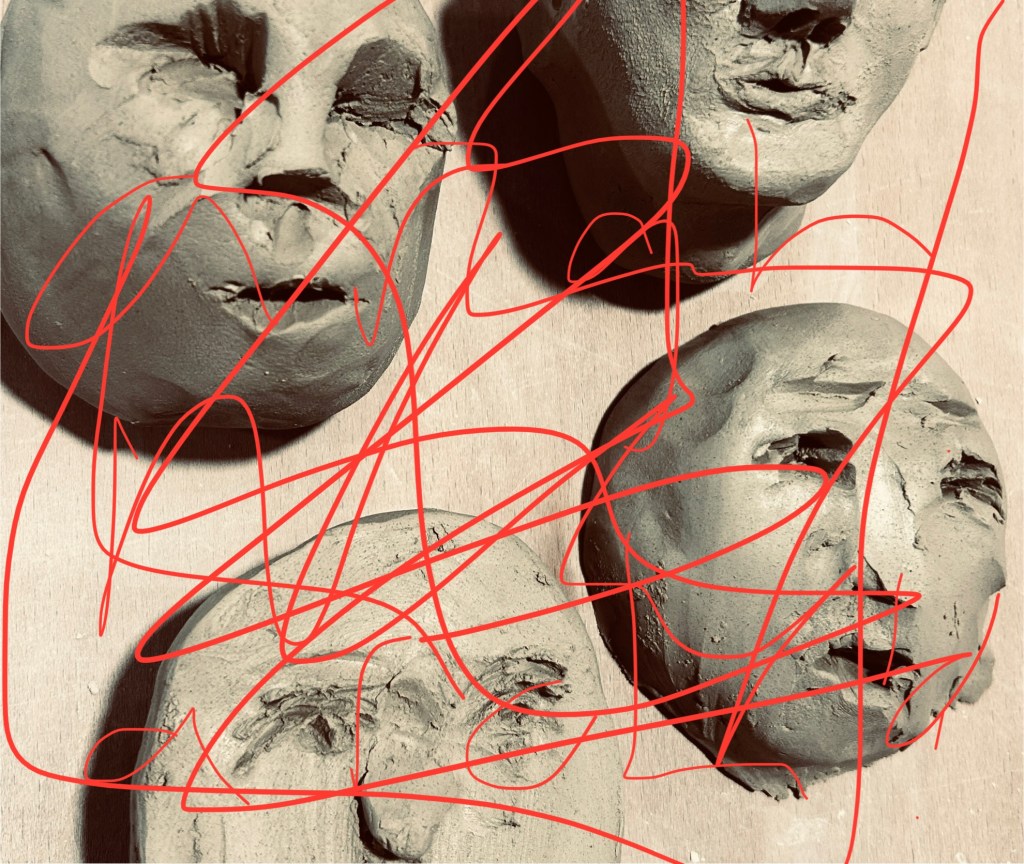
Some weeks ago we were challenged to take a risk. I didn’t do it because at the time I couldn’t think about what sort of risk I wanted to take. My first thoughts about artists taking risks involves them making themselves extremely vulnerable, or exploring things that are really confrontational to people with conservative values (Yoko Ono, Marina Abramovic, Tracey Emin). Thinking about my own blocks and resistance I noticed that risk, for me, is bound up with taste. I’ve made a judgement call somewhere along the way where X is ok and Y is not.
Somehow particularly in ceramics. Perhaps I’ve picked this up from other makers I look up to.
And partly it’s something about the fact that ceramics is tough badge to earn – it’s very technical, there are no shortcuts to experience, it’s slow and resource-hungry. You had better get it right.
In my case I am drawn to the human experience – being from a physical theatre and story-telling background. And yet I think I have an aversion to the figure in figurative ceramics – to capturing a human form. So thus far I have kind of abstracted that by creating three-legged or pot-like figures. Which look kind of alien – and that also doesn’t satisfy me. I also often get the feedback that they’re ‘cute’ which makes me feel sad.
So maybe the biggest risk for me is to explore the human form.
I decide to spend some time with the the human figure. I get three books out of the library about the human figure in ceramics. My husband says ‘why are they all so creepy?’
I guess the human frozen in time is creepy. You can paint a face on a still thing but it remains a still thing. 2D imposed on 3D. I guess there’s something of the puppet or doll – staple figures in any horror movie. I wonder if the idea of the clay pot surviving the centuries is inevitably somewhere in our minds when looking at a ceramic object?
In my theatre practice I have often worked with puppetry and one of the key things about a puppet is to ‘keep it breathing’. Even when it’s still, we feel the breath. Puppeteers think about the breath all the time – they breathe with the puppet. If you stop the puppet’s body from having it’s life breath – say you just sit it down and move away – we say it ceases to ‘live’.
You might think going into the studio and making a real human face isn’t going to kill me. (I go to life drawing classes, I enjoy figurative paintings…). But when I walk into my studio and try to make a figurative head I feel kind of sick. If I’m honest – I feel kind of cheesy. I tinker away with the human head and I hate it and hide it in a box. I explore other less realistic, more abstracted faces. I dislike them all.
I enjoy the making. There are technical considerations that are interesting to me – finishing a head or even a whole body one has to then slice it in half and hollow it out. If the thing is going to stand on two feet – there has to be consideration of how it balances. How will it sit in the kiln. It’s arms need to be propped up or they might warp. I can imagine that making a truly realistic full size bust might be enjoyably challenging.
I don’t have a satisfying conclusion to this experiment. I stop short of firing the things because I hate them so much.
But I push on and decide to commit to making an angry menopausal wolf-woman, with high heels and a long bushy tail. I think it might be the ugliest thing I’ve ever seen in my life. Someone comes a long and says ‘oh, cute!’
Onwards.
 Alex Murdoch, Artist