Tag: validity

  • Immaculate Heart College Art Department Rules

    Been turning over in my mind the 10 rules from Corita Kent’s Immaculate College of Art that we looked at in the last session.  It occurs to me that Kent’s rules are so fresh precisely because she wasn’t (for a long time) accepted or part of the art establishment, that her outsider status gave her permission.  That somehow not being accepted can actually be a freeing thing.   Being outside of something being a ‘point of departure’ – to return to Alex Schady’s quote (see earlier blog) that comforted me when I was worrying about being from a different art discipline.  I recently watched ‘Maudie’ – a biopic of outsider artist Maud Lewis played beautifully by Sally Hawkins.  Maud Lewis just painted images everywhere she could find, over the furniture and the walls of her tiny Nova Scotian hut.  In terms of the collective judgement of the art establishment Lewis had a lot in common with Kent – no recognition until much later in life – and a delegation to the ranks of ‘outsider’ status.  Problematic word – ‘Outsider Artist’.  What defines the Inside, if you put aside more cynical ideas such as class, money, contacts and a nice stable upbringing that means you can work the room at a Private View…?  Something defined must have rules or there is no definition.  But artists break rules – don’t they?  Shouldn’t they?

    What’s refreshing about Lewis and Kent is they keep making.  Rather like wise Yoda’s – they either do or do not, there is no try.  Keep putting things down on paper, or any surface.  Make.  Don’t think.  Try trusting.  Rule no. 1 is that you try trusting for a while.

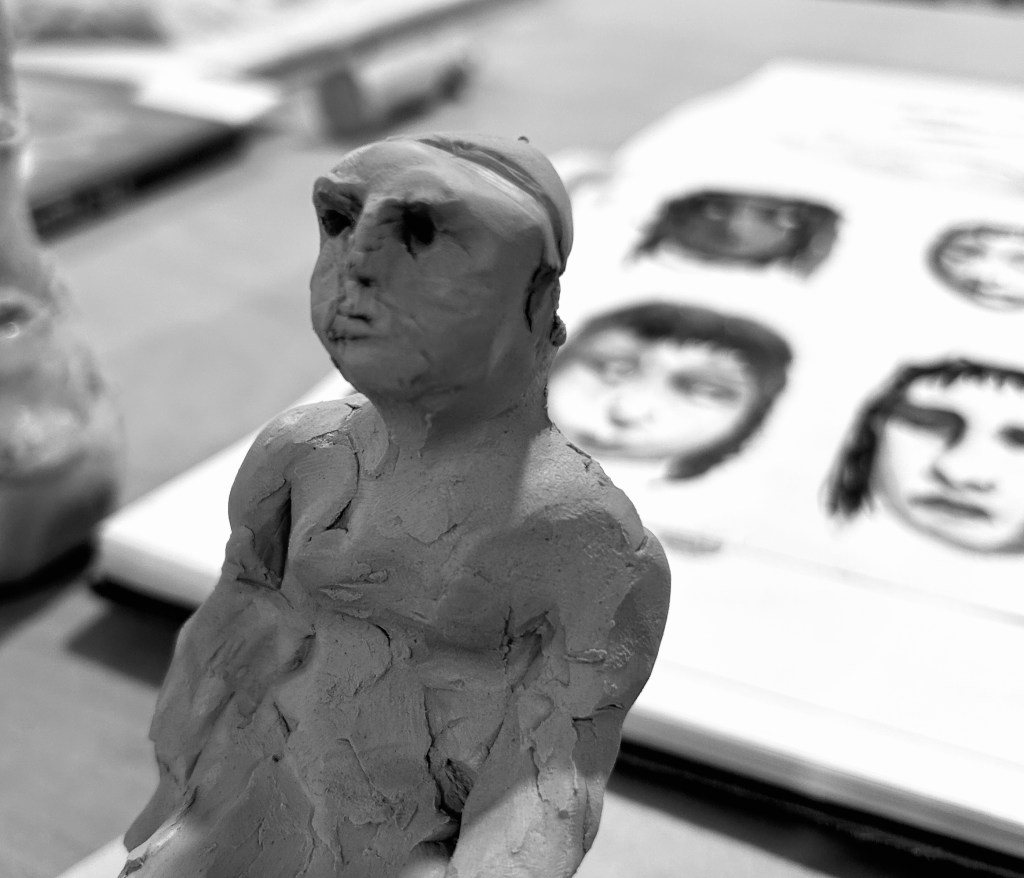
    Yesterday I forgave the sorrowful kind of realistic figures I was making (which I am resisting because of what…taste, trends, some sense of what’s ok to do – and that literally nobody has told me not to do).  I just committed to them and I believed that if I endow them with seriousness and validity – then maybe they would have this.  

    Actors do this also.  When they don’t commit – or they half commit – everything falls apart. So again, the other discipline contributes to my work.

    Rule No 8* (which should be tattooed on my forehead) – 

    “Don’t try to create and analyse at the same time.  They’re different processes.”
  • Permission, presence, purpose

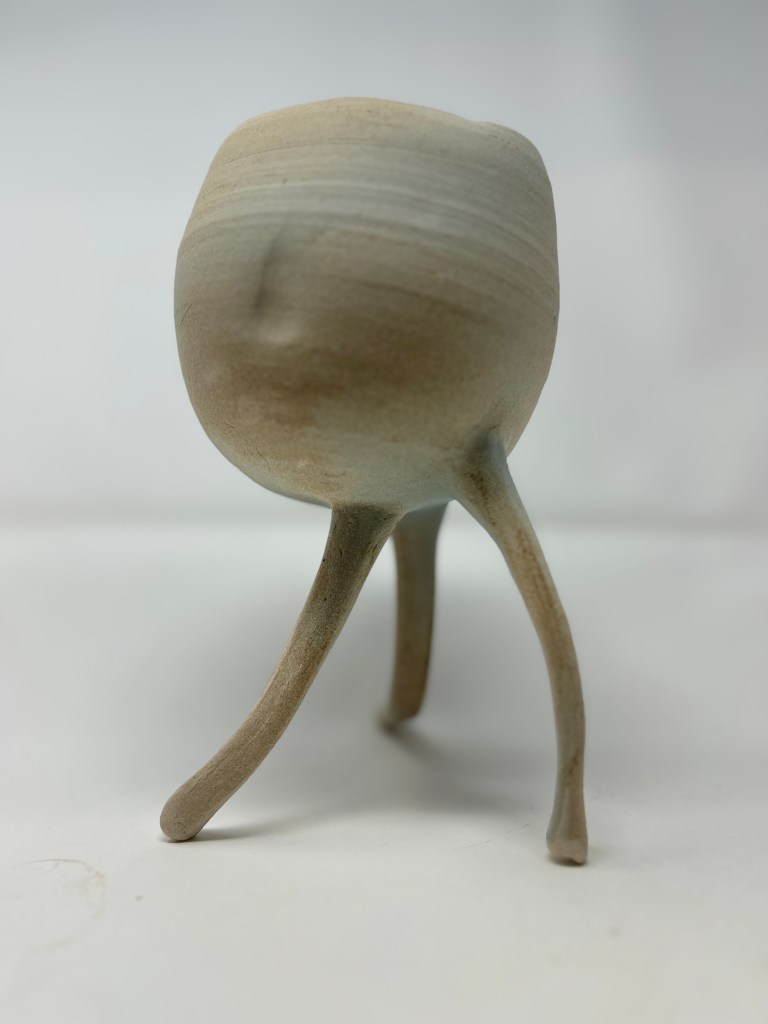
    Trying at the moment to work from my gut, and trying not think to many steps ahead.  Trying, trying, trying to not try so hard.  We have a discussion about what blocks the imagination, taking as a starting point the word resentment.  Which interestingly turns out to mean re-feeling (French: sentir, Latin: sentio).  This makes me think about presence.  If we are re-feeling, we are cycling past emotions.  And I can see that this can happen with re-feeling in the direction of the future also – being in that stuck place of ‘this will happen, that will happen’ – which will always be cyclical because it doesn’t exist.  There is only now.  And now.  And now. Etc.

    My internal narrative when unhelpful, when not-present, is often littered with questions about validity – what’s good, what’s good enough, what’s excellent, what’s not, what’s ok, what’s correct.  When you write it down it’s pretty ugly.  Again in improv ideas are generated on the foundational premise that there are no bad ideas.  Keith Johnstone (aforementioned improv forefather) would coach actors with ‘be boring’ or ‘too original!’.  I trained as an actor at École Philippe Gaulier, an eccentric but unrivalled master of engendering the essential quality of presence in the actor.  Famous for ordering actors to ‘leave the stage immediately’ seconds after their entrances, because he could ‘see a little idea coming’, it was a school of hard knocks.  We once asked him about talent.  He said ‘There is no such thing as talent.  Only what you authorise in yourself to do’.  I think about this nearly every day. 

    We discuss results of an automatic writing exercise on what blocks the imagination.  The discussion is framed as ‘Where do we need new creativity, new imagination?’.  We think about the ‘we’.   Tim – ‘the lofty idea of the artist as solo genius, artist as hero, that model, Rothko – is really unhelpful’.  We think about the ‘new’ – are there new ideas – probably not.  We think about the ‘need’ – is the work doing the job it is meant to be doing?

    What is that job exactly?

    Jonathan reads a provocation from Ben Okri in the Guardian about the artist’s responsibility towards only working on the subject of the climate emergency.  What does existential creativity look like in our art practice? How do we translate that or interpret it?  Also read out – an extract from Douglas Hine’s ‘At Work in the Ruins’ – about the problem of seeing art only as a tool for getting across a message.

    Art is not a cheap alternative to an advertising agency or a sophisticated extension of the communications department, and the urgency of the message doesn’t change this.

    I really enjoyed Luisa’s response to this ‘our art practice is to protect thinking’.  I take from this that we need to give our audience space.  To not be conclusive.  To leave space for a dialogue – even if the artist has left the room, or the planet – we are in conversation with them through the work.  We remember how shut down we were at school when preached at. 

    Hine quotes in turn playwright Anders Duus – 

    Our job is to complicate matters

    I think this has really helped me think about how I approach meaning.  I’ve worked in a discipline where storytelling is at the centre of things – and clarity is essential in script/playwrighting.  I suppose I am still telling stories but maybe in my art practice in a different way, giving space for the audience yes, and also space for the intangible, as Hine puts it, for the ‘messiness and strangeness of life’.